


- Stage 2: Functional Testing Real-World Performance
- Stage 3: Dimensional Measurement — Verifying the Specs
- Stage 4: Pressure Testing — Final Leak Check
- Common Defect Patterns: Insights From Experience
- Record Keeping: Documentation That Protects You
- Building Your Inspection Station
- Make Inspection a Part of Your Receiving Process
- About Linkup Hookah
After weeks of waiting for a container of new hookah equipment, the excitement to start using the new equipment can be overwhelming. However, every experienced lounge manager knows that what’s on the packing list isn’t always what’s in the crates. Without a hookah quality control checklist, you are relying on luck, and luck is not a strategy for quality control. Just one defective stem with a bad seal can ruin sessions and cost more than the 15 minutes for quality control the shipment should have received. The most noticeable difference between a professional lounge and an amateur lounge is the discipline of quality control for each component before it gets used at the lounge. brand hookahs
Routine inspections for new hookah equipment protects your investment and assures that any new hookah equipment meets the performance and safety standards for your guests. This guide provides a complete hookah QC checklist covering the four critical steps — visual inspection, function test, dimensional measurement, and pressure test, — plus the AQL and record keeping. This should be your procedure for every shipment, and you will always know when your shipment is ready to be used.
Stage 1: Surface and Finish Visual Assessment
Start with a focused visual assessment with even and appropriate lighting. Visually cover each component prior to any other assessment.
Abrasions and Scratches
Use your fingernail to run along each surface. A shallow scratch that does not catch a nail, and is not located on a visible surface, is generally acceptable. A catchable scratch that is located on a high visibility surface and/or exposes foundation metal beneath an anodized or plated surface warrants a mark. For ステンレス製の水タバコ, shallow scratches from shipping are generally acceptable. However, a scratch that is deep enough to create a recess for the collection of residue is not acceptable.
Dents and Other Impact Related Defects
Dents and dings for any component are to be assessed, especially for threaded surfaces, the connector rim of the base, and edges of all trays. A dent on a threaded surface is acceptable, as it will not cause an air leak. For the base of the system, if the base is constructed from glass, examine the entire external surface of the base at an elevated angle to a bright light. An invisible surface crack will cause the component to fail, especially if the glass is filled.
Random Surface Finish
Brushed stainless steel is to have a uniform appearance for the direction of the finish. For all aluminum components, the finish should be uniform. Streaks on surfaces that are shallow and of inconsistent quality are a quality deficiency. Surfaces treated in this manner will promote corrosion of the material.
Thread Quality
Examine male and female threads on all stem, downstem, base port, bowl port, purge valve, and hose connector components. Look for imperfections that can include missing thread sections, burr formations, uneven thread depth, or metal shavings embedded in thread grooves. Run the connecting component through each thread for complete and smooth implementation.
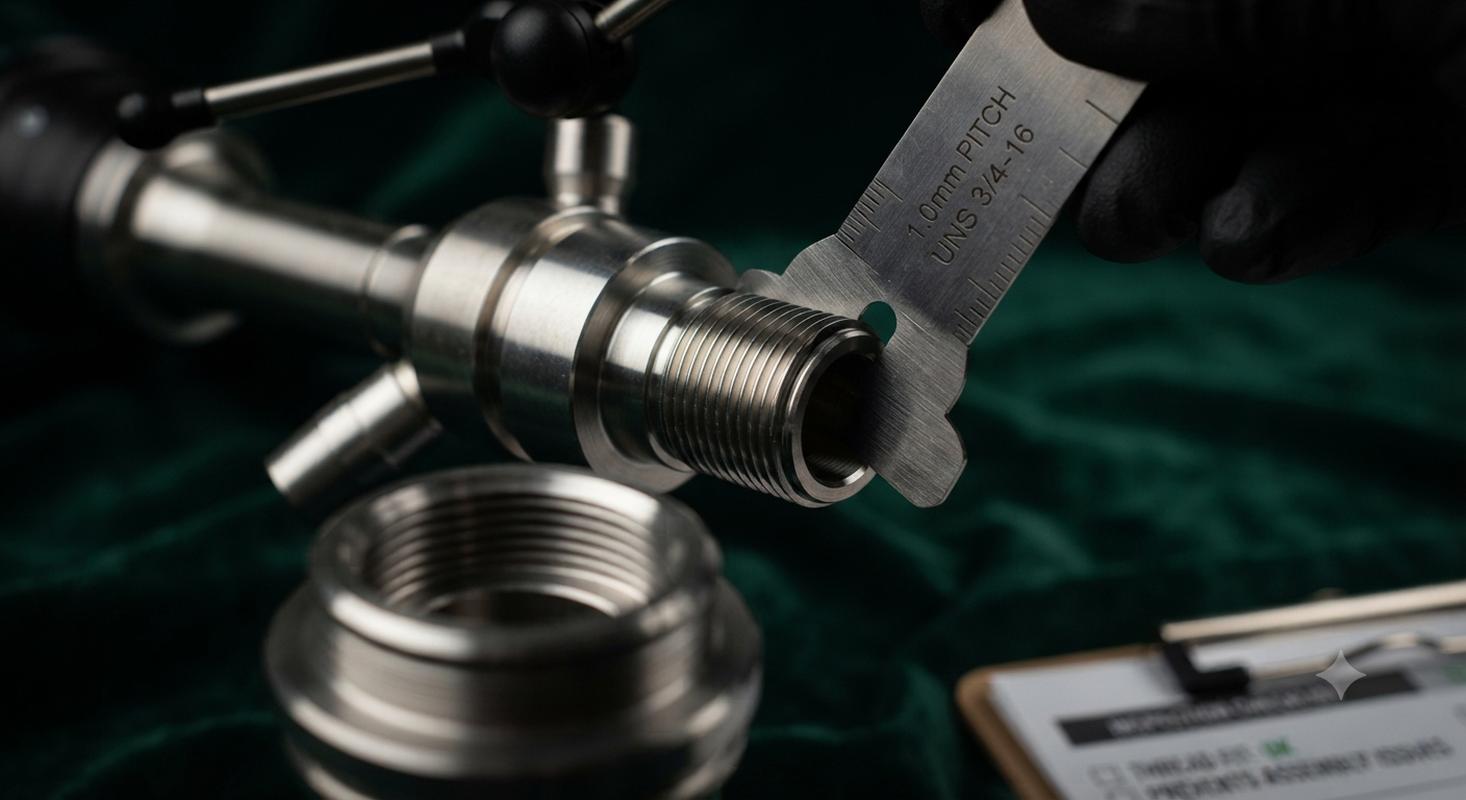
Stage 2: Functional Testing – Real-World Performance
Functional Testing
Inspection for defects is the first phase of quality control. The second, and most important part of the hookah functional quality control system, is functional testing.
Stem to Base Air Seal
This is the most important of all the tests. Assemble the stem to the base with the グロメットの交換 supplied. Fill the Base with water (approximately one to two inches above the tip of the downstem). Seal the bowl port with your palm and take a draw from the hookah. You should feel a strong draw resistance. Rotate the stem slowly while watching the downstem; if you see or feel a stream of bubbles from the grommet, the seal is compromised. Any hookah that fails this test is a critical defect, and it cannot be put into a service until the grommet or the stem fit is corrected.
Bowl Port and Bowl Fit
Test every bowl port with the bowls you typically use. Bowls should fit level and stable. The port inner diameter should match the bowl’s downstem and allow for unobstructed passage of smoke. Bowls should have a compression fit with the grommet of the bowl port. The grommet should neither be too loose nor too tight. With threaded bowl ports, the bowl should fit with a tight engagement but should not require excessive force to fit.
Purge Valve Function
(A) The hookah should be assembled. The bowl port should be closed. Air should be able to exit the purge valve when the hose port is sealed with minimal resistance. (B) The purge valve should seal with no internal air and no air should be able to enter the valve. (C) The purge valve should remain sealed when the hose is drawn. Sticking purge valves or purge valves that rattle or require an excessive amount of pressure to exit the purge valve are defective. These defects are typically caused by a bearing ball that is out of specification.
Hose Port Seals
A hose should be able to fit into every hose port with the hose port sealing other hose ports and should be able to pass draw air with no leakage. With threaded ports, the threads should engage with minimal resistance and should be seated flush. With push-fit or magnetic connectors, the retention force should be sufficient to hold the hose connected when the hose is pulled. Each port must be tested individually on each multi-port hookah.
Stage 3: Dimensional Measurement — Verifying the Specs
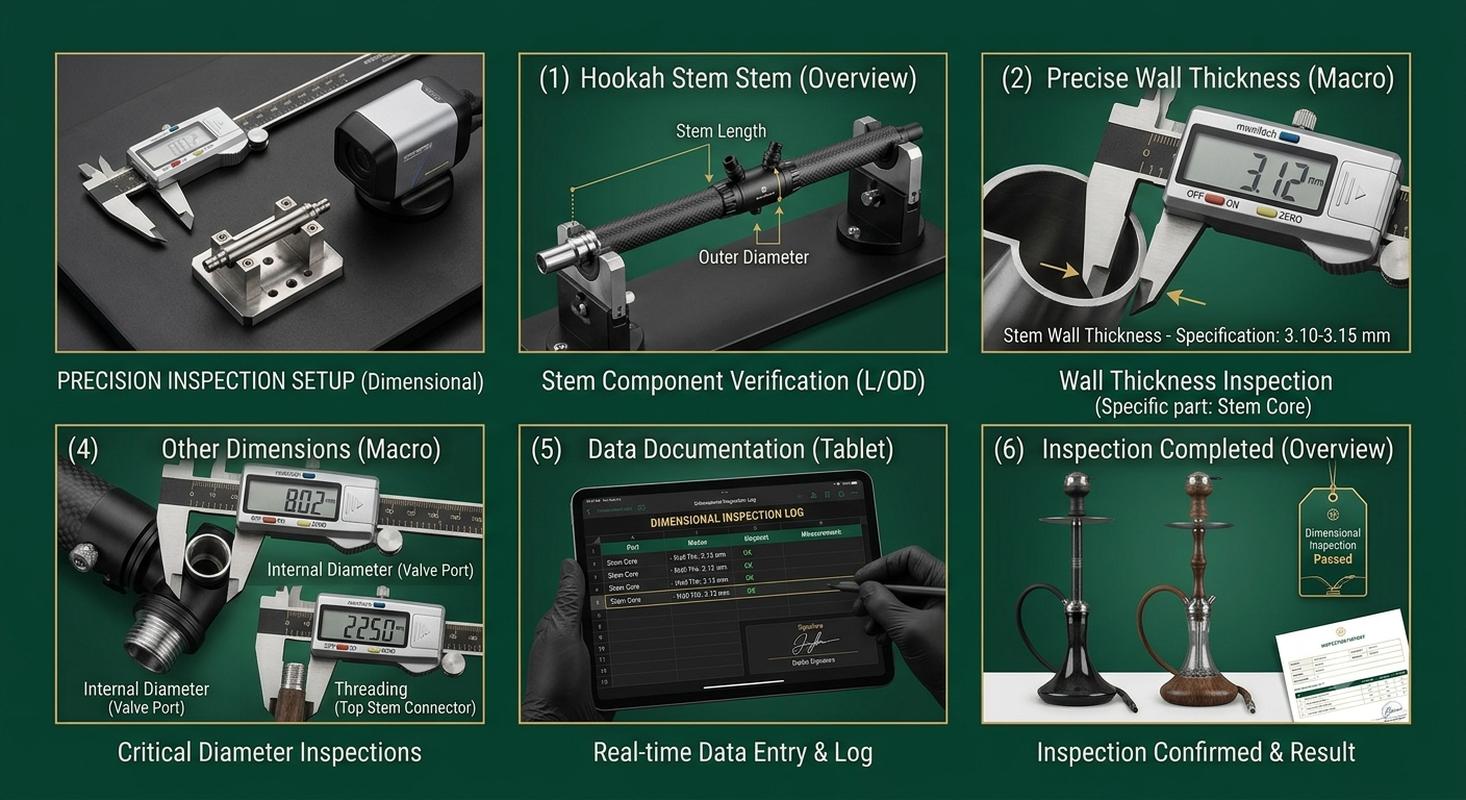
Using pitch gauges and calipers, document and verify the most critical dimensions against the spec sheet. This creates objective, documented data for your records.
Downstem Length, OD, and ID
Evaluate: (1) Overall downstem length (from thread shoulder to end of the downstem) — Determines how deep the downstem gets submerged in the water. Downstem length that is too short results in downstem length that is too long contacts the base of the smoke. (2) Measure and document the OD at the widest point of the downstem (This should match the ID of the grommet). Measure the downstem and document it in two separate perpendicular directions to test if the downstem is oval. If the difference is larger than 0.3 mm, the downstem is bent. (3) Evaluate the ID at the tip of the downstem. This impacts the resistance of the draw. Document resistance and deviation from the tolerances provided.
Thread Specifications
Evaluate each and every threaded connection. Measure major diameter. Measure the pitch in mm per thread and document the thread style (straight / tapered). The majority of hookahs utilize the following thread sizes: M20x1.5, M18x1.5, M14x1.25 for bowl ports. If you encounter a size that is not present in your inventory or is present and does not comply with the stated requirements in the specs, this is a critical defect, and you must engage the supplier immediately.
[Product link placeholder: Industrial digital caliper and thread gauge set. A must-have for any hookah quality inspection checklist. Tools available through industrial suppliers. Linkup Hookah provides all the critical dimension specs for every model cataloged. Test products using calipers and gauges.]
Stage 4: Pressure Testing — Final Leak Check
This test aims to replicate the conditions of a typical hookah session. To begin, fill the hookah with water and fully assemble it, then seal the hookah bowl port. Finally, take a deep pull using the provided hookah hose and observe. A vacuum should create a seal for at least five seconds, and then the vacuum must be released. During this test, it must also be observed that no water trickles back down the hose, and that no air is sucked through the purge valve.
If the vacuum is not working, the source of the leak must be narrowed down by sealing off all the hookah’s ports, with the exception of one port. The most common sources of a vacuum leak, in order, are the seal for the base grommet, the seal for the hose port, clearing valve bearing, bowl port, and the threaded joints. Any hookah failing this test is isolated as a defect. If the leak has not been identified after 15 minutes, the defect must be communicated to the manufacturer.
Common Defect Patterns: Insights From Experience
After a lengthy period of quality control, defects will appear frequently. By analyzing these, their emergence will be easier to handle when inspecting fresh shipments of hookahs.
The most common recurring defect found are thread issues. These can be attributed to incomplete threading passes which can leave a flat spot on the thread, burrs left at the start of the thread, or inconsistent thread depth which shows the thread is shallower on one side. These can all be signs of worn tools that are used for cutting as well as the speed of the machining operations. If a defect is found on a single unit, it is safe to assume the same defect also exists on other units that were produced in the same batch.
The second most common defect is a variation in surface finish. This occurs most often in anodized aluminum. Within a single anodizing batch, if there are fluctuations in the temperature of the anodizing tank, there may be severe color variations. Although this defect is usually minor, it can be major if there is a requirement for a consistent anodized color.
Issues with grommet fit happens frequently. This isn’t always due to the hookah. Grommets are manufactured to a tolerance and if the grommet is a little undersized, it may not seal with the downstem. A hookah grommet can be tested to determine if it can be used with a grommet.
Make sure to record these types of defects. If a supplier produces the same three batches with the same threading defect, that defect becomes a systemic issue of the supplier and a supplier quality review becomes necessary.
AQL Sampling: Unit Inspection Quantity
Inspecting every unit in large shipments can be unfeasible. AQL sampling provides valid sampling-based results. These minimum thresholds should be used for new hookah shipments, for example.
Critical defects (AQL 0%) — A product can be deemed unsafe or unusable for a number of reasons, including a cracked glass base or a missing purge valve bearing. Critical defects can even include completely stripped threads. Burrs that have the potential to cut skin are also critical defects. There will be a zero tolerance policy for critical defects. If one is found in a shipment, the entire shipment is to be rejected.
Major defects (AQL 1.0%) — Defects that would result in an air leak at any of the sealed connections on a hookah, or a downstem that is more than 5 mm off from the specifications are also major defects. Major defects can result from a mismatch in the thread pitch, as well as scratches on surfaces that are visible and have been deep enough to be a significant marking. Up to 1.0% of the sampled units can have major defects.
Minor defects (AQL 2.5%) — These minor defects can be related to scratches or surfaces that may be a little bit less aesthetically pleasing, but are not impacting any of the functioning within the unit. Examples can include light scratches that go unnoticed on surfaces that are not visible to the naked eye, minor blotching that can occur on a finish, a little uneven anodizing color, or even small marks that can be a tooling defect that resides within threaded openings of surfaces. Up to 2.5% of the sampled units can have minor defects.
Example: For a shipment that includes 500 hookahs, an inspection level II (ANSI/ASQ Z1.4) would require that a sample of 50 units be inspected. These samples are then assessed against the quality inspection checklist. These 50 samples are then inspected against the baseline of quality and the standards that would be used for acceptance or rejection of the shipment as stated in AQL. This
Record Keeping: Documentation That Protects You
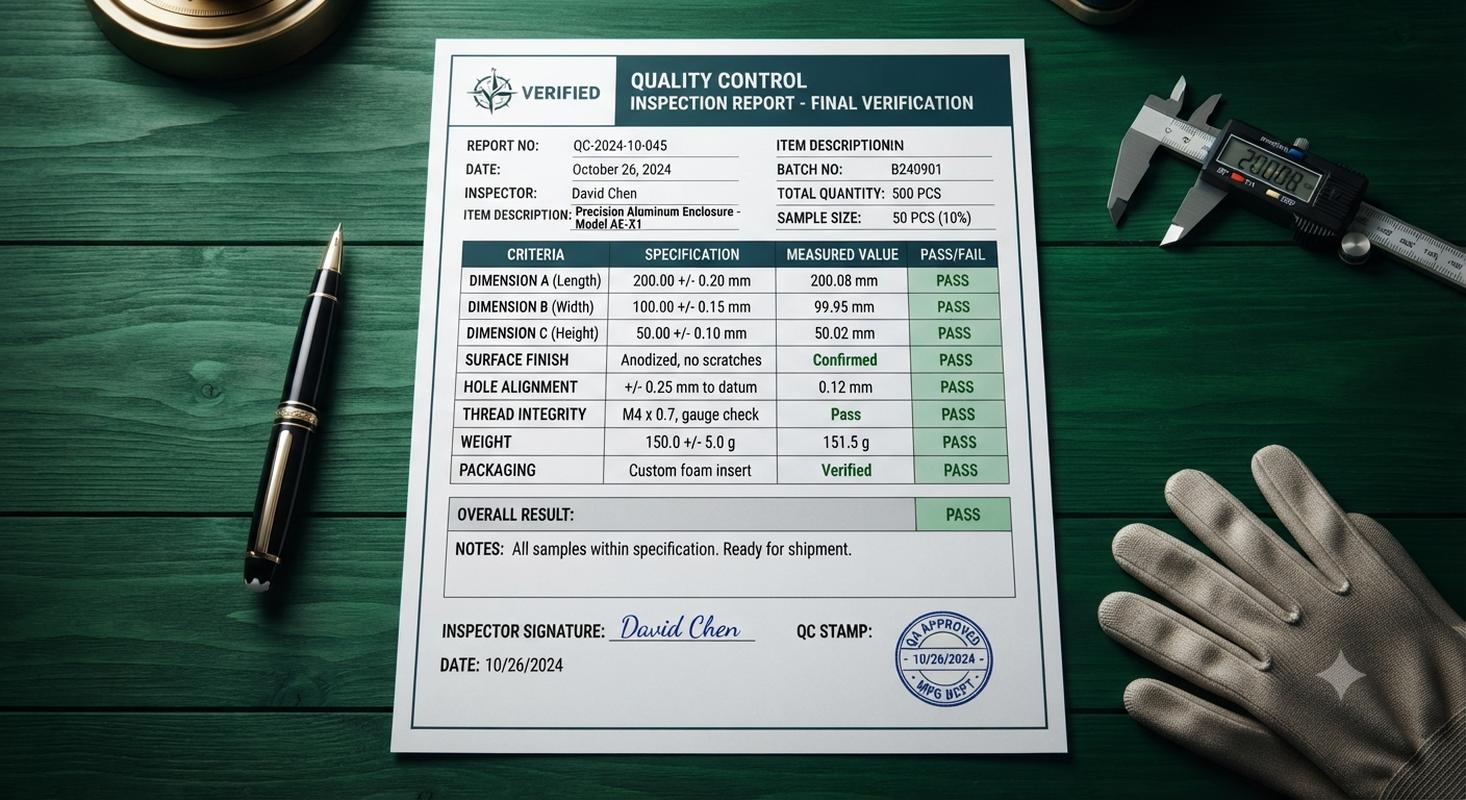
With every inspection, you should create a permanent record showing the date, shipment identifier (invoice or packing list), supplier name, model number and quantities, names of the inspectors, results for each of the inspection categories, details of defects with photographs, results of the AQL with acceptance or rejection of the lot, and the disposition of the inspected units.
There are three primary reasons for keeping records. First, the records provide essential data for negotiating with the supplier. For example, if a lot contains the same defect in each shipment, the records support the request for a corrective action. Second, the records prove that a defect that occurs several months following the inspection was the result of the normal use and service of the product. Third, records reflect your work and inspection protocols, and define when personnel within your team must be retrained. We recommend that records be kept in an inspection application or an electronic spreadsheet with photographs showing each unit’s serial number for complete traceability.
Building Your Inspection Station
Creating a station for your hookah quality control checklist makes the process faster and more accurate. Here are some of your essential items:
Digital Caliper
(150 mm, 0.01 mm resolution), downstem outer diameter, inner
diameter, and length.
Metric thread pitch gauge
Lighted magnifying loupe
Fit testing reference bowls, hoses, and grommets.
Pressure testing rubber stoppers.
Camera for docs of defects
Digital inspection log (spreadsheet), or application.
Colored tags for rejection are red (critical), yellow (major), and white (minor).
The total cost for this system is a little under $200, which is a small price for less than the price of a single damaged hookah that goes through the system without inspection.
Make Inspection a Part of Your Receiving Process
A hookah quality inspection checklist is an essential process for an operational hookah lounge. This four-step process: visual inspection, function inspection, measurement inspection, and pressure inspection, covers all of the important quality aspects. When coupled with an AQL (Acceptable Quality Limit) inspection for larger orders and electronic record retention, this creates a repeatable quality control system that protects your investment and provides the same level of quality across all of the hookahs in your fleet. Each minute spent performing inspections is time saved on repairs, replacements, and dealing with unhappy custome
Every hookah that we send out is measured, has a function inspection, and has a pressure inspection before they leave our facility. We include all of the quality documents and detailed sheets to all of our bulk orders, and our B2B staff works with each of the lounge operaters to ensure that the end product matches the promised order down to the smallest detail. This is the quality that allows us to be the equipment partner for the premium hookah lounges across the globe. For more information on our quality assurance, we invite your curiosity on how we help you create a hookah lounge fleet from day one that provides a premium smoke service.
About Linkup Hookah
Linkup Hookah is a Chinese B2B supplier of hookah equipment and 水ギセルのアクセサリー for overseas hookah lounges, bars, and restaurants. We provide commercial hookahs designed for durability, reliability, and efficient use in high-demand occupancies. For wholesale inquiries, custom OEM requests, or shipping pre-verified equipment, contact us.