


For the last six years, Marco has managed Blue 水タバコセット Lounge, located in the busy city of Berlin. On full nights, the team has to manage a queue of more than twenty customers, each an eager prospect for a tabletop hookah. Each round, staff go through forty to fifty cycles of fully lighting, ashing, and heating coals. The old burner was a disaster; not only did it take twelve minutes to finish, but it left half of the coals cold as well. Poor equipment means less table turnover, which is ultimately a reduction in income.
Despite the various designs and layouts, all high-volume hookah lounges face a common problem: which commercial charcoal burner will meet the demands of my business. The answer is not as simple as purchasing the largest available burner. When shopping, more powerful, efficient, and safe burners should be considered. Of course, throughput and durability also matter, but ease of maintenance should not be overlooked. This is especially important for busy lounges, as the staff’s time is better spent serving customers rather than fighting with equipment.
If you’re trying to buy a commercial hookah charcoal burner for your lounge, this guide will help you understand everything you need to know. We’ve broken down the essential specifications and compared the key burner types. Here, you’ll find a useful tool for choosing the right burner 水ギセルの台座d on your volume and workflow.
What is a Commercial-Grade Burner?
At a casual glance, a commercial-grade burner and a home-use burner appear to be similar. There will be an obvious difference once you put them under a Friday night load, though. Not every hookah burner is made the same, and the quality will show when you put them to use.
Elements of a Quality Burner: Power and Heating
The first thing to understand about burners is their power rating, listed in watts. It is the main differentiating feature of each burner. An average home-use burner is around 500 watts to 900 watts. A commercial-grade burner ranges from 1,200 – 1,800 watts. A $50 home burner will take around 10-12 minutes to light 8-9 pieces of 25 mm coconut charcoal, while a 1,500 watt commercial-grade burner with a higher price point will light the same charcoal in about 6-8 minutes. That additional four to six minutes on a home grade burner adds up quickly, especially if you do that 50 times in one night.
The heating element and wattage are equally important. High quality commercial burners use nichrome wire that is thick and resilient to oxidation. It has the consistency to keep the same temperature through thousands of cycles. Cheap burners have elements that develop hot spots, cold spots, and breakage within three to six months of heavy use. A commercial hookah charcoal burner should have a heating element that is replaceable, since even the best elements can wear out from high use.
Build Quality and Heat Distribution
The elements of commercial burners are recessed in a ceramic trough which is designed to control the flow of heat upward to the coals and away from the countertop. The portion of the housing that supports the heating element is critical, since a burner that loses heat into its housing will break faster, and if a burner loses too much heat downwards it will become a fire hazard on wooden surfaces.
Burners that use solid-state temperature control should be favored since they have a sliding switch to control the coils. This feature helps eliminate the light shock that is caused by temperature changes and creates more consistency in the lighting of coals.
Throughput and Capacity
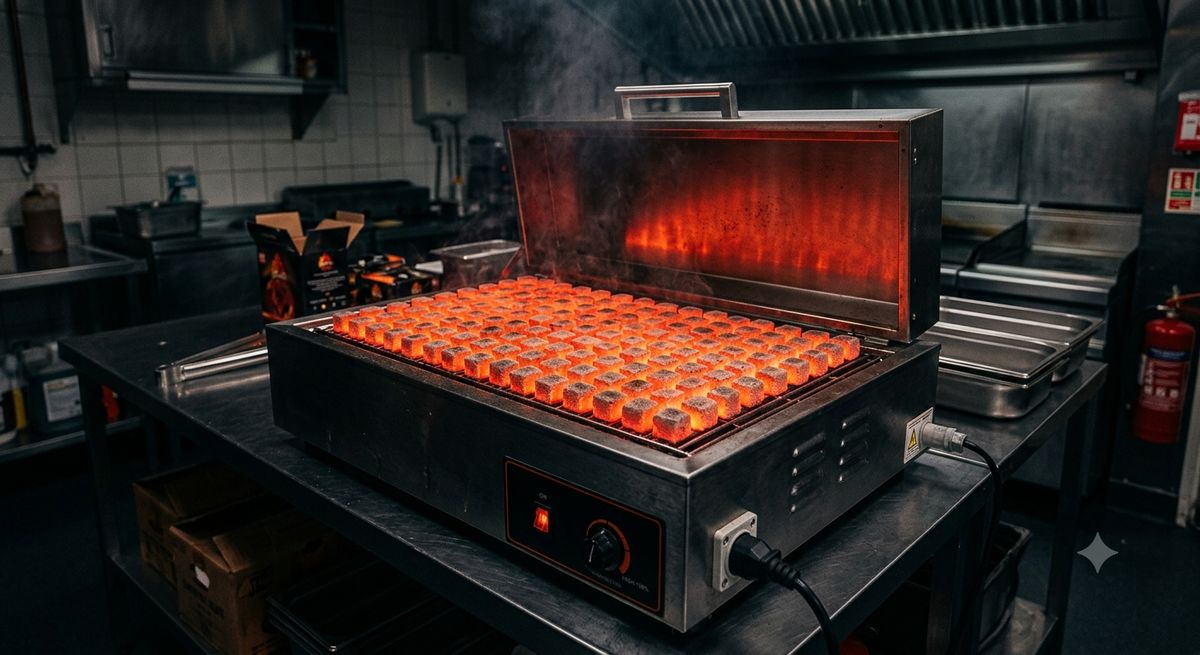
The real metric of throughput is the number of coals that can be burned in an hour. This number is influenced by the surface area of the heating plate, the power rating, and the recovery time needed to cool down the heater before the next batch of coals is lit.
A large commercial burner with a heating surface of 6 inches by 8 inches can process 9 – 12 25 mm coals simultaneously. Given a 6-minute cycle time with continuous operation, that is about 90 – 120 coals per hour. For most mid-size lounges with 15 – 20 hookah tables, this is suitable. For even bigger businesses or bars with hookahs as a secondary business to bartending, you may need two burners with one doing the primary function of starting the new hookah rounds and the other doing the primary function of re-lighting used coals.
Key Features to Look For
There is a big difference between commercial burners. The workhorses are miles apart from the letdown burners.
Adjustable Temperature Control
A fixed temperature burner is a bit of a gamble. Several brands and different types of hookah coals (e.g. disc, cube, etc.) require different heat levels to get the coal to light. Some coals can scorch if the temperature is too high. Commercial burners with temperature control allow you to manage coals with the different types of coals you may need to use.
Temperature control also helps manage energy. During low demand, you can reduce the burner temperature instead of cycling the burner on and off at full power, which extends the heating element life.
Heat Distribution
Burners of low quality face complaints of uneven lighting from lounge staff. A burner that heats coals would feature coals that glow on the center and black coals on the edges. This forces staff to waste time and get hostile results, as they are forced to reposition the burning coals.
The commercial burner offers a serpentine coil pattern or parallel elements dispersed over all the heating plates. Therefore, every coal on the plate receives the same amount of heat, and every coal is prepared at the same time.
Safety Features
In a busy lounge, a burner runs for hours at a time, so safety features are a must.
Look For:
- – Automatic shutoff after a set period of inactivity (usually two hours)
- – Overheat protection, which cuts the power if the internal temperature exceeds the safe limit.
- – A stable wide base
- – Raised edges or lip around the heating surface
- – Cool-touch handles (or heat-shielded exteriors) so staff can move the burner without waiting for it to cool
Ease of Cleaning
Charcoal produces ash, carbon dust, and tiny fragments that stick to the heater coil. A burner that is hard to clean loses heating efficiency and develops hotspots. The best designs have a removable drip tray or ash collection pan that is easy to clean between shifts. ステンレス製の水タバコ surfaces are easier to wipe than painted or coated metal.
その electric charcoal burners for hookah available through Linkup Hookah are designed with these commercial considerations in mind. They have removable trays, heavy-duty coils, and bases suited for high-volume use.
Burner Types Compared
Flat-Plate Coil Burners
The most common type in lounges worldwide is comprised of a flat metal plate sitting atop a coiled heating element. Coals rest directly on the plate and heat through conduction.
Infrared Ceramic Burners
Ceramic heating panels clearly are used in infrared burners. The heat of a ceramic panel directly heats coals without a contact plate. Compared to a metal plate, ceramic panels increase in temperature quicker, and they recover temperature between batches instantly.
Induction Burners (with Coal Basket)
Induction burners heat a ferromagnetic coal basket or tray through an electromagnetic field. The coal basket itself heats up and the heat does not transfer through a plate. These types of burners are the most recent innovations in the market.
Matching Burner to Lounge Volume
Low Volume (5-10 Tables)
With low volume round, a single coil burner of 1,200 watts is adequate. You can expect to do about fifteen to twenty coal rounds per night. Between rushes the burner is not in use and does not need to recover temperature quickly. The focus should be on the burner’s reliability and ease of use as opposed to throughput.
Medium Volume (10-20 Tables)
An adequate burner for a medium volume round is a single 1,500-watt burner of the coil type that is high-end and has quick recovery, or an infrared burner of the mid-range type. You can expect to do about twenty-five to forty rounds per night. Since you will be running the burner for about four to six hours nonstop, then controlling the temperature is a key concern. It is important to look for burners of this type that have a built-in overheat protection with a replaceable element.
High Volume (20+ Tables)
For operations of this size, you should have two burners running in parallel, one flat-plate coil for regular lighting of coals, and one infrared or induction burner to meet peak demand. Even if you are doing forty to sixty rounds in a night, it is critical to keep downtime to a minimum. Because of this, you need a second burner to continue operations while the first one is being fixed. The commercial hookah charcoal burner of this size should have an easily replaceable heating element that can be done without tools in less than ten minutes.
Ultra-High Volume / Multi-Station Lounges
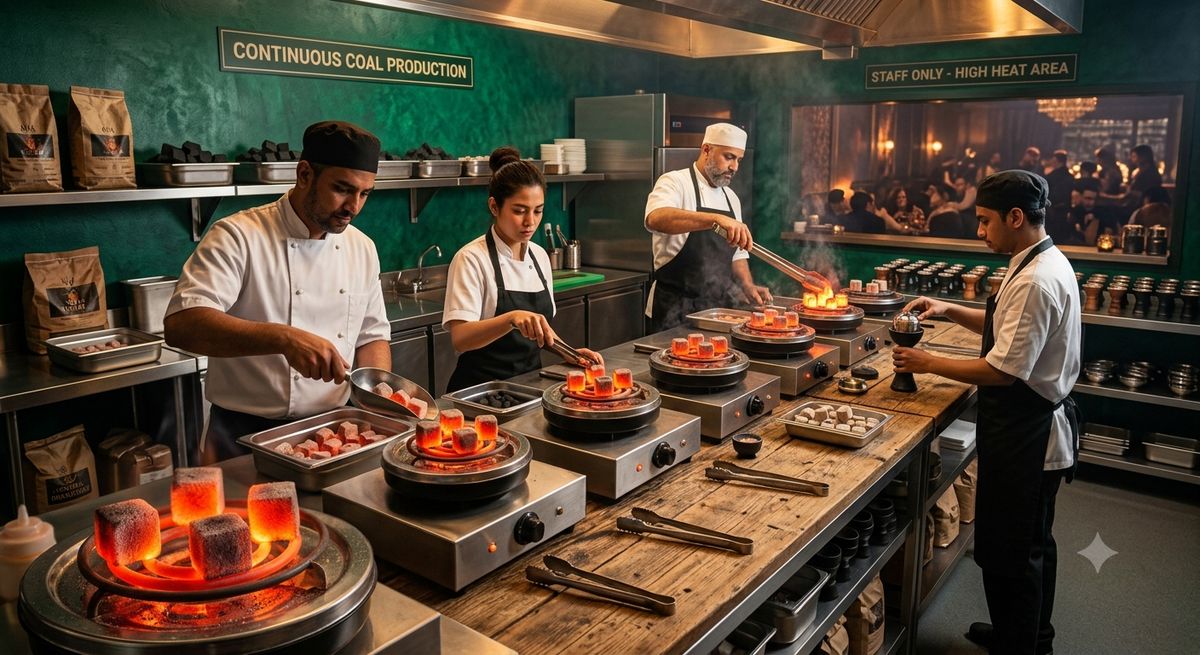
If you are getting into lounges that have multi-hookah setup stations or multiple coal prep stations, you should set up a coal prep station with two or three different coal burners mounted side by side. One three-burner setup that is used by some of the bigger lounges works as follows: while one burner is lighting the next batch of coals, the second burner is holding coals at the hot and ready stage, and the third burner is being cleaned and is available as a spare. This setup ensures that coals do not become the limiting factor in your service efficiency.
Maintenance and Longevity
A commercial burner is a large purchase. With proper use, one of these burners can last two to three years with daily high-volume use. Here is how to ensure that you maximize this.
Daily Cleaning
At the end of each shift, the ash tray or drip pan should be removed and emptied. Once cooled, the surface of the burner can be wiped with a dry cloth or brush. Water should never be used on a hot burner as the thermal shock can crack the heating element.
Weekly Deep Cleaning
If your model has a removable heating plate, be sure to remove it weekly and clean underneath. Ash and carbon dust gather in the gap between the plate and housing, and it also becomes a heat transfer barrier. When enough build-up occurs in the coil, it can completely block the channel, resulting in a loss of heater function. You can blow out the channel with compressed air or use a soft bristle brush and remove the debris.
Element Replacement
Every heating element has an end of life and your commercial burner is no different. To minimize downtime, ensure you have a replacement element on hand to swap it out. To enhance coal handling safety, pair each burner with a custom solid stainless steel tongs set.
 Preventing Common Failures
 Preventing Common Failures
The leading element killer is running a burner on full power all day with no breaks. If your process allows for it, use multiple burners and alternate between them so each one has down time. Doing so can significantly increase the lifespan of your heating elements.
Power surges, however, can happen regardless of usage patterns. Plug an appliance with a high-wattage draw, like a 1,500-watt burner, into a surge-protected circuit. For your burner station, use a dedicated circuit and a surge protector with at least 15 amps.
Price Breakdown
There are commercial charcoal burners that start at $80 for a basic model and range up to $300 for a fully loaded infrared option. The price range depends on the quality of the materials used to make the burner, the technology used to apply heat, and how long the manufacturer of the burner expects the burner to last.
The greatest expense is not the purchase price. It is the price of being unable to serve your customers. If your burner dies on a Saturday night and you don’t have a backup, you can’t serve hookah to your customers. Even one hour of being completely closed on a busy night can cost you a dozen times the price you paid for the backup burner.
When doing your budget, remember to add:
- – The actual price of the burner
- – A spare burner heating element ($15-$40)
- – A second burner for backup (This is not required at all, but is strongly advised for lounges that serve a large number of customers)
- – The cost to run the burner for the desired amount of time (an average 1,500 watt burner running for 8 hours costs $1.44, at a typical $0.12 per KWh, and this is almost nothing compared to lost revenue for being unable to serve your customers)
Final Thoughts
Marco upgraded his 800-watt burner for a 1,500-watt commercial infrared burner. He also purchased a backup burner that now sits on a shelf in the storage room. The improvements were almost immediate. The time it takes to start the burner and for it to reach the desired temperature and for the coals to be ready to serve to his customers, now only takes six minutes, instead of the old time of twelve minutes. His staff also stopped having issues with very uneven, burnt, and raw coals. The time it takes for each of his staff members to serve his customers also improved by one full table. This improvement generated hundreds of euros in additional revenue in just one month.
The best commercial hookah charcoal burners are not the biggest or the most expensive. They are the best match for your needs. They help you maintain your workflow and ensure coals don’t run out in the middle of your shift. If you own a lounge with ten tables, and you have one of these burners, or you own a lounge with forty tables, and you have a burner station, the same principles apply. When it comes to burners, you need to consider the power, the evenness of the heating, and the safety and ease of maintenance of the unit. If you have these features in your burner, then it will become a part of your schedule that you don’t need to think about as it will become a reliable workhorse for you. Get the right equipment to help you manage coals for every shift. The right equipment includes burners, tongs, pre-punched aluminum foil that is very thick, and heat management tools.