


- Heavy-Duty Packaging: How We Ensure Glass Shipments Have Zer
- Our four-layer protection system.
- How we test our packaging: three industrial standards
- Pallet Optimization: Designing Cartons within the Reality of
- Material Science: Comparing EPE Foam vs. PU Foam vs. Honeyco
- Our Track Record: <1% Breakage Rate
- Design your own packaging solution
- Zero Breakage is a Process, Not a Promise
Heavy-Duty Packaging: How We Ensure Glass Shipments Have Zero Breakages
When you buy a glass 水タバコセット base, 水ギセルのボウル, or other accessories by the pallet, every item must arrive unbroken, or Linkup Hookah pays the cost in time, money and lost customers. Each month, we ship thousands of glass products to lounges and bars across North America, Europe and the Middle East. Due to the design of our packaging system, our breakage rate is less than 1%. This is no accident. We’ve built this system after years of experience in real world shipping. our hookah collection 水ギセルの台座
In this article, I explain how we arrange every glass vase, base and bowl. I discuss each stage, from the type of packaging material, to the design of the layers, and the quality testing, all the way to the packaging of the pallets. Whether you’re the lounge owner making a wholesale purchase for the very first time, or the procurement manager making a purchase for a larger order, knowing how we package our products will reassure you that the products will arrive unbroken.
The Cost of Broken Glass
There are specialized considerations when it comes to international freight for our glass hookah products. Hookah bases have uneven weight distribution due to their curvature and have long necks. These create complexity and difficulty when it comes to packaging compared to traditional flat glassware. One of the general risks with any packaging that’s just a cardboard box and a few sheets of bubble wrap is that it is essentially a guarantee that the product will break. Some of the impacts of poor hookah packaging include:
- Replacement costs for broken products which may be 15-25% of the original order.
- Loss of future sales due to loss of customer goodwill.
- Disrupted freight services during costly delays from claim processing.
- Increased costs from disposal of broken products and leftover packing materials.
This is one of the reasons that we consider packaging to be a core part of our engineering. Ensuring our customers never have to consider the reliability of our breakage prevention packaging during shipping is the goal for us.
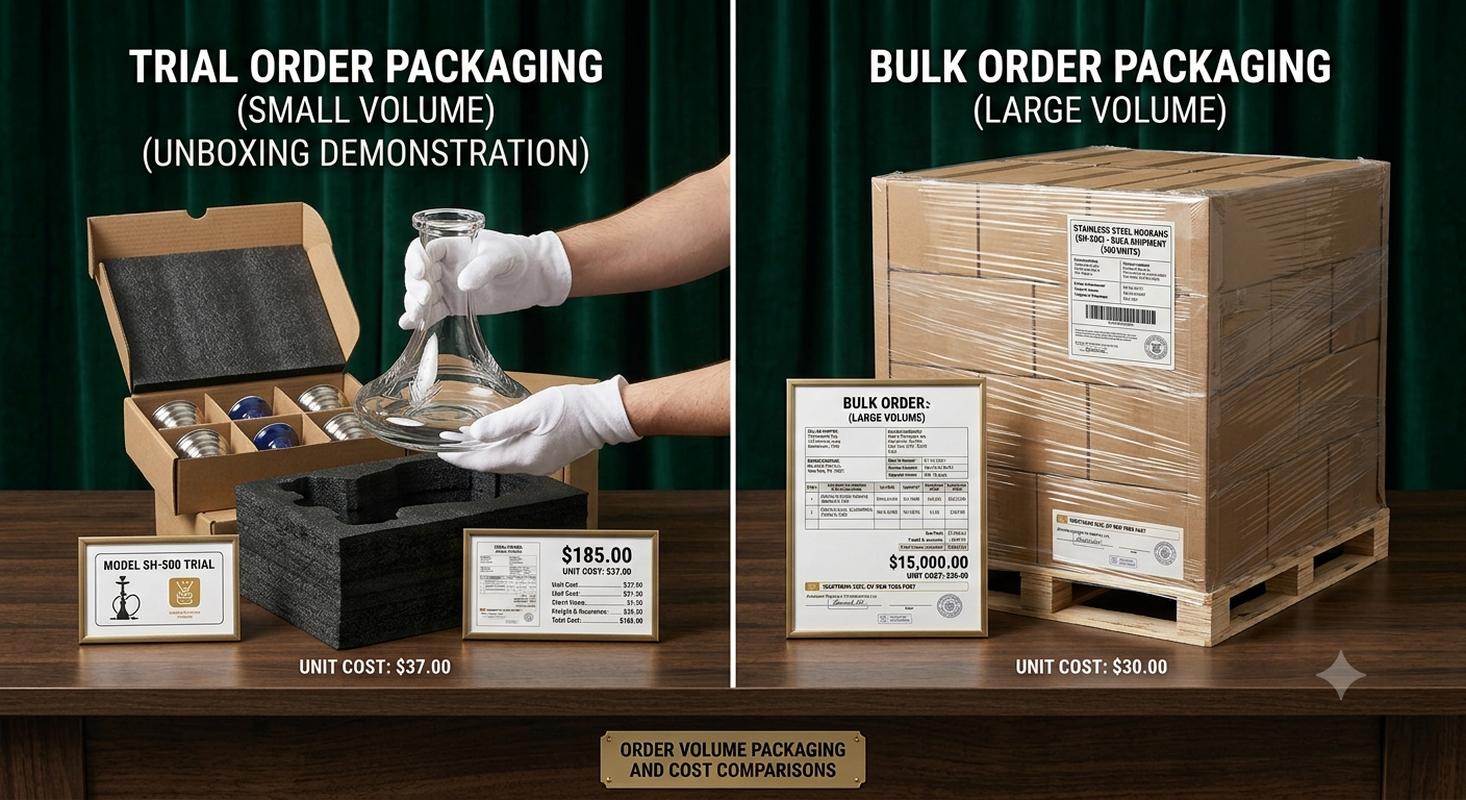
Our four-layer protection system.
We ship every glass product with four distinct layers of protection. Each layer serves a unique and specific function, and while layers work on their own individually, they also work together in unison. This system has been proven with reliability through the success of thousands of shipments.
Layer 1: The Fashioning of Individual Bubble Wrap
Before the boxing phase, every glass product that we sell is wrapped in a layer of our own 50mm, grade bubble wrap. It is only the best bubble wrap for our glass bases, bowls, and vases. Thin bubble wrap that is designed for use in offices and breaks within seconds of being pinched is not used. The bubbles on our wrap are 30mm and the outer covering is a puncture-proof material that has a membrane that retains pressure throughout shipping and protects the wrap.
Key details of our bubble wrap protocol:
Minimum three full wraps around all glass surfaces
Extra layers on rims, bases, and necks
Every glass piece is wrapped individually
Fragile tape is used to seal bubble wrap, eliminating residue
Wrap protocol reduces breakage due to glass contact. Breaking the hookah base also requires detaining professionals, as shapes vary.
Layer 2: Precision-Cut Foam Insert
Glass pieces go into packing foam. Three types of foams are used depending on geometry, weight, and shipping.
EPE (Expanded Polyethylene) Foam
EPE foam is used most in bases and bowls with glass. It’s moisture resistant and great for shipping over sea.
PU (Polyurethane) Foam
This foam is used for heavier glass pieces and the long routes. PU foam offers better compression and recovers faster at higher impact. The trade-off is slightly higher cost, which we factor into our eco-conscious packaging roadmap.
Honeycomb Cardboard
Honeycomb cardboard is a great option for lightweight shipments. It is used for bowl collections and some accessory packs. Though we use this cardboard for streams, its crush resistance is beneficial in a variety of ways. Honeycomb cardboard is also sustainable.
We give all inserts, regardless of material, at least 25mms of clearance on all sides of the product. The air gap and foam energy absorption properties provide a cushion and absorb impact before they reach the product.
Layer 3: Double-Walled Corrugated Carton
Foam inserts are placed in double-walled corrugated cartons. Foamed BD construction cartons are good enough for retail shipping. However, large scale logistics require stronger cartons. Our cartons provide:
- Edge crush test (ECT) rating of 48 lbs/in or higher.
- Burst strength of more than 275 lbs per square inch.
- A water resistant coating on the outer ply.
- Reinforced hand holes.
We also use 3M pressure sensitive tape. We use a H-tape pattern (one center seam and taped along the edges) to seal each carton. This prevents the cartons from the seams splitting, which is the most common way a carton fails during rough handling.
Layer 4: Outer plywood crate (for bulk/high-value orders)
For larger wholesale orders or high-value orders, we consolidate the individual cartons inside a custom plywood crate. The crate is designed to be a sacrificial shell that bears the brunt of impacts from a forklift, compression from straps, and side loads from container stackings. Below are some of the specifications:
- 9mm birch plywood panels
- Steel-reinforced corners that are joined with L-brackets
- Internal blocking to secure the cartons from moving
- Ventilation gaps to accommodate air circulation and avoid internal condensation
Over the last two fiscal years, crated shipments have achieved a 99.6% rate of being damage-free. For clients that order complete pallets or mixed SKU containers, this is our preferred option.
How we test our packaging: three industrial standards
We don’t make the assumption that our hookah glass shipping packaging is effective. Rather we test them under extreme conditions to mimic the type of handling that is common with most logistics. Our internal quality lab conducts the three main tests on all possible packaging configurations that are to be approved for manufacturing.
1. Drop Test (1.2 m / 47 in)
An ISTA 1A standard drop test occurs from a height of 76 cm (30 in). We test from 1.2 m. This is to ensure that foam inserts protect products from damage caused by real-world scenarios. For example, damage may be caused when a forklift operator inadvertently drops a pallet from the top tier. Our protocol is as follows:
-We do a total of 10 drops. This includes one drop flat on each face: top, bottom, and four sides.
-Each of the packaging’s critical edges (rim side and base side) is also tested with one drop each.
-One drop is done at a critical corner (this is considered the worst drop orientation).
This yields a pass/fail test. To pass, foam inserts must show zero damage to the packaging and zero glass damage. All packaging that fails this test is sent back for further design. Our company has retired seven designs for foam inserts that passed standard drop tests, but unfortunately, they failed our elevated drop test standard.
2. Vibration Test (Simulated Road Transport)
During a 12 to 18 day transit of a 20 foot container ship across the Pacific, the container is subjected to low frequency vibrations and this can cause screws to back out, cartons to walk across pallets, and glass to slowly fatigue. To account for this, our vibrations test includes:
- A random vibration profile per ASTM D4728
- A frequency that spans 3 to100 Hz (to include the spectra for truck, rail, and ocean vessel shipping)
- A 120 minute duration per each of the three axes. (X, Y and Z for a total of 6 hours)
- An exposure at 0.52 Grms (to simulate a trans-Pacific container)
The test is passed if glass within the packaging does not come in contact with other packaging and there is no movement of the packaging or deformation of its wrap. Failure of the test that results in as little as 2 mm of movement of the packaging requires an immediate redesign of the foam insert.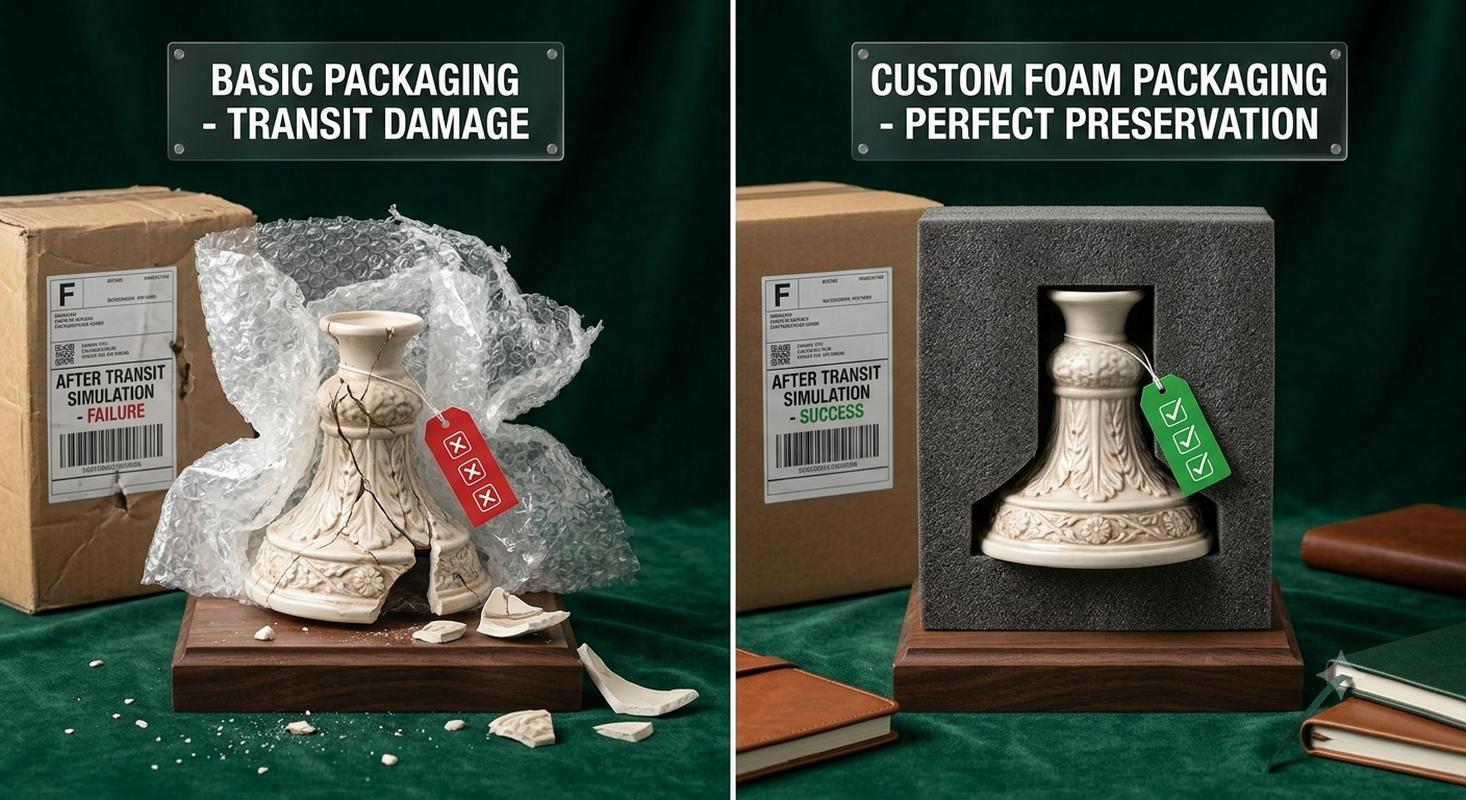
3. Compression Testing (Pallet Stacking)
Pallets carrying 4-5 layers of cartons place all of the weight on the bottom carton. If the bottom carton fails, all glass items stacked within the column will be damaged. The following approximates a compression test. Load is applied according to ASTM D642.
- The goal is 4× the maximum expected load (4:1 safety factor).
- Load is applied for 24 hours to simulate long port dwell time.
- The load is considered accepted if there is a vertical deflection of less than 10 mm.
Due to the results of this testing, we have begun to use BC-flute double wall board and added internal corner posts for heavy shipments.
Pallet Optimization: Designing Cartons within the Reality of Logistics
A good packaging system integrates seamlessly on a standard 1200×1000 mm Euro/ISO pallet. Cartons that are too large waste space, increase freight costs, and shift during transit. Cartons that are too small cause a pallet to be unstable. Therefore, our carton dimensions are mathematically optimized to fit a pallet as efficiently as possible.
For a standard pallet of 1200×1000 mm with a height of 150 mm (pallet nominal footprint), we design every carton footprint to cover the pallet footprint exactly. A common carton footprint is 400×300 mm, which allows for 10 cartons per layer. (5 along the 1000 mm side and 4 along the 1200 mm side in a 2×2 arrangement). Some alternative footprints that we accommodate are 600×400 mm (5 per layer) and 500×400 mm (6 per layer).
Vertical stacking is equally calculated. Each carton layer is 250-300 mm high, meaning 4 or 5 layers can be stacked on a standard 1200 mm pallet height. The total pallet weight is kept below 500 kg to comply with freight carrier limits and manual handling regulations.
This achieves a volumetric pallet utilization rate of 94-97%, compared to the industry average of 80-85%. Less freight is paid per unit and products shift positions during transport less, as there is no empty space to move.
Material Science: Comparing EPE Foam vs. PU Foam vs. Honeycomb Cardboard
Selecting the appropriate cushioning material requires balancing the protection level needed against the weight, cost, and environmental considerations. The three main cushioning material options we use offer the following balance:
EPE Foam (Expanded Polyethylene)
-Density: 20-35 kg/m³ — ultra-light
-Water absorption: <0.1% (closed-cell)
-Recyclability: Yes (Type 4, LDPE stream)
-Recommended for: Medium-weight bases, bowls, multi-product kits
-Cost per unit: $ — Low
PU Foam (Polyurethane)
-Density: 25-50 kg/m³ — slightly denser
-Excellent recovery: Compression set <5% after 50% deflection
-Recyclability: Yes, but only in specialized places
-Recommended for: Heavier bases with glass, long sea freight
-Cost per unit: $$ — Medium
Honeycomb Cardboard
-Density: 8-12 kg/m³ per sheet — our lightest option
-Compression strength: Direction-dependent in the Z-axis (5-15 tons/m²)
-Recyclability: 100% (paper and cardboard stream)
-Recommended for: Bowl collections, short-haul domestic, and eco-conscious orders
-Cost per unit: $ — Low
For our standard glass hookah base packaging, the EPE foam provides the best protection with the lightest environmental impact. We are developing a fully bio-based EPE foam made with sugarcane ethanol that will be available for pilot testing in Q3 2026.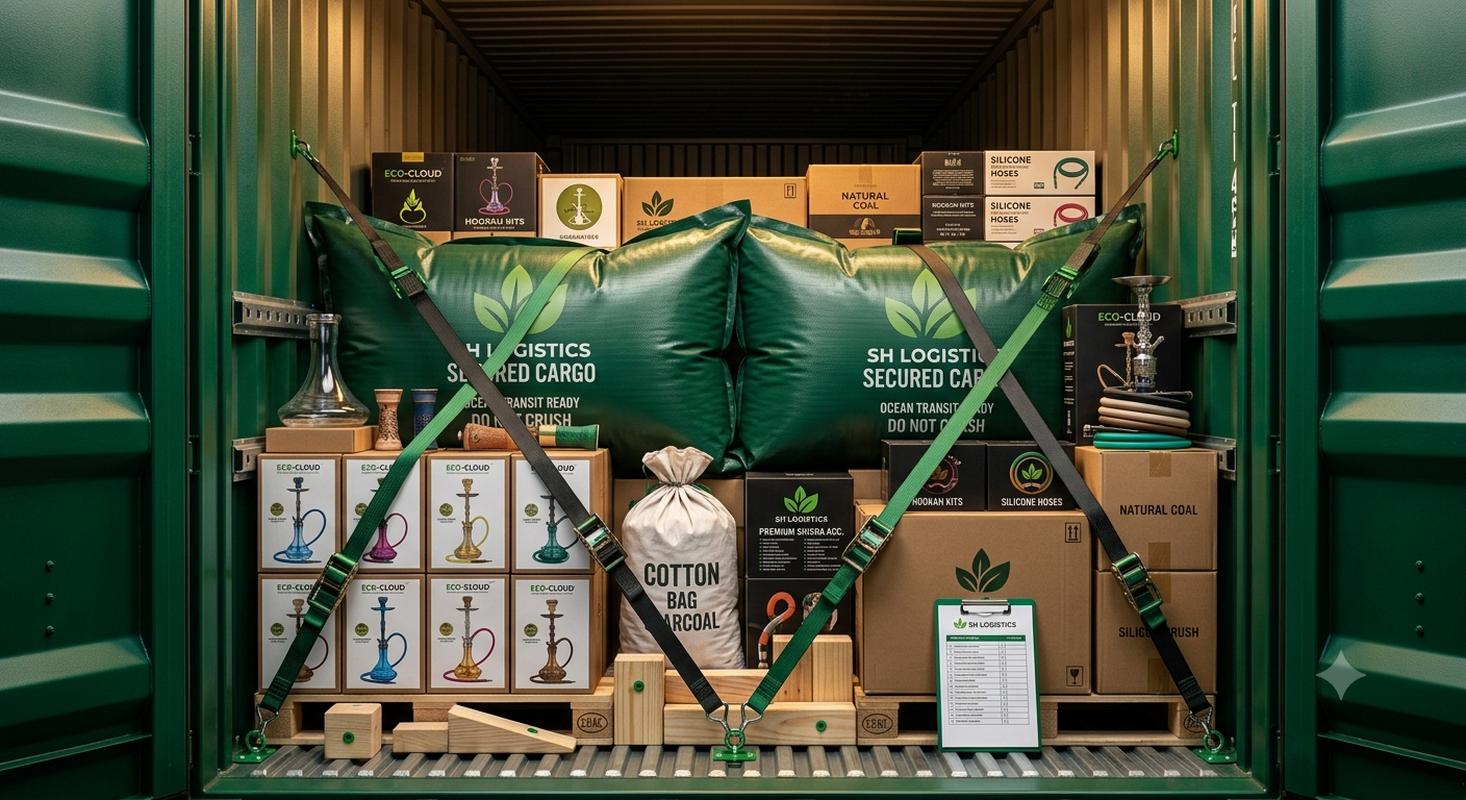
Our Track Record: <1% Breakage Rate
Facts not fictions. In the last 24 months, an estimated 48,000 glass products were shipped through 1,200+ wholesale orders with Linkup Hookah. Our overall breakage rate becomes 0.87%, compared to the 2-5% industry standard for the breakage rate of glassware. The breakage rates per packaging arrangement are as follows:
- Bubble wrap + double-wall carton (smaller orders): 1.2% breakage
- Bubble wrap + foam + double-wall carton (typical orders): 0.6% breakage
- Complete crate system for bulk/high-value orders: 0.4% breakage
Every case of breakage is documented, and evidence is archived. Breakage root causes are identified and integrated into our packaging engineering cycle. The main causes for the few breakages we experience are as follows:
- Customs Inspections with severe package opening and poor package reseal
- Breakage due to the severe temperature changes and tape adhesion failure
- Breakage during a cross border transfer and pallet re-assembly
These are continually improved: pasteurization and packaging tape with high temperature cushion and multi-language halt pallet breakage signs.
Design your own packaging solution
Linkup Hookah offers our fortified packaging protection for free with every wholesale purchase. Your specific foam, crate, or carton with your logo, can be designed by our procurement team so reach out with any requests.
Need more details about our products? Take a look and let us know what you need:
Glass Hookah Bases — Shop our range of premium hand-blown glass bases and machine-made bases for wholesale orders. Our bases are ready to ship and come with protective four-layer packaging.
Bowl Collection: Available in classical materials and modern silicone retainers; while also being heat-retaining, our hookah bowls are packaged with foam inserts and wrapped for damage-free shipping.
Complete Hookah Sets: Order everything you need for your hookah bar at once! Our large orders are secured on the shipping pallet.
Don’t stress about shipping our items to your locations! Each page in our catalog provides a downloadable packaging spec sheet with the exact details on how our products are packed for shipment. This includes shipping measurements for each unit, the pallet details, and the dimensions of each carton.
Zero Breakage is a Process, Not a Promise
Our packaging solution is specialized and very unique. Breakage prevention is the core focus of our team, and is reflected in the countless improvements we have made, such as adhesive-layered, 50mm bubble wrap to protect each layer of product or completing 1.2 meter height drop tests in our lab to ensure our products are protected. This is why our breakage rate is less than one percent, allowing lounges and distributors to have complete faith in our shipping hookah glass packaging.
When you choose us, you receive a product that is fully supporting a shipping and fulfillment program for your peace of mind and totally validated. Our services have been proven by thousands of successful, intact deliveries. Want to place an order? Reach out to our wholesale team or start your browse.