

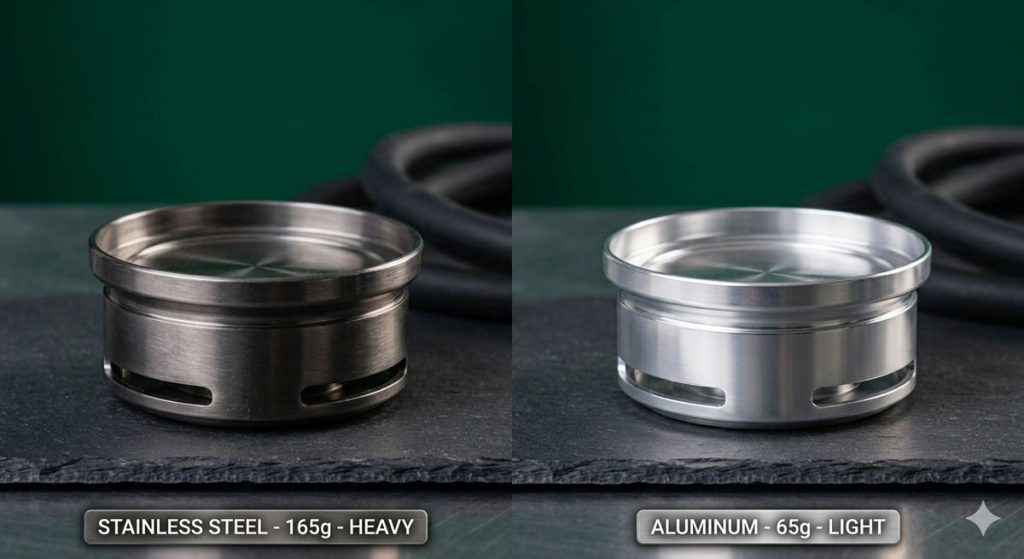
Stainless Steel or Aluminum HMD? Every lounge owner finds themselves asking these questions. The answer has nothing to do with why some products are hyped and why some aren’t. And no, it has nothing to do with what product is better to have on display. It has everything to do with the science (and methodology) of using charcarbones para cachimba to heat tobacco. The method has a huge impact on how long sessions last, how consistent and flavorful the sessions are, and probably most importantly, how many sessions the staff can run.
HMDs have completely changed the way we smoke hookahs. Before HMDs, the smoking experience at a lounge was completely dependent on the foil arrangement and hookah charcoal positioning of the staff (or the group itself) (or the group itself). On a busy night, everyone was getting bad hookah bowlss, resulting in inconsistent tobacco and dissatisfied customers. HMDs changed the ability to have a consistent and pleasurable experience for everyone by creating a controllable space between tobacco and charcoal. Not every HMD is built the same, and the metal they’re made of can completely alter their performance.
Compared in this article are aluminum and stainless steel HMDs using only the science of heat transfer. Things like thermal specific heat, thermal resistance, and temperature will be evaluated in the context of a busy hookah lounge. After reading this paper all the HMDs will have no secrets on which material is better for them.
1.Heat Transfer in HMDs
The path heat takes in an HMD is from hot charcoal to metal plate to air gap to tobacco. The heat transfer metal plate in HMDs plays the role of both a conductor and a heat reservoir. To prevent scorching of charcoal, the metal plate has to conduct heat from charcoal to the bowl. The plate also has to have enough thermal energy to maintain the temperature of the plate and charcoal between coal rotations, and to heat the bowl surface evenly.
There are two material properties that determine the behavior of the HMDs:
Thermal Conductivity (W/m·K): This determines how fast heat moves through a chunk of metal. Higher thermal conductivity means that the HMD responds faster to units of coal since the HMD heats up faster and cools down faster with coals.
Heat Capacity / Thermal Mass (J/kg·K): This determines how much thermal energy the metal can store per degree. If the metal plate has a high thermal mass, the HMD can maintain a stable session.
These two properties are often at odds. A metal that has very high thermal conductivity but low thermal mass will be very reactive to each coal fluctuation, which is not always desired. A metal that has moderate thermal conductivity but high thermal capacity will be less reactive to coal changes but more stable. This is the primary distinction between aluminum and stainless steel HMDs.
2. Aluminum HMDs — Fast but Volatile
One advantage of aluminum HMDs is their rapid temperature response. Aluminum has a thermal conductivity of around 205 W/m·K, more than ten times that of stainless steel. This allows aluminum HMDs to reach service temperatures several times quicker than their stainless steel alternatives.
However, this rapid response can be a disadvantage. Along with aluminum’s lesser heat capacity, this results in an HMD that is highly responsive but unstable. This means that session control is entirely lost. Aluminum HMDs spike to very high temperatures as fresh coals are added and rapidly drop when coals are consumed. This results in very harsh hits and very weak clouds, requiring staff to manage coals more frequently than HMDs made of other materials.
The lightweight nature of aluminum HMDs is both a positive and a negative. Aluminum HMDs are cheaper to manufacture and ship because of their reduced weight. However, this means they have less thermal mass. In a busy lounge, aluminum HMDs can result in a sawtooth temperature curve rather than a stable plateau.
Kaloud Lotus HMDs are extremely popular aluminum HMD designs that have sold millions of units and are the most common choice for personal use. However, they present serious problems for lounges and staff must be trained specifically to manage coals.
Related Product: Kaloud Lotus III HMD (Aluminum Alloy)
 3. Stainless Steel HMDs – Stable and Predictable
 3. Stainless Steel HMDs – Stable and Predictable
Compared to aluminum, stainless steel possesses about one-tenth the thermal conductivity, at about 16 W/m·K. This may work to its disadvantage when looking at the stainless steel HMD’s ability to heat up. In this case, the stainless steel HMD requires about 2-3 minutes more to heat. However, this comes with its greatest advantage in a commercial setting.
Compared to aluminum, stainless steel possesses about one-tenth the thermal conductivity, at about 16 W/m·K. This may work to its disadvantage when looking at the stainless steel HMD’s ability to heat up. In this case, the stainless steel HMD requires about 2-3 minutes more to heat. However, this comes with its greatest advantage in a commercial setting.
Lower thermal conductivity means that stainless steel will transfer the heat much more slowly, creating a natural buffer between the charcoal and the tobacco. It means that instead of simply conducting the heat, stainless steel will absorb that heat, store it, and slowly release that heat. HMDs made of aluminum will conduct the heat instantly, creating heat spikes.
A stronger argument can be made for stainless steel HMDs because it has a much higher specific heat (approximately 500 J/kg·K) and a denser, silky smooth feel (8,000 kg/m³ compared to aluminum’s 2,700 kg/m³). That means a stainless steel HMD will have 2-3 times the thermal mass compared to aluminum HMDs, dependent on wall density.
For lounge owners, this innovation is a game changer. An HMD made from stainless steel can keep the surface of the tobacco between 170–200 °C for 45–60 minutes while needing minimal staff intervention. Staff are able to place new coals without the concern of burning the bowl. The slower transfer of heat means that the top layer of the tobacco is less prone to burning, meaning each bowl can last an additional 15–20 minutes compared to a bowl made of aluminum.
Check it out: Alpha Hookah FNX HMD (Stainless Steel)
4. Head-to-Head Comparison
 4. Head-to-Head Comparison
Let’s compare the important metrics:
Thermal Conductivity:
Aluminum ~205 W/m·K
Stainless Steel ~16 W/m·K
Winner for speed: Aluminum. Winner for stability: Stainless Steel.
Thermal Mass (per unit volume):
Stainless steel has roughly 3× more thermal mass than aluminum. This directly correlates to longer temperature plateaus and fewer coal adjustments.
Heat-Up Time:
Aluminum can reach the vaporization temperature in less than 60 seconds, while Stainless steel takes 2–4 minutes. The trade-off is worth it though, the slower warm-up means less shock to the tobacco.
Temperature Stability (ΔT over 30 min):
Aluminum HMD’s temperature can fluctuate between 40–60 °C and Stainless steel HMDs can fluctuate 15–25 °C.
Durability:
Stainless steel is significantly harder and more resistant to denting, scratching, and corrosion. HMDs made of Aluminum develop visible wear within months of daily lounge use, while HMDs made of stainless steel remain clean after a year of use with regular cleaning.
Weight: Aluminum HMDs are lightweight. This makes a difference for cost of shipping, and for the user who carries their own HMDs. The weight of stainless steel HMDs, combined with their expensive price, adds to their thermal stability and premium feel.
Cost: HMDs made from Aluminum cost 30–50% less. But, when considering a 12 month usage of a lounge, stainless steel HMDs would be better. This is mainly because of longer life spans and less waste of tobacco from burnt bowls.
5. Practical Lounge Examples
 5. Practical Lounge Examples
Example A: A lounge with 20 or more tables where staff members bring fresh coals to each table every 25 minutes. With aluminum HMDs, each bowl requires active temperature monitoring. One distracted staff member would result in a burnt bowl. Stainless steel HMDs were used in a trial, and the result was a 60% reduction in burnt bowls, due to the thermal buffer allowing the staff the 5 to 7 minutes before the HMDs would be unfit for use.
Example B: A lounge that specializes in dark leaf packing tobacco. Dark leaf tobacco is highly sensitive to heating. If dark leaf tobacco is over-heated, the flavor becomes ashy in a matter of minutes. When using dark leaf tobacco, using stainless steel HMDs is nearly a requirement. Unlike aluminum HMDs, stainless steel HMDs would provide a gradual heating which would keep the dark leaf tobacco premium price justified.
Example C: Lounge that has thermal shocks as the ambient temperature goes down. Due to their low thermal mass, Aluminum HMDs would be the most sensitive to wind and cold. Stainless steel HMDs would keep their temperature in colder conditions better than aluminum HMDs, making them the best choice for uses with outdoors a lot, such as patios and rooftop venues.
For premium lounge setups with HMDs, check out the Kaloud Lotus III (Aluminum)
For a stainless steel option, see the Alpha Hookah FNX (Stainless Steel)
6. Heat Storage Coefficient — This Forgotten Metric
In the HMD world, the focus is on thermal conductivity. However, the heat storage coefficient (also called thermal effusivity) is worth noting. Thermal effusivity is a measure of how material surfaces absorb and release heat. It is expressed by the equation e = √(k·ρ·Cp).
Aluminum has a thermal effusivity of roughly 23,000 W·s¹ᐟ² / (m²·K), while stainless steel is around 7,900 W·s¹ᐟ² / (m²·K). A lower effusivity means the material is less resistant to thermal change and is therefore “warmer” when touched. When discussing the transfer of heat in HMDs, the higher aluminum effusivity means it will absorb heat from charcoal and release it into the tobacco with equal intensity. Stainless steel, with lower effusivity, serves a more gentle role in the heat transfer process.
Sessions with stainless steel HMDs are described as “smoother” because the material is smoother in thermal behavior. Stainless steel HMDs absorb heat and release it in a more gentle manner similar to a ceramic heat sink but in a more durable way.
7. What is the best HMD material for your Lounge?
If you own a fast-casual lounge where sessions are less than 45 minutes and bowls are frequently changed, choose aluminum HMDs.
- – Every staff member has received advanced training in coal management and can monitor every individual table.
- – Budgeting is a major restriction since aluminum heat management devices have a much lower initial cost.
- – You prefer lighter materials for carry-out or delivery services.
Select stainless steel HMDs if:
- – You sell premium branded tobacco, particularly dark-leaf varieties, that require careful heating.
- – Your sessions last 60–90 minutes, and you wish for a session’s flavor to remain consistent from beginning to end.
- – Your staff have to oversee multiple tables and cannot keep an eye on every single bowl.
- – You wish to reduce tobacco waste that is a result of scorching.
- – You prefer long-term value from the product’s appearance and durability over the product’s initial cost.
- – You work outdoors or in places where the ambient temperature can change frequently and heat management devices are needed.
8. The Bottom Line
When it comes to choosing between aluminum or stainless steel HMDs, the question is which metal fulfills your operational functions, not which metal is superior. Aluminum metal systematizes operational functions at the trade off of thermal reliability. On the other hand, stainless steel provides thermal reliability at the trade off of a slower heat up and a greater initial cost.
For the majority of commercial lounges, the greater the initial cost of HMDs, the better the return on investment, and the longer the HMDs last. The savings in labor costs from staff monitoring, the extended durability of equipment, and the reduction in bowls that are scorched and therefore unusable all more than compensate for the long-term value of the product. A single stainless steel HMD that lasts two years and saves one bowl of tobacco per week has already paid for itself.
Having said that, aluminum HMDs that are well managed can still offer a great session. The most important for this, is knowing the HMD’s limitations, and having the staff trained on them. Regardless, each HMD is paired with a compatible bowl and quality charcoal to maintain the thermal chain. Consistency comes from the thermal chain.
For your wholesale lounge supply requirements, Linkup Hookah has aluminum and stainless steel HMDs that can be used in the commercial arena. Check them out to discover what works for your lounge.