


- 1. Why a Shisha Sommelier Program Matters for Your Bottom Li
- 2. The Four Pillars of Shisha Sommelier Training
- 3. Building a Certification and Assessment System
- 4. Equipment and Product Selection for Training
- 5. From Training to Retention: The Repeat Purchase Connectio
- 6. Where to Start: A 90-Day Implementation Plan
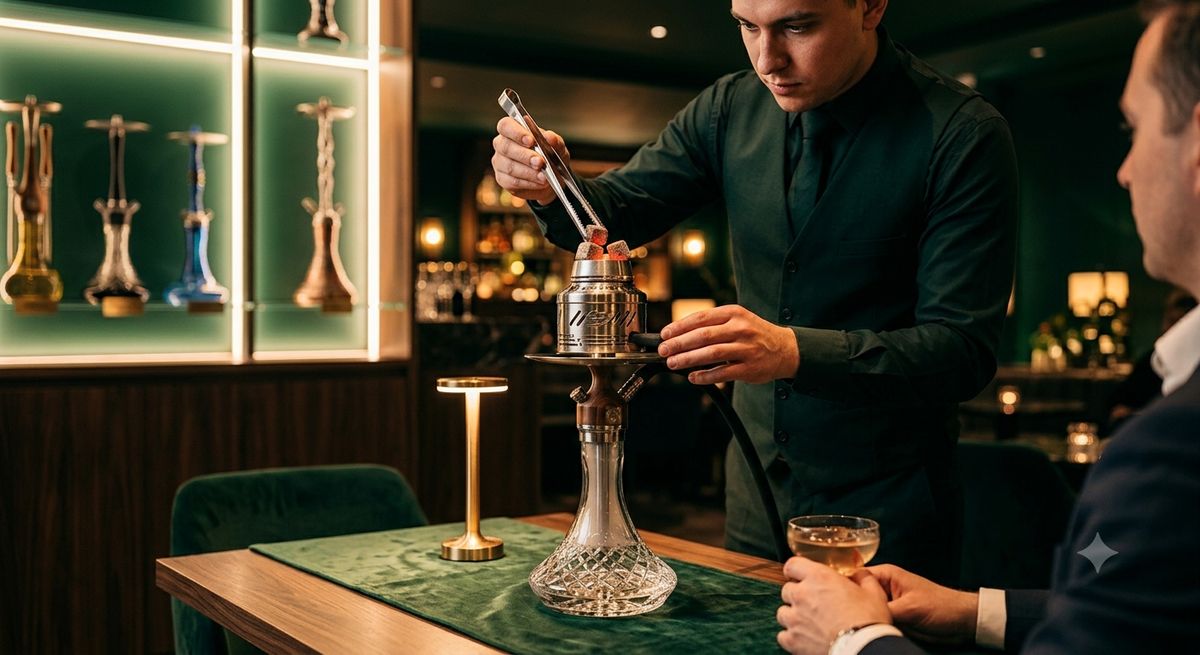
If you go to almost any good juegos de narguile lounge, you will notice something peculiar about their customers: every table smokes differently, and every session has the same high standards. The hookah is easy to breathe. The flavor is consistent. The carbones para cachimbas remain hot and unburnt. This phenomenon does not occur by accident. This is the work of a professional shisha sommelier. Every successful sommelier is a lounge worker who has the knowledge and skills about the science of tobacco, the control of dynamics, airflow and how to get the best out of customers.
Lounge owners do not have to ask themselves if staff needs to be trained professionals, instead they ask themselves how to create a training program that will drive consistent, quality sessions. If you want to be a hookah lounge that is at the top of its game, you will need to have a program that creates top professionals, making every employee a brand ambassador. This guide is intended to provide you with the knowledge to create this program.
1. Why a Shisha Sommelier Program Matters for Your Bottom Line
1.1 A Problem of Inconsistency
In the hookah lounge business, the largest complaint is inconsistency. A customer comes in on Tuesday, has a great session (there’s a reason they use the word session) with mango and mint in a clay hookah bowls, and comes back on Friday expecting the same experience. However, the Friday staff member prepares the bowl differently, applies too much heat, and ends up with a session that lasts for only twenty minutes. That customer will not be returning for a third session.
The data on hundreds of lounges states that a badly conducted session (e.g. burnt session, weak clouds, and short duration) can reduce the likelihood of that customer returning to the lounge by 60%. When you look at the customer’s lifetime value, that one bad session costs the lounge not just a visit, but a number of visits to come in the next year.
1.2 A Certified Sommelier’s Revenue Effect
A certified shisha sommelier raises your average check by two measurable factors. They sell more premium tobaccos, and more custom bowl setups, because they are able to explain the difference of the experience. They also reduce waste. There are less bowls that need to be remade, less charcoal that is wasted on poorly conducted sessions, and shisha yields can be increased by packing it technique by 30%.
A shisha master is a nice person to be with in your lounge, because they help to keep the customers happy, and help to improve the margins of the lounge. You spend less on shisha waste, so the training pays for itself.
 2. The Four Pillars of Shisha Sommelier Training
 2. The Four Pillars of Shisha Sommelier Training
Four essential components form the foundation of a successful training program. Each staff member must demonstrate all four components before serving a customer.
Pillar 1: Tobacco Knowledge
Your staff cannot sell what they do not understand. A shisha sommelier must know:
Tobacco types: the difference between blonde leaf and dark leaf, washed and unwashed leaf, tobacco leaf vs. stem, and how each behaves under heat, understanding of nicotine ranges and absorption.
Flavor profiles: how flavors blend and clash, and how to build flavors that evolve and change over time throughout the session.
Moisture and cut: knowledge of tobacco mist and its packing density, and cut techniques and style.
Storage and freshness: proper conditions and ways to store tobacco in order to prevent drying and to maintain freshness over time.
Training exercise: Provide each trainee with a set of tobacco samples. Each trainee must identify the leaf type and nicotine level and suggest an appropriate bowl and heat source.
Pillar 2: Heat Management
Heat management is the most technical skill in shisha preparation and the most common cause of errors. A shisha sommelier must demonstrate:
Coal selection: the difference between quick-light and natural coconut coalss, proper lighting technique, and how coal size affects the duration of the session.
Coal placement: how placing coal on the edges vs. the center of the bowl changes and affects the session over time.
Heat Adjustment: the knowledge of when to add, remove, or change the position of coals during a session without ruining the overall customer experience.
HMD (Heat Management Device) proficiency: knowledge and skill of Devices, the proper coil placement and use of the Control lid and cover.
Training exercise: Each trainee has to pack bowls with precise tobacco quantities. One certified trainer conducts a session, and the other trainee conducts a session of the same length. They are assessed on the cloud density, flavor longevity, and whether there’s a burnt flavor, all at the thirty-minute mark.
Pillar 3: Packing Technique
The density of the pack of tobacco relates to the draw and the flavor a user experiences and determines the length of the session. Each tobacco type, bowl, and customer can have an infinite number of variance and can result in an infinite number of correct ways to be packed. Each sommelier must know at least:
A sommelier must know at least three packing techniques.
Fluff pack: For blonde leaf tobaccos the juice of which maximizes both the flavor and draw.
Semi-dense pack: For sessions of a moderate length and nicotine content.
Dense pack: For the dark leaf tobaccos that produce rich voluminous and thick clouds.
Training exercise: Using the same type of tobacco, pack three bowls, and make one of the bowls a fluff pack, pack another as a semi-dense pack, and the final bowl a dense pack. The trainer must then smoke all three back to back and provide feedback on draw resistance, flavor intensity, and cloud density from each of the bowls.
Pillar 4: Customer Experience
There are several factors that go in the user experience, and the first part is understanding the user experience and providing proper service: Each sommelier must know:
Consultative selling: The proper way to ask the correct questions to understand the customer.
In-session controlling: The timing in each of the activities is critical, whether it be when to replace the coals or when to disrupt the session to let the customer know you are controlling it.
Mid-session troubleshooting: The ability to correctly assess a session and understand the reason for weak flavor and weak clouds while keeping the customer feeling satisfied and not at all like a test subject.
Customer complaints of stimulated burnt sessions after 15 minutes require a diagnosis and easy explanation of the malfunction, with a fix that does not require rest time.
3. Building a Certification and Assessment System
No assessment, no training. When aiming for a general quality threshold, one must consider a general measurable system for assessment and determine staff competencies.
3.1. Tiered Certification Levels
Level 1 — Apprentice Mixologist: Trains online on tobacco types, care and safety of equipment, and sit to take a theory paper and score 80% or higher. Can pack a simple, single, one flavor bowl.
Level 2 — Certified Shisha Mixologist: Mastery of the 4 Pillars via practical exam is a must. Must pack 3 different bowls (fluff, semi-dense, dense) which are judged blindly by a senior trainer. Must conduct a full hour of a session, and the rest of the time must remain error-free. Can operate alone.
Level 3 — Senior Shisha Sommelier: Must clear the trainee exam for Customer Service and be able to handle burnt bowl complaints, and other factors like managing large groups and/or custom multi-layered flavors. Can train and certify staff in Level 1 and Level 2. Can be a Shift Lead on a paid basis.
3.2. Blind Evaluation Protocol
- 1.To promote objectivity, we will ensure that every practical exam for certification is formatted as a blind evaluation. The first step will be to prepare a bowl with the tobacco and equipment as directed to the trainee.
- 2.A panel of at least two certified staff members (or a single external evaluator) scores the session without prior knowledge of the session author.
- 3.Evaluation criteria include: draw resistance (1-5), flavor intensity (1-5), cloud density (1-5), session duration (1-5), and burnt flavor (1-5).
- 4.The minimum passing score is 20/25.
Using a blind evaluation process eliminates evaluator bias and creates a benchmark scoring system. It provides junior staff with an opportunity to receive constructive and objective feedback focused on specific areas for improvement.
3.3. Continuous Improvement Process (CIP) Assurance
Certification should not be a single event. Monthly random check-ins should be performed by senior staff on the gauge of one session for each junior staff. If two consecutive check-ins fail a junior staff, they lose their certification and must retrain.
This ongoing evaluation increases the uniformity of the output — every single bowl that comes from your kitchen has the same standard, no matter what staff or what shift is operating.
4. Equipment and Product Selection for Training
The level of control and consistency of the output is in part a function of staff skill and the equipment. Standardizing your instruments will eliminate some of the inconsistencies.
Bowls: Use the same bowl throughout the stations. When all staff members know the specific utility of a bowl in regards to its ability to conduct heat and its ability to bind the tobacco, the uniformity of the box becomes self evident. Visit our collection of custom ceramic bowl heads in order to establish your baseline for training.
HMDs: The Heat Management Devices (HMDs) will resolve the majority of the placements of the coal. Use one or two of the HMDs — like the Kaloud Lotus III — and train all staff to use these HMDs until they are accomplished.
Source Tobacco blends that have the same moisture level and that are consistent and available in bulk. For lounges that are developing a training pipeline, we recommend the Premium MustHave Series for its reliable cut and predictable heating.
Focusing on these three product categories — bowls, HMDs, and tobacco — will give you a training program that is repeatable. The goal is to shift the focus from equipment to the human skill set.
5. From Training to Retention: The Repeat Purchase Connection
 5. From Training to Retention: The Repeat Purchase Connection
If you create a solid training program, you can expect to see a repeat purchase rate increase within three months. Here’s why:
- – Customers develop trust after consistent sessions. Once a customer learns that they will receive the same value on every visit, they will have no need to shop around. Your lounge will become their go-to location.
- – Staff members become higher earners when they deliver knowledge. Customers are willing to pay a premium if a lady who is a shisha sommelier explains why that dark-leaf tobacco is paired with that bowl.
- – Turnover decreases when staff members are able to grow within the company. Employees that know that they can complete the certification and have a future at the lounge see value in their own training. This decreases the workforce turnover and retains beneficial employees with knowledge that they gained during their employment.
If your current repeat visit rate is less than 40 percent, you will receive the greatest return on investment when you create a training and certification program.
6. Where to Start: A 90-Day Implementation Plan
Month 1 – Foundation:
Choose one senior staff member or hire an external consultant to become your Master Sommelier. This individual will prepare the training materials, standardize the equipment for the bowls and the HMDs, and prepare the protocol for the blind evaluations.
Month 2 – First Cohort:
Enroll 3-5 staff into the Apprentice curriculum, and conduct four Pillars training for 2-hour blocks each week. Blind evaluations will be performed for the first time at the end of the month.
Month 3 – Quality Baseline:
The first Mixologists will be on the floor starting now. They will be subject to spot checks that are performed on a monthly basis. To evaluate the starting baseline, metrics of remake rate, customer complaints, and average session length will be captured and then reported on for the first time.
4th Quarter and Beyond:
The Mixologist training will be rolled out to the entire staff. Certification for levels 3 and 4 will also be added to the program. Internal Mixologist staff will be promoted to a trainer role for new hires, building an ongoing training program and a self-sustaining internal pipeline.
Conclusion: Investing in staff training increases customer retention. Consistent training, whether for internally (or externally) hiring a Shisha trainer, increases revenues. Staff prepare new complements and customers make the additional investment.