


- Why Go for Stainless Steel Ghosts
- The Standard Wash vs. The Deep Clean
- Baking Soda vs. Professional Cleaner: A Comparison
- The Multi-Layer Deep Cleaning Process
- What Not to Use on Stainless Steel
- Creating a Stainless Steel Maintenance Schedule
- Picking Equipment To Make Cleaning Less Stressful
- Conclusion
Sofia manages the facilities at the Horizon Lounge in Dubai. She can identify every juegos de narguile by its serial number and is able to smell which ones are malfunctioning.
Recently, a distressed customer returned a Moze Sphere 2 —one of our premium setups made of 304 stainless steel— because the smoke was laced with the previous table’s flavor of double apple. The bowl was fresh, and a fresh pack of shisha was added. The culprit was the stainless steel stem. The flavor was retained in the metal, and no amount of the standard rinse passed through by Sofia could remove it.
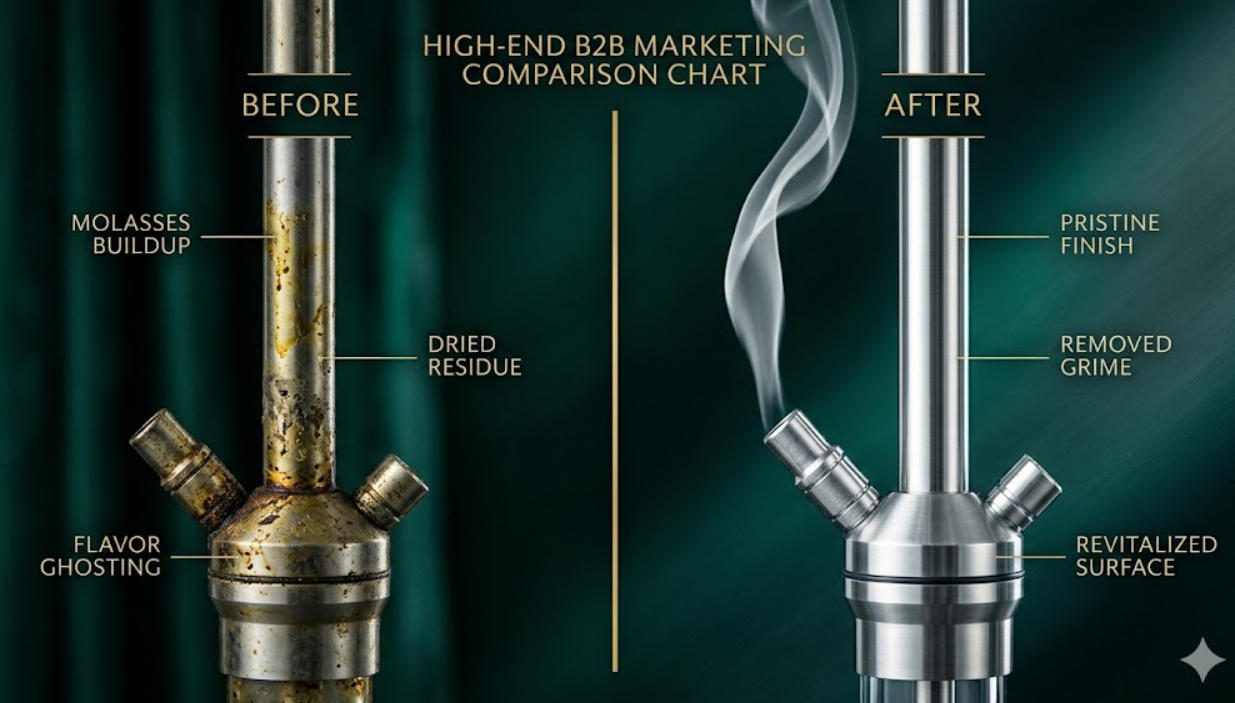
The primary reason metal hookahs are made of stainless steel is because it is a non-oxidizing metal and it presents a more professional image. However, it is not immune to flavor ghosting. Ghosting happens when shisha flavors penetrate the metal’s microstructures and the flavor persists even after an adequate amount of time. When standard cleaning fails to remove this ghost, a more aggressive approach is required.
If you have been in a similar situation of frustration where a standard rinse leaves a ghost flavor behind, this guide is for you. We look into the science behind ghosting on steel, provide a comparative analysis of baking soda vs professional cleaning solutions, and provide a clean solution that is multi-layered and professional.
 hookah parts laid out for deep cleaning including all components” width=”1201″ height=”660″ srcset=”https://www.linkuphookah.com/wp-content/uploads/2026/06/disassembled-hookah-parts-for-cleaning-02.jpg 1201w, https://www.linkuphookah.com/wp-content/uploads/2026/06/disassembled-hookah-parts-for-cleaning-02-300×165.jpg 300w, https://www.linkuphookah.com/wp-content/uploads/2026/06/disassembled-hookah-parts-for-cleaning-02-1024×563.jpg 1024w, https://www.linkuphookah.com/wp-content/uploads/2026/06/disassembled-hookah-parts-for-cleaning-02-768×422.jpg 768w, https://www.linkuphookah.com/wp-content/uploads/2026/06/disassembled-hookah-parts-for-cleaning-02-600×330.jpg 600w” sizes=”(max-width: 1201px) 100vw, 1201px” />
Why Go for Stainless Steel Ghosts
At a large scale, stainless steel is smooth, but it is textured at a smaller scale. The chromium oxide layer that supplies stainless steel with corrosion resistance makes it a uneven surface when it comes to chemistry. Flavor compounds from shisha tobacco, such as the heavy oils in dark leaf packing blends, shisha with double apple, and the extreme mint shisha with menthol crystals have a good affinity with this oxidized layer by the process of adsorption.
There are a lot of differences between adsorption and absorption. The flavor molecules will not permeate into the metal. The affinity will be done using weak forces such as van der Waals forces and hydrogen bonding. This is strong enough to resist a regular hot-water rinse. The flavor molecule will remain on the surface and are ready to escape when heated the metal.
This explains why a hookah can ghost even when it has been cleaned and dried. The flavor molecules are waiting to be heated.
Why Some Flavors Ghost More Than Others
The effect of shisha flavors on stainless steel varies. Bonding strength is determined by the molecular weight and polarity.
High-ghosting compounds:
- – Anethole (double apple, licorice) – hydrogen bonds
- – Menthol (mint, ice blends) – crystalline alcohol
- – Cinnamaldehyde (cinnamon, spice) – reactive aldehyde
- – Low volatility compounds
- – Pyrazines (dark leaf tobacco) – nitrogen compounds
Low-ghosting compounds:
- – Citrus terpenes (lemon, orange, grapefruit) – quick evaporation
- – Light fruit esters (peach, watermelon, pineapple) – high volatility
- – Simple sugars and glycerin
If you sell a double apple flavor, extreme mint, or dessert flavors, they will ghost faster and be more difficult to remove than fruit and citrus flavors.
The Standard Wash vs. The Deep Clean
The easiest way to tell that a shop owner knows how to effectively clean hookahs is when they understand that a standard wash is not enough for everyone. Most lounges have a basic wash and do the following: rinse the stem, scrub with a brush, rinse, air dry. Sounds simple, right? This is actually a great basic wash. This daily maintenance gets rid of ash and left over tobacco oils. While these flavors will not adhere to the hookah, this will break the molecular bonds.
Deep cleaning requires more thought than a quick cleaning. What do you use to aid your cleaning?
Baking Soda: An Option at Home
When you look at the cleaning mechanisms, baking soda works through pH chemistry and an abrasive nature. When baking soda is mixed with water, it can help with cleaning through breaking some of the interactions between the surface and the compounds.
Baking Soda Protocol:
- Mix 2 tablespoons into 1 liter of water, warm, but not hot, as that can change the layer of oxide
- Fill and let the stem sit for 15 to 20 minutes
- Brush and pay extra attention to the curves and edges
- Wash thoroughly with cold water
- Repeat as necessary, intending for no more than a single time
Pros: Non-toxic, cheap, food safe, and safe for stainless steel the entire time.
Cons: More than a few run-throughs should be expected with a multi-step process, and the polymerized films don’t break.
White Vinegar: The Acid Option
Vinegar (acetic acid, pH ~2.5) can dissolve some flavor compounds and mineral deposits.
Vinegar Protocol:
- Mix equal parts white vinegar and water
- Run through stem and let sit for 10 minutes
- Rinse thoroughly as vinegar can ghost into future sessions
- Follow with baking soda rinse to neutralize acid
Pros: Great with mineral buildup, cheap.
Cons: Will cause a dulling effect on stainless steel with repeat use. Not great for expensive hookahs
Commercial Stainless Steel Cleaners
Professional grade cleaners are at the end of the extreme and use surfactants, complexing agents, and balanced solvents to break stainless.
Things to check for:
- – pH neutral (6–8) to assess how the oxide layer is affected.
- – Food-grade or NSF-certified, as it is safe for surfaces that may come into contact with smoke.
- – Surfactant and chelating agents which are useful for breaking away oils and for absorbing remaining compounds.
- – No chlorine, bleach, or ammonia. These are very dangerous and damaging to stainless steel.
Commercial cleaner procedure:
- – Apply following the manufacturer guidelines.
- – Let it stand or “dwell” for the prescribed contact time of 3-5 minutes.
- – Scrub with a brush that is soft and is not abrasive.
- – Rinse with cold water and dry it immediately.
Pros: Commercial cleaners are more effective for heavy ghosting than baking soda and are faster; typically, they only require one usage while baking soda usually requires three treatments.
Cons: Sourcing may be difficult, they are more costly, and some can leave a residue.
Baking Soda vs. Professional Cleaner: A Comparison
Cost per clean
- – Baking Soda: Negligible (free)
- – Professional Cleaner: $0.50 – $1.50 per treatment
Light ghosting
- – Baking Soda: Good
- – Professional Cleaner: Excellent
Heavy ghosting
- – Baking Soda: Fair; 2-3 treatments
- – Professional Cleaner: Excellent; 1 treatment
Polymerised films
- – Baking Soda: Poor
- – Professional Cleaner: Good
Safety for steel
- – Baking Soda: Excellent
- – Professional Cleaner: Good (needs checking for pH)
Time requirement per treatment
- – Baking Soda: 20-30 minutes
- – Professional Cleaner: 5-10 minutes
Where to find
- – Baking Soda: any grocery store
- – Professional Cleaner: specialty supplier
Verdict: Baking soda is the best option for light ghosting and daily maintenance, while a professional artist stainless steel cleaner is the best option for severe ghosting, because it is more effective and more time efficient. Most high-volume lounges keep both on hand.
The Multi-Layer Deep Cleaning Process
The standard wash and the baking soda soak aren’t enough to eliminate all flavors sometimes. This three-layer process will help address all levels of ghosting: surface debris, adsorbed molecules, and the final rinse.
Layer 1: Degreasing
Heavy deposits of flavor molecules will be trapped by oils. To remove these, complete the following steps:
- Fill the stem with warm water and add 2–3 drops of unscented, residue-free dish soap.
- Scrub with a soft brush for 2 minutes and rinse with cold water until soap bubbles remain.
- Dry the stem with a clean microfiber cloth.
Layer 2: Chemical Bond Breaking
Chemical agents are useful at this layer of the process. Light ghosting can typically be overcome by a baking soda soak (2 tablespoons per liter; 15 minutes; scrub; rinse), whereas agents more suitable for heavy ghosting (per manufacturer’s instructions) should be used.
Layer 3: Thermal Reset
The remaining ghosting in your stem will be removed once any adsorbed compounds are flushed away by the application of a heat source. This layer is complete.
19.1. After rinsing, put the hookah back together with a new bowl and new base water.
20.2. For 60 seconds, run 50–60°C hot tap water through the stem.
21.3. After that, immediately run cold water through the stem.
22.4. Run hot and cold water through the stem in the same manner, 2–3 more times.
23.5. Dry the stem with a microfiber cloth.
Thermal shock breaks ttubos para cachimbas residues, and the hot water helps to collect and re-adsorb them, which the cold water helps to wash away.
Post-Clean Check
After finishing, sniff the hookah to see if the problem was resolved. To collect a sample, run hot air through the stem while you either sniff the stem or use an unused mouthpiece to collect an air sample. If a flavor is still present, go to Layer 2, and do not use the hookah.
What Not to Use on Stainless Steel
Bleach and Chlorine-Based Cleaners
Bleach reacts with the bonding layer that protects the stainless steel. Then, the metal is prone to pitting, corrosion, and rapid ghosting. The microscopic pits provide a rough, porous surface where flavor molecules are trapped.
Abrasive Scrubbing Pads
Steel wool and scouring pads scratch the surface. Every scratch creates a groove where flavor oils accumulate. Over time, an aggressively scrubbed stem ghosts faster than a gently maintained one.
Dishwasher
The flavor oils become more chemically bonded to the steel, which will be more exposed to the environment. Hand wash only.
Hot Water Alone Without Cold Rinse
While hot water can help with the flavors, it doesn’t clean. Without a cold rinse, the flavor compounds that absorb into the metal are back. Just remember that hot water needs cold water.
Creating a Stainless Steel Maintenance Schedule
Cleaning the hookahs during a rush is not ideal and can be avoided by having a schedule with daily maintenance as opposed to a routine deep clean.
After Every Session
- – Rinse stem with cold water for 30 seconds
- – Wipe dry with a cloth
- – Air dry, lying down on a drying rack
Daily (At End of Shift)
- – Normal wash: a hot water scrub with a soft brush, cold rinse, and dry
- – Look over each stem for residual waste
- – Identify for a deep clean in the morning any hookah with ghosting
Weekly
- – Deep clean protocol: Layer 1 (degreaser) + Layer 2 (baking soda or professional-grade cleaner)
- – Each hookah in your inventory should receive a deep clean at least biweekly
- – Check lower stem, gaskets, o-rings, and joints for damage
Monthly
- – Perform a deep clean with multiple layers on every hookah.
- – Dismantle all removable parts (downstem, diffuser, hose adapter)
- – Use food-safe stainless polish to clean the oxide layer
- – The [custom stainless steel tongs collection](https://www.linkuphookah.com/product/custom-stainless-steel-tongs-collection/) makes handling during deep cleans safe.
Replacement Threshold
Even with the maintenance schedule, ghosting can appear on any stainless steel product. If a hookah ghosts from a full three-layer deep clean, the stem should be replaced. For a high-volume lounge with 30+ sessions per hookah, this happens roughly every 18–24 months with 304 stainless steel.
Picking Equipment To Make Cleaning Less Stressful
Stainless steel hookahs require specific features that make them relatively easier to clean. When buying, look for things that prevent ghosting and help with deep cleans.
Completely Disasswithable
A hookah that completely disasswithables is the easiest to deep clean because the whole thing comes apart, including the stem, downstem, diffuser, hose ports, and purge valve. Un-cleanable areas are the best spots for ghosting to reside.
Linkup Hookah sells fully detachable hookahs made from 304 stainless steel from Moze, Steamulation, and Aeon. The Moze Breeze Pro 304 Stainless Steel Hookah has a modular design that allows you to access every surface.
Smooth Internal Bore
Compared to downstems with cast surfaces or threaded joints, a downstem with a smooth, machined bore carries less flavor oils.
Replaceable Downstems and Diffuser
Since they experience the highest concentration of smoke and heat, downstems and diffusers ghost more than other components. A stem design allows you to swap the most ghost-prone component without having to replace the whole stem.
Goose Necks That Seal Without O-Rings
Compression fittings or ground joints are easier to clean than o-ring connections. The custom soft-touch silicone hoses paired with metal handles minimize ghosting points across the entire setup.
Conclusion
Sofia resolved her Moze Sphere 2 double apple hookah ghosting issue with the three-layer deep cleaning method. From this experience, Sofia learned how to clean a hookah when the standard rinse isn’t enough: a degrease scrub, soak with commercial stainless steel cleaner, and a thermal reset with alternating hot and cold rinses. The ghost flavor disappeared. No ghosting has been reported for the hookah that has been in the rotation for four weeks.
Flavor ghosting on stainless steel is not a defect and is not permanent. It is a surface chemistry problem, but it can be resolved. The flavor compounds can be pulled from the stainless steel oxide layer; this can be accomplished with the right cleaning method and the right cleaning agent.
Baking soda is a great cleaning agent for routine cleaning. For ghosting that is more stubborn, using professional stainless steel cleaners takes less time and provides the results needed, and for the worst cases like double apple stems and extreme mint setups that seem to leave the taste of last week’s flavor, the three-layer deep clean method is required.
Your goal is to keep inventory clean and have a routine maintenance schedule. Also, invest in cleaning equipment that is designed for disassembly, which will make your maintenance easier. Customers will appreciate that they will only taste what they have ordered.