

- Mistake #1: Use of Hot and Cold Water in Alternation (Therma
- Mistake #2: Using Steel Wool and Abrasive Scrubbers
- Mistake #3: Soaking Components Too Long
- Mistake #4: The Use of Caustic Cleaning Chemicals
- Mistake #5: Not Cleaning the Hose or Grommets
- Mistake #6: Not Drying Components Thoroughly
- Mistake #7: Cleaning Hookah Parts Using your Dishwasher
- Suggestions for Better Hookah Care
- Better Cleaning Habits to Protect Your Investment
Linkup Hookah distributes the finest quality hookahs and accessories to lounges throughout the world. Each season, we observe the same sad phenomenon: a lounge invests in exceptional equipment, and then, through terrible cleaning habits, destroys it.
We know that the top hookahs from Steamulation, Moze, or Aeon can, with proper cleaning, the hookah equipment can last a long time in a busy lounge. The difference between a hookah that lasts five years and one that rusts out in twelve months is rarely about build quality. It is almost always about technique.
This article will teach you the seven ways lounges destroy expensive hookah cleaning. If your cleaning staff has bad habits, you need to fix that.
A good hookah setup from Steamulation or Moze will cost a lounge with 30 hookahs approximately $6,000 to $18,000. Poor cleaning will destroy an entire setup and result in $3,000 to $9,000 of unnecessary costs for the lounge every year. When you consider how many years the equipment will be replaced, you will see that maintaining the hookahs with proper cleaning will be a cost-effective strategy.
This guide is intended for lounge managers and head shishas supervising the training of cleaning employees. This guide explains the reasons behind various cleaning steps and the reasons why certain cleaning procedures are damaging. This ensures you can tell your employees why taking such shortcuts is detrimental. For the most common errors that cleaning staff can make, practical and reasonable solutions have been proposed.
Mistake #1: Use of Hot and Cold Water in Alternation (Thermal Shock)
Thermal shock is one of the most common errors leading to the destruction of hookah bases para cachimbass and the destruction of glass components. Employees working in busy lounges often have to wash components such as stems and hookah bowlss, and to save time, rinse the bowls and the stems in tap water that is ice cold and then rinse with hot water. The glass and metal elements undergo abrupt temperature differentials and warping.
Glass bases are even more delicate and can shatter if staff perform routine cleaning when the base has not cooled fully and is still warm from the previous session. While glass bases do not shatter immediately, thermal shock makes it possible for cracks to develop and bacteria to trap and even spread these cracks until complete failure occurs.
All hookah components should be allowed to cool to room temperature. The initial rinse should be done in water that is roughly the same temperature as human body temperature. Residues that are hard to remove can be soaked and left in warm water. Water that is lukewarm is acceptable but boiling or ice cold water should never be used. If the water temperature is such that it would be uncomfortable to be in contact with bare skin, then that water should not be used on the hookah.

Mistake #2: Using Steel Wool and Abrasive Scrubbers
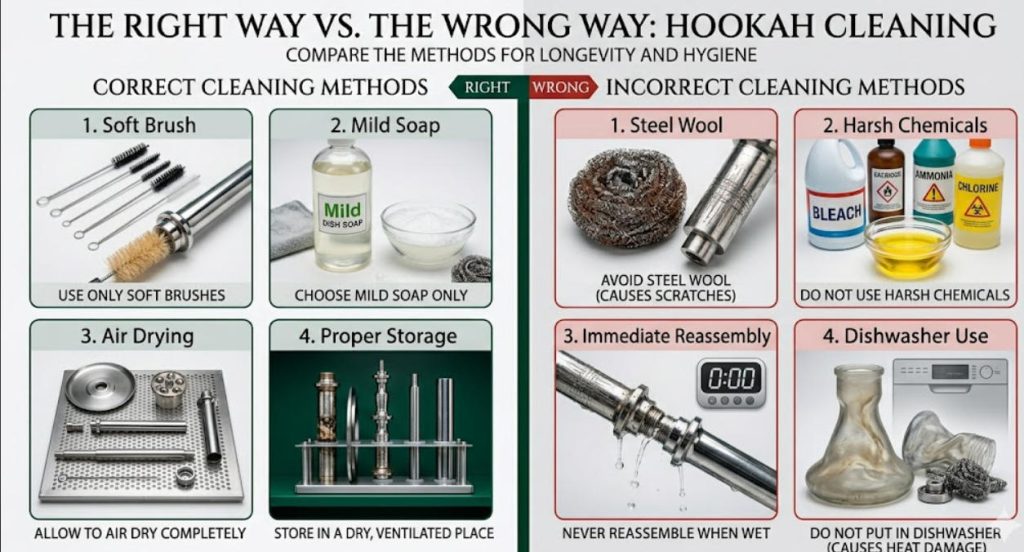
While steel wool is efficient at removing stains, it ruins a protective surface layer and scratches steel stems and bowls. This means it is not an appropriate cleaning tool for the lounge staff. Here’s what happens when steel wool is used. Scratches from steel wool create tiny nooks that can easily be colonized by bacteria. This becomes an odor trap. Finally, pitting corrosion occurs over time due to the accumulation of moisture and smoke residue in the nooks, even on 304 stainless steel.
There are other cleaning tools that fall in the same category as steel wool. These include green Scotch-Brite pads, wire brushes, and most scouring powders. Each of these cleaning tools will eventually remove the thin protective layer of chromium. Once that layer is removed, the stainless steel will rust and corrode.
To avoid these mistakes, use a soft cleaning tool like a microfiber cloth or sponge. An accepted practice for removing stubborn residues is to use a cleaning brush that is specially designed for hookahs, which has a soft bristle. A correct cleaning practice is to remove the residue and then soak the residue in warm water and a mild cleaner. Steel wool and other abrasive cleaning tools are helpful in other industries, but they do not belong within the lounge staff hookah cleaning toolset.
Mistake #3: Soaking Components Too Long
Soaking is one of the more reliable cleaning methods. However, soaking hookahs for too long is damaging. This is especially true for stainless steel, which can develop water spots and corrosion. Chrome-plated brass stems have oxidation and peeling when over soaked. Lastly, silicone tubing breaks down when water is absorbed.
The downstem and diffuser are the most vulnerable pieces. These parts are designed with narrow passages that can trap pool water. Keeping the downstem and diffuser submerged in water can damage these pieces because stagnant water will promote bacterial growth and scale, which can clog the passages and impede steam flow.
Do not soak any pieces for longer than 15 to 20 minutes, and for especially tough residue you can use a hookah specific cleaner or a solution of vinegar and water in a 1 to 3 ratio—but even these “soaks” should not exceed 30 minutes. After being in cleaning solution, it’s important to rinse these pieces thoroughly and immediately dry them. If you manage a hookah lounge with heavy traffic, you should consider investing in several hookahs and rotating to give each hookah lift between uses.
Mistake #4: The Use of Caustic Cleaning Chemicals
Hookah maintenance does not include cleaners like oven cleaner, ammonia, or bleach. You cannot believe the number of lounge owners who proudly say they use bleach to “disinfect” their hookah between uses. If you are lucky, these caustic chemicals will discolor your metal parts, destroy your rubber and silicone seals, and destroy your glass. But, the glass will be clean.
Porous surfaces will always hold a cleaning chemical residue. These residues can be especially detrimental to a hookah. Bases that are sanitized with bleach can release vapors and chemicals when hot water is added to nourish your hookah, which will also affect the taste of your hookah. The silicones of the tubing can also absorb these chemicals, and you will have a very hard time getting the chemical odor to go away.
Solution: Either stay with products made for cleaning hookahs, or choose natural alternatives like white vinegar for mineral build-up or lemon juice to clean odors. For regular cleaning, warm water with mild dish soap is enough. As a more thorough cleaning option, grab food-grade 70% isopropyl alcohol to clean it, and be sure to rinse it well. Don’t ever use anything labeled as ‘corrosive’ or ‘caustic’ on your hookah.
Mistake #5: Not Cleaning the Hose or Grommets
The hose is the most overlooked component in hookah lounge maintenance and is the one that is the most in contact with the customer. Traditional leather or metal-wrapped hoses cannot be washed– water will destroy them. Even washable silicone hoses need their fair share of care.
Grommets are also neglected. They build smoke residue and bacteria over time and lead to inconsistent smoking experience. Grommets also affect performance due to air leaks.
Solution: For silicone hoses, just get warm water running through the hose and then hang the hose upright to dry. For commercial hoses, replace it every 3 to 6 months. Whenever you do a deep clean, don’t forget to remove grommets and wash them with a mild soap. Don’t forget to check on grommets when you deep clean as well. If you need a replacement before a deep clean, provide a better seal to your bowl assembly with an ultra-thick, pre-punched foil and prevent ash from falling in your water.

Mistake #6: Not Drying Components Thoroughly
Moisture is the leading cause of a hookah’s longevity issues. A cleaned but damp hookah will develop rust, mold, and mildew at an astonishing rate. This can happen even faster than if the hookah is never cleaned at all. This is especially true in lounges with high humidity and a busy daily schedule.
The downstem is the most important area. Downstem tubes with water beads inside will stay contaminated for hours or days if the beads are not removed. Over time, a rusting and flaking downstem will contaminate the smoke. Chrome-plated downstems will rust and spot under the plating. This will cause the plating to eventually peel and fall off.
Mold also becomes a concern. If there is a damp downstem and the hookah is stored in a cabinet, mold will likely form. This creates a health risk to customers, and all lounges must be cautious to avoid this.
Solution: After every cleaning, dry every component individually with a soft cloth. Use a narrow brush to dry the downstem. Let all components air dry for at least 30 minutes before putting the hookah back together. Do not keep a hookah assembled if cleaned within the last 24 hours. Use a dedicated drying rack for your hookah parts if you find it necessary.
Mistake #7: Cleaning Hookah Parts Using your Dishwasher
In theory, your dishwasher would make short work of cleaning hookah parts, but in reality, it is one of the worst cleaning methods to use on your hookah. Using a dishwasher can cause irreversible damage due to the combination of temperature, corrosive cleaning agents, and scalding jets of water.
For glass, this can case a cloudy appearance from the etched surface. For stainless steel, it can case surface corrosion and pitting. For smaller parts, such as grommets and hose ports, it can even be disassembled and destroyed. The rest of the parts can be covered in an unclean burnt layer of charcarbones para cachimba.
Each hookah part must be cleaned separately. Yes, this can be time consuming, but it ensures that parts are not ruined. For high volume hookah lounges, consider setting up a cleaning station setup for your staff with soft cleaning brushes, sponges, drying racks, and a staff poster with instructions. Having a proper electric charcoal burner also helps manage the heat to reduce burnt charcoal from sticking to the hookah.
If a dishwasher must be used, the cleaning temperature and the drying temperature must be kept as low as possible to prevent drying damage, and the detergent used must be very mild. However, it is always better to hand wash rather than risk the damage for the hookah parts that come contact with burnt charcoal and smoke.
Suggestions for Better Hookah Care
For regular maintenance of your hookah, use this checklist after every session:
- – Allow all hookah parts to cool to room temperature.
- – Rinse parts with lukewarm water to avoid temperature shocks.
- – Only use soft brushes and non-abrasive sponges.
- – Limit soaking to 15-20 minutes and never overnight.
- – Use mild dish soaps or vinegar solutions, never bleach or harsh chemicals.
- – Clean hoses and grommets every time and not just the visible parts.
- – Dry every component thoroughly with a lint-free cloth.
- – Allow parts to air dry for over 30 minutes before reassembly.
- – Store components disassembled to allow for air circulation.
- – Inspect every part weekly for cracks, rust, and other signs of wear.
Implement a deep clean rotation schedule. Every 10-15 sessions, each hookah should be given a full disassembly and a thorough cleaning. Hookahs should be rotated so no hookah is in constant use. For lounges with 20 hookahs used each session, this means having 25-30 hookahs in rotation to allow for adequate cleaning and drying time.
Better Cleaning Habits to Protect Your Investment
Hookahs purchased from Linkup Hookah are designed to be durable. Our stainless steel products are made from premium 304 stainless steel with protection from chromium oxide. Our glass bases are made with thickness and precision. But even the highest quality build of our products cannot withstand the daily cleaning abuses we see.
The seven mistakes in this article are the main reasons for early hookah failures in a commercial setting. If these mistakes are eliminated, you can increase the life cycle of your hookahs by 300-500%. This amount of increased life cycles is a real cost savings on purchasing new hookah units.
Educate your employees. Post procedures and protocols at your wash station. Purchase appropriate cleaning implements, such as soft brushes and microfiber drying cloths. Invest in drying racks. Your customer base, and your hookahs, will appreciate it. As an Authorized Linkup Hookah Partner, you can access the best maintenance instructions and advice and a complete assortment of cleaning supplies. For your specific setup, your B2B account manager can even offer a specialized maintenance consultation.
Maintenance is critical. Each time staff skips drying, grabs steel wool for the sake of expedience, or cleans a hot base with a cold water rinse, the equipment is damaged and the lifespan is shortened. Aim to incorporate cleaning accountability into the company culture of your business. Proper cleaning should be a KPI. Those lounges that ensure proper maintenance with the same regard they place on customer service, retain their equipment for the long haul and sustain profit margins.