

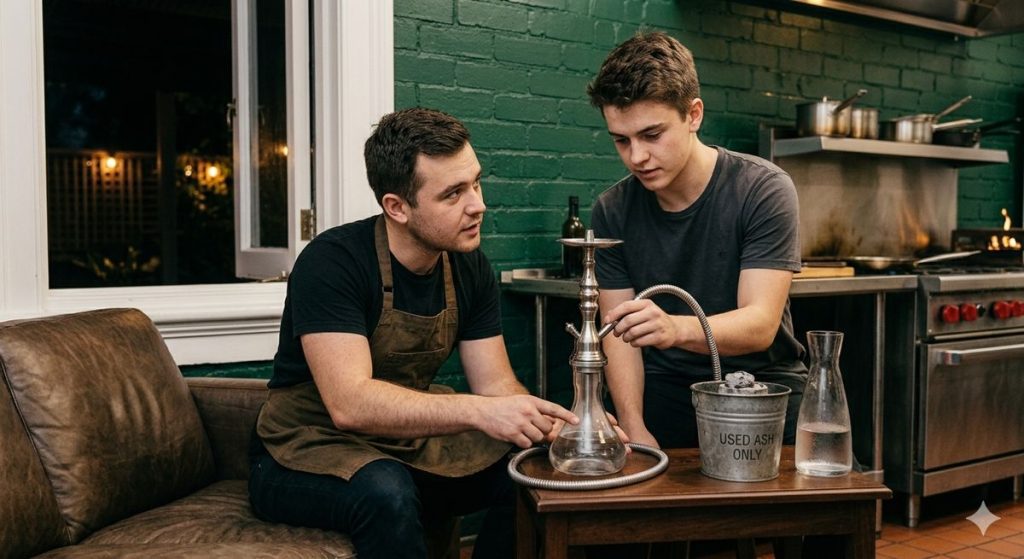
- Training Staff to Handle Service Emergencies
- The Training Framework: From Onboarding to Mastery
- Standard Operating Procedures and Pocket Cards
- Product Recommendations for Emergency Spares
- Training Log and Accountability System
- Medical Emergency Deep Dive: Dizziness and Nausea
- Pre-Service Inspection: The First Line of Defense
- Conclusion: Training Is the Difference Between Chaos and Con
Training Staff to Handle Service Emergencies
A busy Saturday night at a hookah sets lounge is a finely-tuned machine. Negligence in a single area has the potential to lead to a chaotic experience; one coal that won’t light, one hose that leaks, one customer who says they feel dizzy. The difference between a lounge that elegantly handles these moments and one that spirals into complete chaos is training and preparation.
Training staff on troubleshooting hookah issues is synonymous with creating the most invaluable resource your lounge can have: a team that actively prevents potential problems. This guide outlines an efficient, all-inclusive emergency training system that describes the ten most common on-the-job service issues and lays out the framework for employee onboarding, testing, and response drills to make these routine protocols second-nature.
There are multiple points of potential failure for each shift in the shisha lounge: coals that die mid-session, jammed purge valves, base seals that lose grip, and customers that are intolerant of nicotine. Without a plan, response to these issues is left to the discretion of the employees, and lack of response consistency results in revenue loss. For example, if one employee replaces a dead coal in ten seconds and another takes three minutes to do the same, the guest becomes annoyed while the associated table loses revenue. The revenue lost becomes a direct reflection of the quality of the employee. If employees are trained on the top ten quick fixes for the ten most common emergencies, the lounge runs smoother, average tips increase, and customers become more loyal. A training system that is structured this way protects the business if a lounge patron would become injured and prompt a lawsuit. If a claim is made for a medical incident that occurs during the business hours, and responsive procedures to the medical emergencies are adhered to, that becomes an integral aspect to the case.
The following describes the 10 most common emergency service issues, along with a quick fix that’s no more than three seconds. For your sake, these solutions are made to be memorable and transparent so you don’t have to overthink them. Staff should be able to see these posted at their station and these can be laminated.
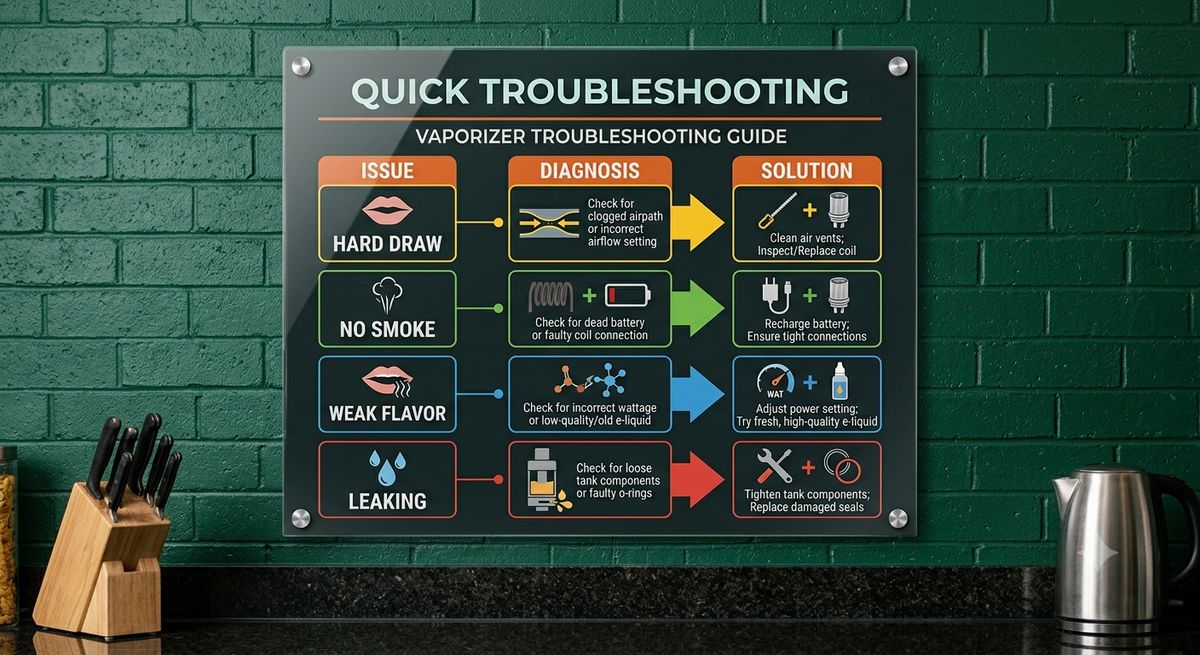
1. Coal Dies Mid-Session
3-Second Fix: Use tongs to replace the dead coal with a fully lit one.
Follow Up: Check the other coals. If multiple dead coals are present, the coal batch has likely been compromised. Move the hot coals to the bowl edge and add new, hot coals to the bowl center. Inform your manager that this batch of coals should be replaced.
2. No Smoke / Weak Smoke
3-Second Fix: Slightly lift the bowl and rotate it 45°. This often re-seats the replacing grommets and restores airflow immediately.
Follow-Up: Check the hookah water level (1–1.5 inches above the downstem tip) and verify the hose isn’t kinked. If airflow is still weak, the bowl pack may be too dense — repack with a looser fill.
3. Harsh / Spicy Smoke (Too Hot)
3-Second Fix: Move the coals to the edge of the bowl. After 30 seconds, ask the guest if the taste has improved.
Follow-Up: Check the foil or HMD screen for ash build-up. Brush the HMD if it is clogged. Educate the guest to manage the bowl’s heat by taking a breath.
4. Water Bubbles Into the Hose (Gurgling)
3-Second Fix: Detach the hose, hold it vertically hookah mouthpieces-up, and blow sharply to the water to clear it.
Follow-Up: Check the base water level — too high if water enters the hose port. Pour out the excess. If the purge valve is stuck, remove the ball from the purge valve to dry the ball valve and the sealing surface of the valve to reseal.
5. Air Leak at Any Connection
3-Second Fix: Wet the grommet (dip a finger in water) and re-seat the connection with a twist.
Follow-Up: If the leak persists, replace the grommet from your spares kit. Check hose port threads for cracks. If it is old, the leak may be coming from the handle — replace the hose.
6. Purge Valve Not Functioning / Stuck
3 Second Fix: Use the back of a tong and tap the purge valve housing to unstick the ball bearing.
Follow Up: Unscrew the valve, remove the ball bearing and clean the valve and bearing using a dry cloth. If the ball bearing is corroded, replace it. Check the purge valve condition by blowing it before reinstalling the hose.
7.Customer Claims Feeling Dizziness / Nausea
3 Second Fix: Remove the hose in the customer’s hand and offer cold water.
Follow Up: Either open a window or escort the customer to an area with fresh air. Offer the customer a sweet snack, and keep an eye on them for five minutes. If you see no change in the customer’s condition, contact emergency services to give the customer the necessary medical help. Make sure to record the customer’s condition in the log. It is extremely important to keep the customer’s symptoms in mind, as they can become severe.
8. Hose Disconnects / Port Breaks During Service
3 Second Fix: Lift the hose end above the base water level to stop backflow, then plug the port with a spare grommet or your finger.
Follow Up: Replace the broken hose with a spare. If the port itself is broken (scratched/shattered glass or stripped threads), retire the hookah and swap the table to a backup unit. No field repairs on broken glass.
9. Bowl / Foil / HMD Catches Fire or Smoulders Excessively
3 Second Fix: Use the tongs and place the burning coals on the coal tray. Do not blow on the coals to extinguish or cool them.
Follow-Up: If the foil or HMD is damaged by burning, replace it completely. Ensure the area is well-ventilated. Reset with new foil or HMD and decrease the number of coals. Inform the guest about damaging the session due to overheats.
10. Base Cracks or Leaks During Session:
3 Second Fix: Place a tray underneath the base to avoid additional leaking, then replace the hookah with one that has a functioning base.
Follow-Up: Permanently remove the base that is now cracked because it will shatter in the future as glass cracks will continue to spread. Make an entry of the damaged base and remove it from the inventory.
The Training Framework: From Onboarding to Mastery
Phase 1: Onboarding — 2 Hours Theory + 2 Hours Practice
Each and every new employee will have to participate in a 4-hour long emergency training session as the first step of training on the first day. This is the foundation of your hookah staff training program.
Theory block (2 hours): Go over the 10 emergencies. Explain the science behind airflow, heat, and pressure, along with seal and integrity. Present some images or videos to show staff how to identify signs of each particular issue. Explain the risks of liability, especially concerning the medical symptoms that appear during Scenario 7. Finish with a “Question and Answer” session.
Practice block (2 hours): Design a training spot with one hookah that has purposeful faults that include the following: loose grommet, an overfilled base, a coal that is damp, and an obstructed purge valve. Then, an individual designated to train will be assessed with regard to the ability to identify and resolve each particular fault, within the time that has been allocated. This individual will need to be able to diagnose and resolve each of the 10 faults in an accumulative total time of 90 seconds, at which point they will be cleared to serve customers at the table. This phase is the most effective at training any employee of a shisha lounge and it is of the utmost importance to ensure that this step of the training is thoroughly and effectively employed.
Phase 2: Weekly Quick Tests (10 Multiple-Choice Questions)
All employees complete a 10-question emergency scenario quiz each Monday before their shift, with questions rotating weekly. Here are a few examples of questions:
- – What is the first action when a customer begins to feel faint?
- – What is the most likely cause when the hose begins to gurgle?
- – What do you do when the coal dies during a smoking session?
- – What do you do when the purge valve sticks?
- – What do you do when the smoking coal begins to create a harsh and spicy smoke?
Staff must obtain a score of 9 or better. Any staff scoring 8 or less must re-take the quiz that same day and participate in a 30-minute refresher practical session before they are able to complete their next scheduled shift.
Phase 3: Monthly Simulated Scenario Drills
At least once a month, the entire front-of-house staff participates in an active drill. The manager picks three emergency scenarios at random and sets them up on an operational front-of-house task. For example, before the service begins, the manager may remove the purge ball bearing and it becomes the responsibility of the staff member to discover and correct the task in less than ten seconds during the pre-service inspection.
Drills will be conducted with a timer and score. The results will be maintained in each employee’s training log, with a continuous record of drill participation, scores from drills, and results from actual incidents. This drives continuous improvement of our mature staff program for hookah troubleshooting. Each month, one scheduled drill and one unscheduled drill will take place, with the unscheduled drill helping assess staff’s ability to naturally follow set protocols, which is the ultimate goal of training.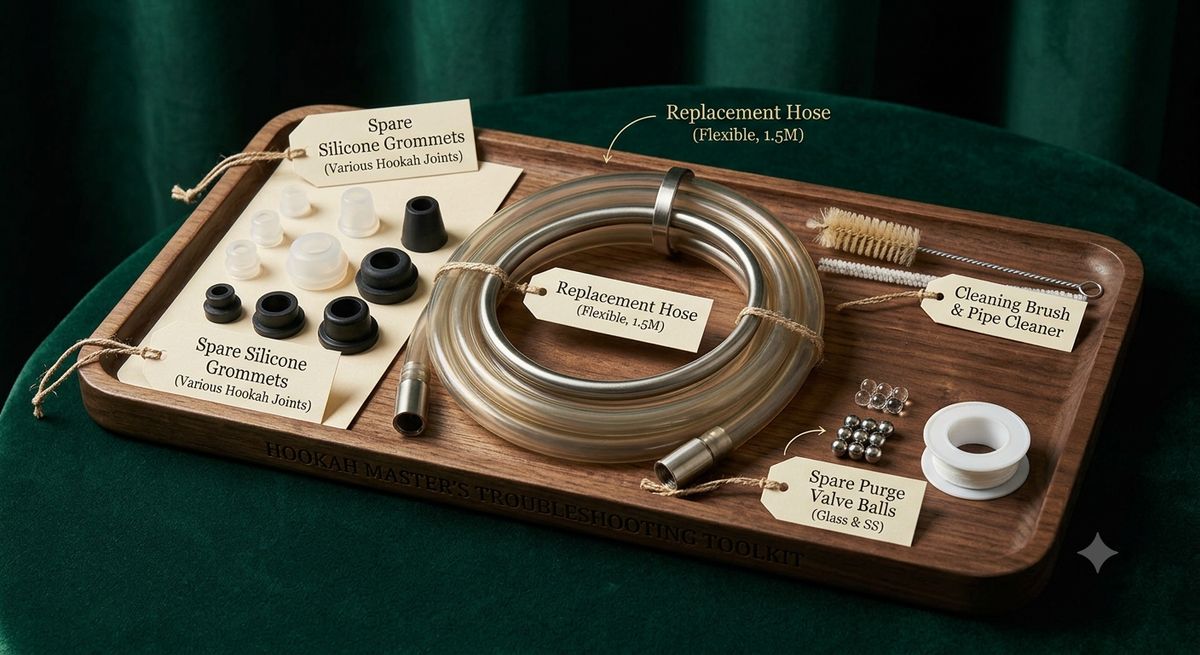
Standard Operating Procedures and Pocket Cards
Every hookah assembly site needs a laminated SOP card which lists the 10 emergencies along with their 3-second fixes and the escalation procedures. Design cards that are easy to read in under 10 seconds. Use two columns, the left column is for symptoms and the right column is for fixes. Add color to the symptoms line with green for airflow, red for heat, yellow for equipment issues, and blue for medical issues. During a busy rush, staff are able to find the right fix alone by color. Keep a backup in the office for reference during check-in and training sessions.
Every staff member should have their own pocket-sized quick-reference card. Pocket cards should contain the 3-second fixes for all 10 emergencies, a diagram of a hookah with numbered connection points and water line levels, the phone number for escalation, and a QR code for a training video. The best way to train staff is hookah troubleshooting is to provide them the tools at their place of duty. A pocket card is a $0.50 investment vs. a $50 loss from a hookah system that’s walking out.
Product Recommendations for Emergency Spares
Every training program includes the right spares. Every lounge should have these items to ensure immediate replacement for unexpected failures. Linkup Hookah sells all of them as a B2B one-stop partner.
- Grommet Variety Pack — silicone grommets for bowl, base, and hose connections. The single most common failure point is a dried-out or loose grommet. You can find Linkup’s hookah accessories collection to get silicone grommets.
- Replacement Hoses — Recommended minimum of three spares. Look for silicone hoses with removable mouthpieces. These can be cleaned and reused. Linkup also sells complete kits with spare hoses on their hookah kits page.
- Purge Valve Replacement Kits — ball bearings and valve housings. A stuck purge valve ruins a session. Keep two kits in stock for every ten hookahs.
- Spare Base — one universal base for every five hookahs. Glass breaks; having a spare means you never retire a hookah mid-shift. Linkup’s range of hookah kits and accessories includes bases compatible with all major stem sizes.
Keeping these spares on hand means you can do a quick swap in less than a minute instead of losing the whole table. These spares are an investment you can be sure will pay off from the income you’re not losing.
Training Log and Accountability System
Documentation is what transforms a one time workshop into a real hookah staff training program. Have on hand a training log (either physical or digital) with columns for: staff name and hire date, training phase completion dates, quiz scores (recorded for individual pattern analysis), drill scores and completion dates, and real incident handling, excluding the name of the employee, the scenario, the outcome, and the recommendation, as well as, the date of a supervisor review, and the date of a real incident, refresher training.
At team meetings, reviews should occur monthly and include data trends. For example, are hose-leak fixes becoming less frequent? Does one staff member consistently fail the same quiz question? A dynamic training focus comes from quiz data. A related benefit of a revision of this employee guide with respect to a shisha lounge is the superiority of a manual based on real-time data over a manual without updates. Consider an incentive for a quarterly championship: the employee with the best combined performance in a quiz and drill for the quarter receives a gift card or is offered to select his/her shifts in an elevated priority manner. Engaging staff members in the performance of drills and quizzes is the essence of “gamification.”
Medical Emergency Deep Dive: Dizziness and Nausea
Scenario 7 is unlike the other scenarios because it is the only one in which the staff member should be concerned about the health of the guest. Dizziness, nausea, and lightheadedness in a guest can be caused by a number of factors, including nicotine poisoning, dehydration, and, in rare instances, exposure to carbon monoxide as a result of coal that is not properly lit. The following list should be referred to in the hookah lounge staff troubleshooting guide:
- Remove the hose without allowing the guest to continue smoking
- Provide water or a juice with sugar
- Provide fresh air by opening a window or by taking the guest outside
- Stay with the guest to observe for 5 minutes
- If the guest does not improve, notify a manager of the situation and ask for medical services to be summoned
- Document the time, patient symptoms, actions taken, and the outcome
In the interests of safety, this procedure should be in place for all staff members on the first day and should be reviewed monthly in a 5-minute drill. This is the most important page in the staff troubleshooting guide that will give staff members essential and time-sensitive information.
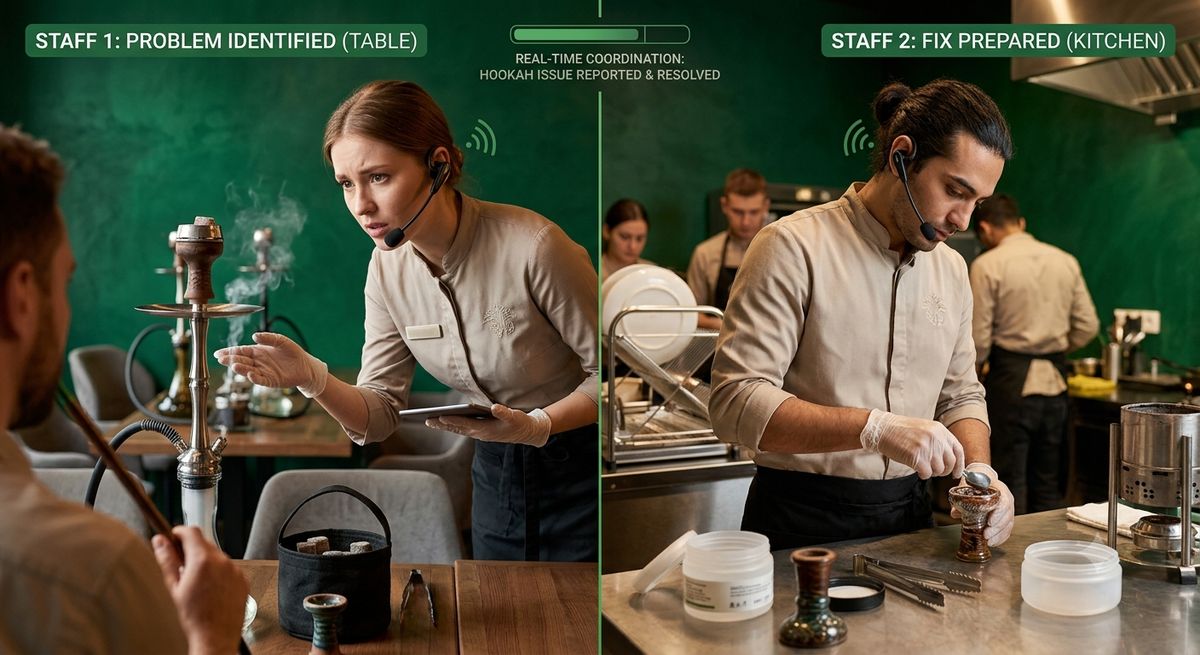
Pre-Service Inspection: The First Line of Defense
The most effective emergency repair is one that never has to be made. Make it company policy to perform a pre-service inspection every shift. Each hookah gets a ten-second check:
- – Grommets: If they’re hard, cracked or not soft and pliable, get rid of them.
- – Purge valve: Remove the ball bearing and the valve flow. Dry the ball. Assemble the valve, and blow into the hole to check it.
- – Hose: Blow through. If it requires high effort, check for liquid or debris inside.
- – Base: Must be full to the rim. Cracks and chips must be checked.
- – coal tray: It should be free from all residual ash from the previous shift.
- – Bowl: Should be free from residual burned shisha or molasses.
Staff initial a log sheet after completing the inspection; the manager reviews it before doors open. This 60-second investment prevents 80% of mid-service emergencies and is a cornerstone of any serious shisha lounge employee guide.
Conclusion: Training Is the Difference Between Chaos and Control
A hookah lounge runs on more than good tobacco and clean glassware; it runs on the competence of its staff in the moment something goes wrong. Training staff for hookah troubleshooting is a clear investment for a culture of problem prevention. It means that the guest never feels the friction of a broken session and that the team is operating with confident poise that is the result of preparation.
Your onboarding schedule has been set to four hours. Weekly quizzes and monthly drills have been planned. SOPs will be hung up in the break room and pocket cards will be distributed. Spare parts will be organized and your training log will get set up. You’ll review it monthly. In ninety days you will notice fewer comped tables, staff more confident, and positive reviews written. This is the benefit of focused training, not wishful hoping.
Linkup Hookah is your specialized partner in equipping this trained team. From silicone grommet packs to full hookah kits to spare hoses and purge valves, our B2B catalog encompasses every part your staff will need to swap. Go to the Linkup Hookah accessories page to load your lounge with the tools that make “emergency fixes” transform into “less than three-second efforts” and “spare parts” obsolete.