


Your first bulk order was placed 6 months ago. Half of the hookahs from this shipment had the wrong stem diameters, meaning the bases didn’t fit. The tuyaux de narguilés were 2 centimeters too short. Your lounge manager wasted a weekend making illegitimate connections. This was time not used on serving customers.
This is the worst way to learn.
A commercial hookah spec sheet stays this way. One document encompasses everything. It says everything. It is the difference between a shipment that works and one that costs you.
Why Standardized Specs Save You Money
Placing a bulk order without a commercial hookah spec sheet is essentially gambling. Each supplier is slightly different, meaning tolerances are different. An 18.5 mm stem and a 19.0 mm stem are not wrong. The problem comes when you expect bases fit to one stem and you received the other.
When a bulk order is placed without a spec sheet, 10 to 15 percent of the order is compatibility issues. This is not a bogus statistic. It is what importers have reported. Using a Standardized Commercial Hookah Specs B2B, this waste is nearly zero.
Your spec sheet is your contract. If you do not have it, the supplier provides what they want, instead of what you need.
The Hidden Cost of Mismatched Parts
Time is the hidden cost. Everyone waits. Every stem replaced causes a 2-3 week wait on the supply chain. Your lounge is unable to use inventory and staff is forced to work with unusable inventory. Your customers get unhappy with the service.
A spec sheet eliminates conversations like these:
“Why doesn’t this bowl fit?”
“Could you change the stems?”
“The grommets are loose.”
One document upstream solves tons of issues downstream.
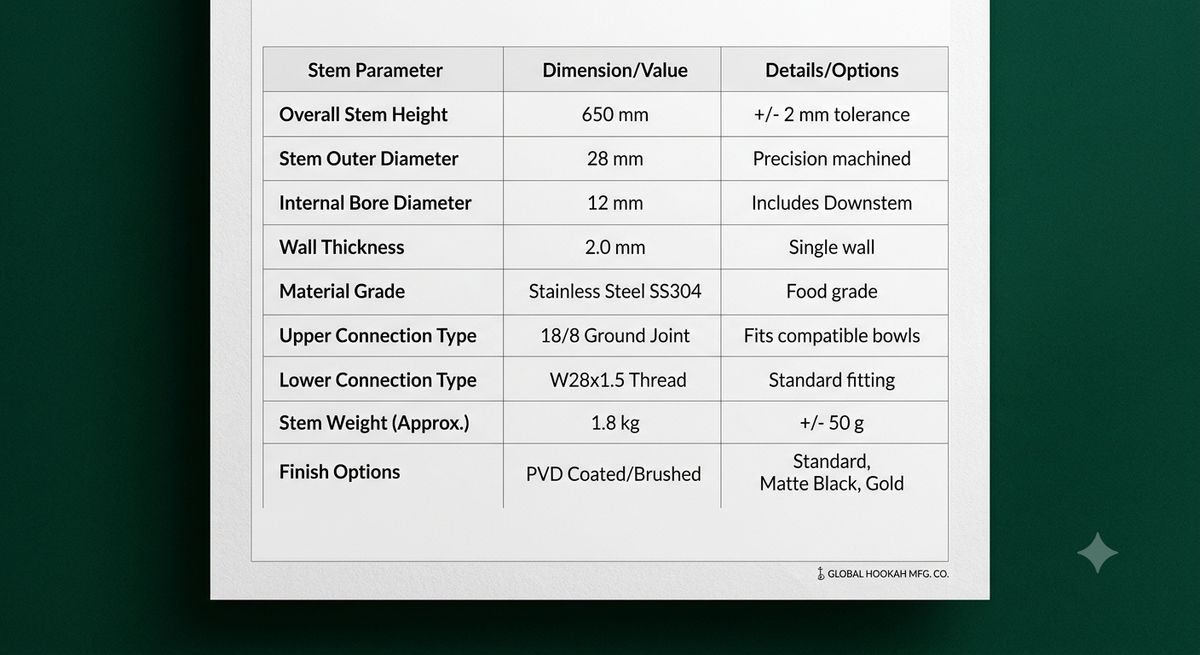
What Your Commercial Hookah Spec Sheet Should Have In Eight Sections:
To design your spec sheet, create eight different sections — these represent separate components that your lounge will use.
1. Stem Specifications
The stem is the basis of the entire assembly. The following stem metrics should be collected for every hookah model in your lounge:
- – Height (cm) — from the base connection to the hose port
- – Outer diameter (mm) — where the base grommet connects
- – Inner diameter (mm) — draws channel
- – Material — write 304 stainless steel. Insist on mill certificates where available
- – Wall thickness (mm) — thinner walls lead to rust preventioning in commercial use
- – Finish — brushed, polished, powder-coated, or painted
- – Downstem length (cm) — how far into the base it goes
- – Downstem end — open or end with a diffuser
- – Weight (g) — lighter stems tip over in high-traffic lounges
Example: The Moze Breeze Pro 304 Stainless Steel Hookah is an example of a commercially viable hookah with 2 mm wall thickness. A 1 mm wall would not be good for a commercial grade hookah, while a 2 mm wall thickness can hold up to cleaning on a daily basis and a lot of use.
2. Base Specifications
Bases are fragile, and you will need to order extras. Be precise with dimensions on the first order.
Neck inner diameter (mm): This must equal outer neck diameter + grommet compression.
Volume (L): For tall stems, larger bases yield more stability.
Material: Use borosilicate glass or thicker soda-lime glass. Thin glass should be avoided.
Wall thickness (mm): 3 mm minimum is mandatory for commercial purposes.
Shape: Can be round, square, or custom bases. Shape can impact stability.
Weight (kg): Bases that are heavier are less likely to tip over.
Connection type: Male or female neck. Be consistent with your entire order.
Bowl and HMD Compatibility
Bowl and HMD specifications are where the majority of bulk order errors occur. Always specify them together.
Bowl port inner diameter (mm): This should equal the stem top.
Bowl depth (mm): A deeper bowl provides a longer smoking duration.
HMD seating diameter (mm): This is the seating lip of the HMD.
HMD brand compatibility: Kaloud Lotus III, Quasar Raas 2, or other brand compatible.
Material: Glazed ceramic, silicone, or a hybrid.
Heat management: HMD is included or is foil only.
The HMD is Kaloud Lotus III, and has a base diameter of 68 mm. Therefore, the bowl lip must be of equal diameter. Most likely, your commercial hookah specs B2B sheet lists `both`, thus, you do not have to guess.
Hoses wear out. Therefore, you will order replacements by the dozen.
Port inner diameter in mm—a way to measure best fit of a hose to a port.
Port type—are the threads male or female or is it a friction fit.
Hose length in centimeters—used to establish a norm based on designed bar layout.
Hose material—silicone; banned PVC. PVC degrades and cracks after thirty days thus becoming unusable in a commercial environment.
Hose handle material—aluminum or carbon fiber. Wood handles despise the flow of nature and warp.
Hose handle length in cm—affects the hose’s sheath.
Standard tips must fit into hookah mouthpieces.
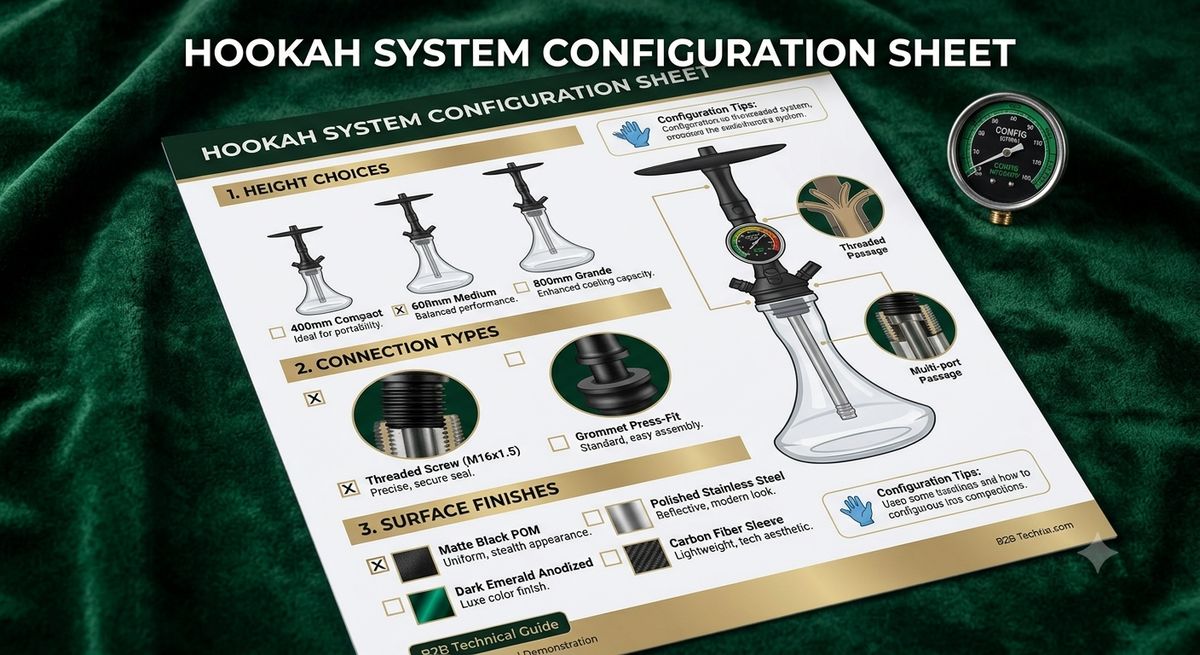
Specifications for the Purge Valve
The purge system should never be an afterthought.
Number of purge holes—determines the system’s efficacy based on draw resistance.
Bearing material—silicone, plastic, or metal. Metal in humid lounges dissolves.
Spring material—stainless steel.
Gasket type—replacing o-rings or flat seal.
Thread size—standardize across all units for easy replacing.
Grommet and Seal Kit
Grommets are little. They cause big problems.
Stem-to-base grommet—inner diameter, outer diameter, thickness.
Bowl grommet—inner diameter, outer diameter.
Port grommets—inner diameter, outer diameter.
Silicone is the material. Rubber hardens after 90 days.
Durometer—for compression seals, a range of 50 to 70 Shore A is optimal.
Order spare grommet kits with your bulk hookah order. Every kit includes one of each. These grommets are lightweight and will save you from downtime in the unfortunate event a seal cracks during service.
Materials and Finishing Specifications
Six months of daily use with the same equipment and the already visible effect of a service as the equipment ages will be a service to foster durability and will showcase how the equipment looks.
- Stainless steel grade – minimum grade 304, grade 316 for coastal lounge application with salt air exposure.
- – Surface treatment – choose between brushed, mirror polish finish, PVD coating, or powder coating finishes.
- – Minimum plating thickness – for coated stems, 5 microns.
- – Glass annealing (select one) – annealed or tempered glass. Tempered is more durable, but more difficult to repair.
- – Paint specification – lead free, food safe, and resistant to chipping.
- – Rust test – stainless steel parts must undergo a 48 hour salt spray test.
For something like the Narguilé Steamulation Pro X Premium, its a high-end commercial hookah which is built using 304 stainless steel and brushed finish. The finish is not decorative as it hides scratches and fingerprints.
Packing and Shipping Specifications
Your spec sheet continues to the product shipment.
- – Master Carton dimensions – must fit your pallet plan.
- – Individual packaging – each unit must be protected by a foam insert or bubble wrap.
- – Unit per carton – there must be fewer units per carton to decrease carton compression.
- – Carton weight – no more than 20 kg to reduce strain when lifting.
- – Labeling requirements – include SKU, quantity, and destination on individual cartons.
- – Palletization – must be standard 1200 x 1000 mm or custom.
This must be included in your specs. Don’t assume the supplier knows your requirements when it comes to freight. They deal with forty different customers, yours is not the default.
 How to Write Your Spec Sheet
 How to Write Your Spec Sheet
There are a few steps in order. First, you measure three units from your last order. Use digital calipers. then, write down the measurements for each dimension, and take the average.
Item 2: Fit Things Together
Fit the complete assembly. Check how well the bowl seats. Note if the base wobbles. Check if the hose port leaks. Document all observations.
Record specs in units you prefer. Millimeters? Centimeters? Grams? Liters? No use of fractions. No conversions to fed. units.
Add tolerances. Use ± 0.5 mm for nominal circles. Use ± 5 mm for nominal lengths. Suppliers need tolerances, but the tighter the tolerances, the better dimensional interchangeability.
Adopt a photograph one-part connection on the spec sheet. Connection traceability photographs are better than any explanation.
The supplier must approve your assembly to connect. Your assembly is a purchase order instruction sheet. Every spec dimension must be confirmed as law. If it is not law, there is no case.
Common Mistakes Bulk Buyers Make
Mistake 1: Giving only names of articles. No one is spec’d with a name. Two articles with the same name, the same model, two units, or two articles, can each be plus or minus 1 to 2 mm. You are required to list dimensions.
Mistake 2: Omitting grommets. Leaving grommets off your spec sheet means there’s a good chance that six weeks after assembly, you’ll be ordering grommets. Then, you’ll be waiting for another three weeks to figure out what assembly is required.
Mistake 3: Not Paying Attention to the Downstem. The downstem depth affects the way the hookah draws. If it is too deep the hookah draws becomes restricted. If it is too shallow the pull is weaker. Take care to make it just right.
Mistake 4: Assuming grade 304 is the minimum. Certain manufacturers will use 201 grade stainless in construction. It appears the same, but it will rust in 6 months. Have it written in the contract.
Mistake 5: Avoiding Tolerance Discussions. You get what you settle for. If you agree to have the diameter of the stem be +/– 2 mm, then you will receive stems with diameters that are 4 mm apart. This would render a grommet useless.