


- 1.Commercial invoice: The King of Documentation Types
- 2. Packing List – What’s In Each Box
- 3. Bill of Lading (Ocean) or Air Waybill (Air Freight)
- 4. Certificate of Origin
- 5.HS Code Declaration – Getting the Numbers Right
- 6. Insurance Certificate – Protecting Your Cargo
- 7. Other Types of Document You May Need
- 8.Your Documentation Workflow – Step by Step
- 9. Why You Should Let a Freight Forwarder Audit Your Documen
- 10. Final Checklist Download Before You Ship
First Import from China: Documentation Checklist for Hookah Products
The first container of hookah products from China is an exciting milestone. However, the first import process can feel overwhelming and stressful. The cost and consequences of making an error can be severe, such as data entry mistakes and missing documentation. Bringing your first container of hookah products from China does present unique challenges that the other products you import may not, such as the potential for your shipment to be seized if you fail to complete the paperwork correctly. This guide walks you through every piece of documentation necessity, the content of every piece of documentation, and the common mistakes first time applicants make. charcoal burners and tongs
This hookah import documentation checklist provides the different types of documentation you will need whether you are importing aluminum hookah stems, silicone hookah hosess, glass bases, phunnel hookah bowlss, coconut charcoal, HMDs, etc. hookah bases
Let’s go through the documentation, with the seven documentation types in order of importance.
1.Commercial invoice: The King of Documentation Types
The most important documentation type in your shipment is the Commercial Invoice. This is the most information-dense entry type that customs draw upon to assess duties and determine the transaction value and applicable regulations. An incomplete commercial invoice, and any other documentation, is a foregone customs hold.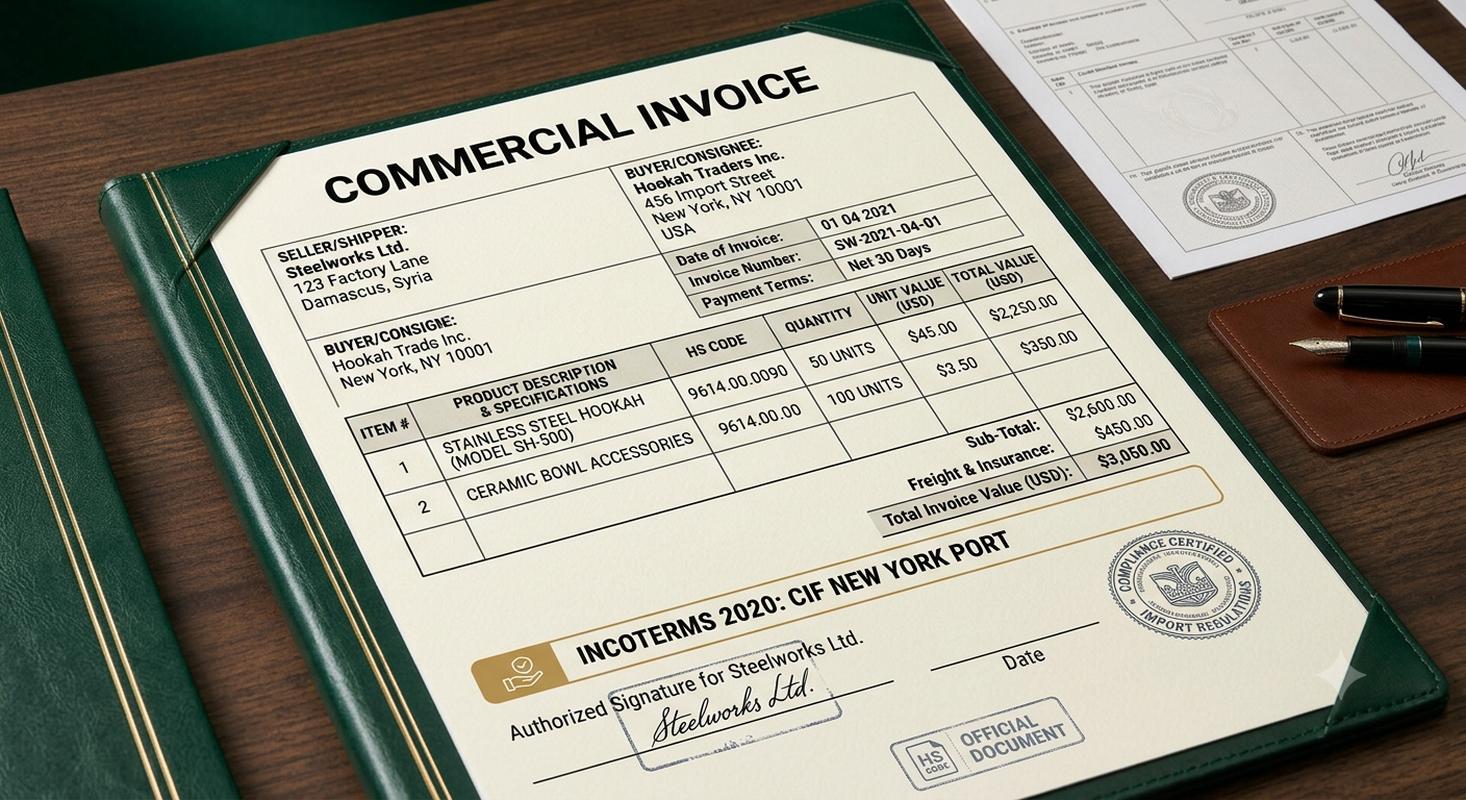
What Must Be on Your Invoice
- Seller & Buyer Information – The seller’s name and address (your supplier in China) and the buyer’s name and address (your name or your company’s name)
- Item Description – A detailed description of each item. Avoid general descriptions like “hookah parts.” Be specific, for instance: “Stainless steel hookah stem, 60 cm, model HS-60, polished finish.”
- HS Code – The 6 or 8-digit HS Code (Harmonized System Code) for every product line. This is mandatory. More information on HS codes is provided below.
- Unit Price – The unit price and the total for each line item in USD or the currency mutually agreed on.
- Total Value & Incoterms – The total value for the invoice, along with the incoterms defined (example: FOB Shenzhen, CIF Los Angeles), and the payment conditions.
- Origin & Port – The country of origin (in most cases, this would be China) and the port from which the merchandise will be loaded.
IMPORTANT. It is a common mistake for first-time importers to leave the HS Code out from the invoice, assuming that it will only be needed on the customs declaration form. This is wrong. Customs brokers from both China and the country you are importing to will compare the HS Codes on the invoice. If you do not provide one, it is likely your broker will be calling you in the middle of the night asking for codes while your container is still at the port.
A commercial invoice should also contain the shipper’s reference number, the customer’s order or PO number, and the invoice date. Make sure your invoice number is in order. Customs officials know when there are significant gaps.
2. Packing List – What’s In Each Box
A packing list informs customs and the freight forwarder what is inside each carton, crate, and pallet. It corresponds to the commercial invoice and assists the verifier in confirming the shipped goods against the invoice.
Mandatory Fields
- Net and Gross Weight — Net weight is the weight of the product alone, and gross weight is the combined weight of the product and the packaging. These weights of each carton must correspond with the weights stated in the bill of lading.
- Carton Dimensions — This is the length, width, and height of each carton, measured in centimeters. This is necessary for calculating the volumetric weight of the carton, which is particularly important for bulky items, such as a base for a hookah that is wrapped in foam.
- Quantity and Package Count – This is the total count of cartons and pallets, and the total count of items.
- Container and Seal Numbers – This includes the number of a container, if used, and the seal number.
For products like hookah, items that are breakable, such as the bases, bowls, and diffusers, must be clearly identified on the packing list to notify the freight forwarder that extra care must be taken while handling the packing list. Other importers state a special handling note or a “Fragile” sticker count.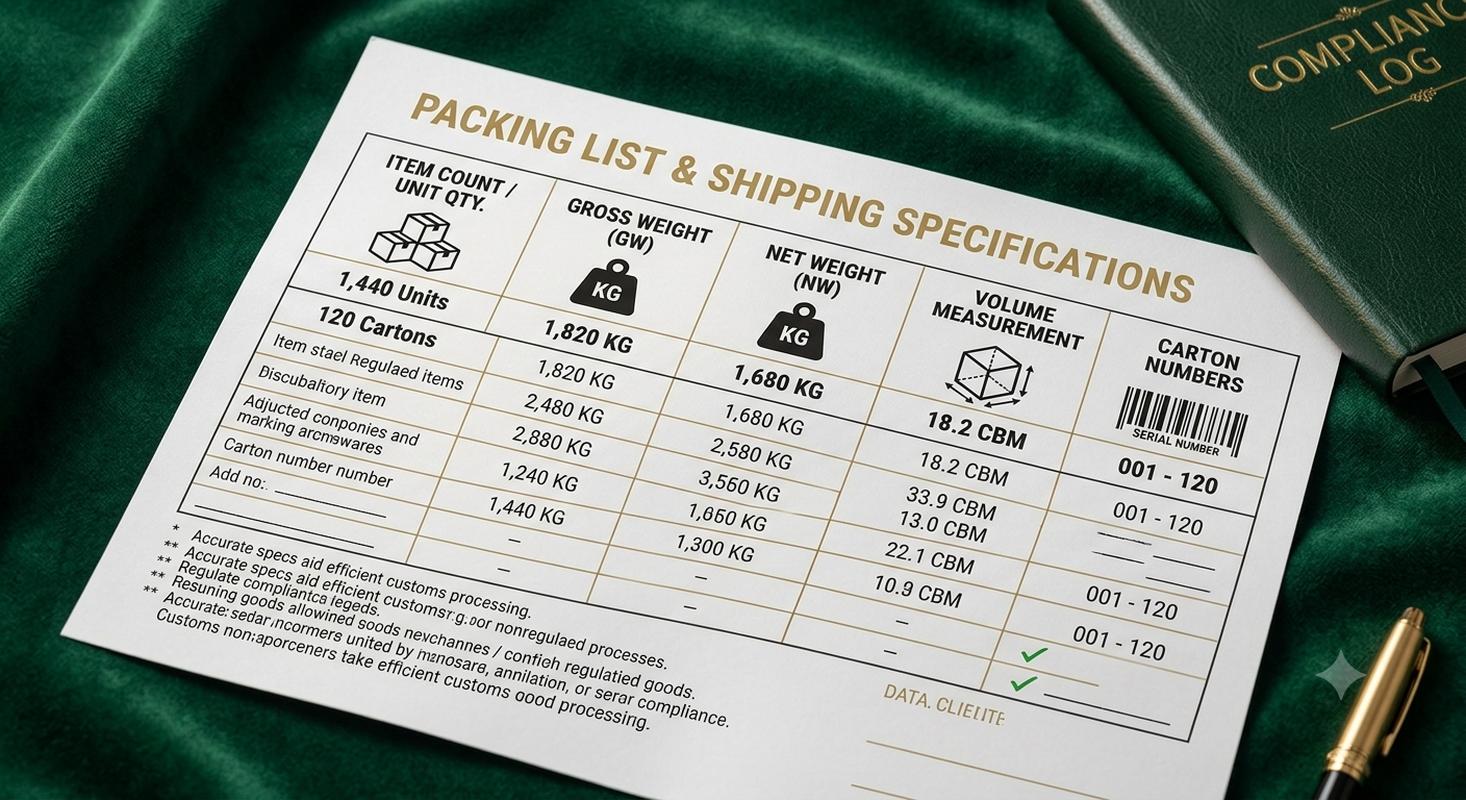
Common Mistakes in Packing Lists
- Only showing gross weight and omitting net weight
- Using inches instead of centimeters (causes freight miscalculations)
- Packing list total quantity does not match invoice total quantity (a customs red flag)
⚠ IMPORTANT: Agreeing on each number between the commercial invoice and the packing list is a must. If the invoice shows 200 hookah stems and the packing list shows 210, customs will hold the shipment for physical inspection — this costs time and arises demurrage fees.
3. Bill of Lading (Ocean) or Air Waybill (Air Freight)
The bill of lading serves as a contract for the carriage of the goods and provides possession of the goods to the owner. If you use sea freight, you will receive either an original bill of lading (a physical or electronic document, which must be surrendered to take possession of the cargo) or a telex release, which allows the cargo to be released electronically without the physical document.
Key Points for Hookah Importers
- Original Bill of Lading: The shipping line issues 3 original copies, and one of them must be sent to your customs broker or freight forwarder to clear the goods. Never lose an original B/L, as replacing one will be time consuming and expensive.
- Telex Release: A carrier releases cargo electronically, and the physical document does not need to be given. This is faster and more common for regular importers. Ask your supplier or freight forwarder if this is on your route.
Air Waybill: The AWB functions similarly to other types of waybills in that it serves to document the contract of carriage. However, it is non-negotiable and does not confer ownership of the goods, unlike other waybills. It is issued by an airline and travels with the cargo.
Bills of lading must reflect your business as it is registered with customs, and minor slips, e.g., “LLC” is not the same as “L.L.C”, can cause costly delays.
Always take telex release if your freight forwarder has that option. Shipping original bills of lading can take days, and should they get lost, it can take months and hundreds of dollars to get a new one (bond priced at 150% of the goods).
4. Certificate of Origin
The certificate of origin is used to prove the origin of your goods to the authorities and your hookah products that’s been manufactured in China. Depending on the destination country, a certificate of origin can help your shipment qualify for free trade agreements, and thus for lower duty or no duty at all.
When You Need It
- Most nations ask for a CO for commercial shipments valued at a particular threshold.
- If your destination has a free trade agreement with China (e.g., China-Australia FTA, China-Chile FTA), your import duties can be cleared with a CO.
- Certain product categories (e.g., wooden hookah stems) could require further origin documentation for CITES or phytosanitary compliance.
The Certificate of Origin (CO) is generally obtained from the China Chamber of International Commerce (CCOIC) or the China Council for the Promotion of International Trade (CCPIT). Your supplier should obtain this prior to departure. Most customs authorities accept a digital CO, but be sure to examine the relevant requirements in the destination country.
What to Check
- The exporter’s name on the CO matches your supplier’s name in the invoice.
- HK codes on the CO match those on the invoice and customs declaration.
- The CO has been issued and stamped prior to the vessel or flight departure.
5.HS Code Declaration – Getting the Numbers Right
The HS (Harmonized System) code is an international trading norm for designating product categories. Each hookah product category has its own specific code. An error in using an HS code will result in a significant cost to first-time importers.
Common HS Codes for Hookah Products
- 961400 : Smoking Pipes and Pipe Bowls (includes complete hookahs) — most frequently encountered in hookah equipment
- 732393: Stainless Steel Tableware (applies to some HMDs) as per design and principal use.
- 392690: Other articles of plastics (includes silicone hoses, mouth tips, grommets).
- 701399: Glassware for Table or Kitchen Use (includes glass hookah bowls and bases).
- 440210: Wood Charcoal (includes briquettes of coconut coals — please check your country for the specific sub-heading).
- 630710: Cleaning cloths and accessories (includes cleaning brushes for silicone hoses that are classified as a textile).
HS Codes are comprised of 6 digits, after which countries expand them (to 8 or 10 digits) to indicate the applicable duty rate (e.g., 9614.00.8010 for the US). For the correct 10-digit code for the considered country, you should consult your customs broker.
⚠ IMPORTANT: Providing inaccurate HS Codes to customs can cause you to pay too much to fulfill your trading obligations, too little while incurring a fine, and trigger an unwanted secondary inspection of your shipment. If you are in any doubt, you should consult your freight forwarder or customs broker to avoid delays and ship without unnecessary complications.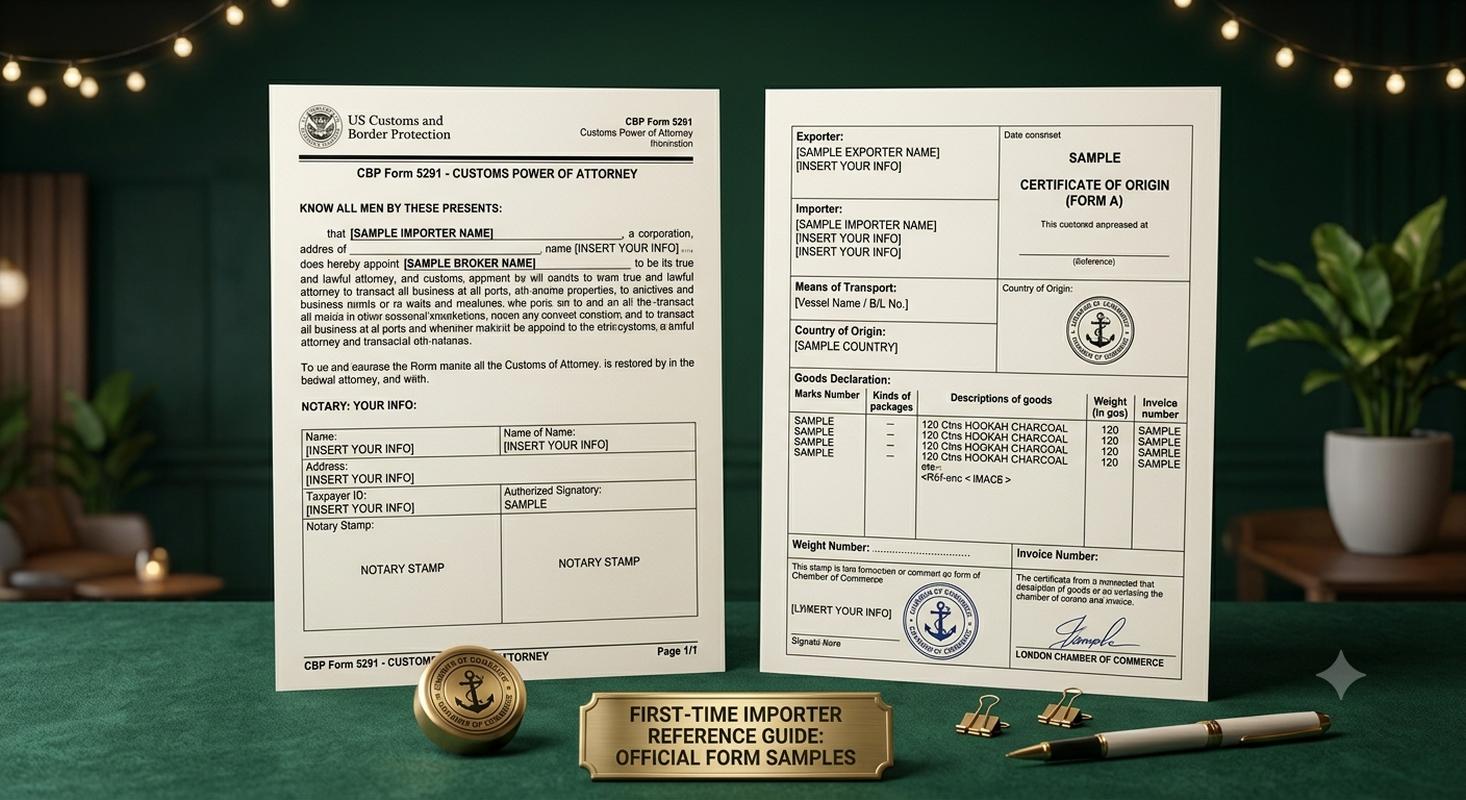
6. Insurance Certificate – Protecting Your Cargo
In many places, the law does not require marine cargo insurance. However, for first-time importers, the risk they may take by shipping hookah items without insurance is that a single hookah parts shipping container is worth almost $10,000 to $20,000. This condition can be due to a bad shipment, broken glass parts due to poor handling, or if the shipment is stolen at the port. Then the total loss is to the importer.
What Insurance Covers
n Total loss of the container (when the ship sinks, the container is lost at sea)
n Partial loss or damage (broken parts, water-damaged goods)
n Theft from the port or container yard
n General average contributions (if the ship jettisons the cargo to save the ship, you have to pay the cargo)
Most freight forwarders include cargo insurance with their shipping service. Cargo insurance costs only 0.3% to 0.5% of the commercial invoice value cargo. If your shipment’s total value is $15,000, then you pay $45 to $75 insurance premium, which is an excellent value given the risk of loss.
What To Check On The Certificate
Check:
- – The insured amount, typically 110% of CIF, which helps cover shipping expense.
- Coverage for “All Risks” rather than “Total Loss Only.” With hookah products, glass can be partially damaged.
- The details of the voyage (the name of the vessel, the date of the sailing, port to port)
- What is NOT covered (some policies exclude specific damages or fragile items)
7. Other Types of Document You May Need
Depending on which country you are shipping to, and which type of hookah product you are importing, you may also be required to acquire:
- Fumigation Certificate: This is required when a product is shipped on a wooden pallet or wooden crates. The wood must be heat treated and labeled with the IPPC logo, and have a Fumigation Certificate.
- FDA Prior Notice (USA): If your hookah products include items for consuming tobacco, the FDA may require certain forms be filed with them. Speak to your broker for clarification.
- CE Declaration (EU): Certain hookah products are required to have CE marking in order to be legally imported into the EU, which liaisons with CE certified products. Speak to your supplier for clarification.
- Product Testing Reports: Some countries require laboratory testing documents for items that interact with food or tobacco, such as bowls and stems that comply with EU Regulation 1935/2004 for food contact materials.
- Labeling Compliance: these are certificates that packaging and labeling of your good fulfill the target country requirements.
8.Your Documentation Workflow – Step by Step
If this is your first time importing hookah products, this is the order you need to keep your paperwork.
Step 1 — Before your production run, confirm your HS codes with your customs broker or freight forwarder. Get your supplier to provide the product descriptions in English with the exact phrasing you need them to use on the documents.
Step 2 — After the production run, engage your supplier to send you a draft commercial invoice and draft packing list. Review them thoroughly. Ensure all HS codes, unit prices, weights and measurements are correct.
Step 3 — One week before the shipment is scheduled to leave, instruct your supplier to request the Certificate of Origin. Ensure that the Certificate of Origin is stamped and signed before the vessel leaves.
Step 4 — The freight forwarder is going to send you the draft bill of lading 2-3 days before the vessel is scheduled to leave. Review the completed draft and ensure the shipper, consignee, notify party, container number, seal number, and piece count and gross weight and description of the goods are all correct. Ensure telex release is completed or make arrangement to courier the originals.
Step 5 — On the day the vessel is scheduled to leave, your freight forwarder will facilitate the provisions of cargo insurance. Ensure the insurance certificate is emailed without delay.
Step 6 — Send the customs broker the complete document package (invoice, packing list, B/L, CO, and insurance certificate) 3-5 business days before the vessel arrives at the destination port so they can prepare to pre-clear the shipment.
9. Why You Should Let a Freight Forwarder Audit Your Documents
The best advice for a first-time importer is to not do this part by yourself. China-importing freight forwarders will have seen every possible mistake. They will:
Check your HS code classifications before you ship/
Flag inconsistencies between your invoice and packing list/
Make sure your bill of lading is correct and not written poorly/
Remind you of country-specific requirements, including but not limited to, the FDA, CE, and labeling/
Arrange insurance and assist in filing claims when necessary/
Work to arrange your customs clearance/
If you’re importing hookah goods from China, your supplier most likely has freight forwarder recommendations, though you are not obligated to use them. Delays from customs are more expensive than freight forwarding costs.
10. Final Checklist – Download Before You Ship
Use this quick-reference checklist to ensure you have everything to ship your order. Print and hang this checklist:
- ☐ Commercial Invoice includes HS Codes, Unit Prices, Total Value, Incoterms
- ☐ Packing List includes Net Weight, Gross Weight, Carton Dimensions, Piece Count
- ☐ Bill of Lading or Air Waybill with exact consignee, telex release confirmed (if applicable)
- ☐ Certificate of Origin with HS codes matching the invoice issued prior to departure
- ☐ HS Codes confirmed with broker to the destination country
- ☐ Insurance Certificate — All Risks coverage, 110% of CIF value
- ☐ Fumigation Certificate if wooden pallets / crates
- ☐ Country-specific certifications (FDA, CE, labeling, testing reports)
- ☐ Full document package sent to customs broker 3-5 days prior to arrival
Congratulations on your first milestone! Your first import from China is a big step and an exciting experience, especially if you fill out and confirm the correct documentation as checking it more than once and having your freight forwarders review it can help you avoid most of the headaches that many first-time importers experience. Use this checklist for your hookah import documentation. Use your logistics partners so you can stay focused on growing your hookah lounge.
Do you have a supplier in China willing to help you with the documentation? Linkup Hookah knows the importance of correct documentation for every shipment, and we provide a complete commercial invoice, accurate packing lists, and HS-code-classified products. Contact us to start your first order.
Browse our complete hookah hardware catalog, from complete hookah sets to replacement parts, all with proper documentation to ship internationally. Linkup Hookah can get your business started today.