

If you operate a hookah sets lounge, chances are you’ve experienced this phenomenon: a customer orders a session, you set up their bowl, and 15 minutes after, they wave you over because the smoke is either thin or, even worse, tastes burnt. You check the bowl, and it is a phunnel. You count the coals. Three. You sigh.
There’s a huge impact on customer satisfaction with just a slight adjustment to the management of coals. The phunnel bowl and the killer bowl (also called a traditional Egyptian-style bowl) have different designs, different dynamics of airflow, and different requirements for management of heat.
This guide supplies the typical answer to the question of, ‘how many coals do I need?’ Whether you are new staff training, creating uniform procedures for the lounge, or just looking for consistent results for the duration of your shift, these ideas will be of value and prevent customer complaints.
Two Bowl Designs
Before we delve into coal counts, we must understand the purpose behind the design of the bowl. The design of the bowl dictates the manner in which heat is absorbed and dispersed through the bowl. This creates a need for a specific number of coals, as well as determines the placement of the coals.
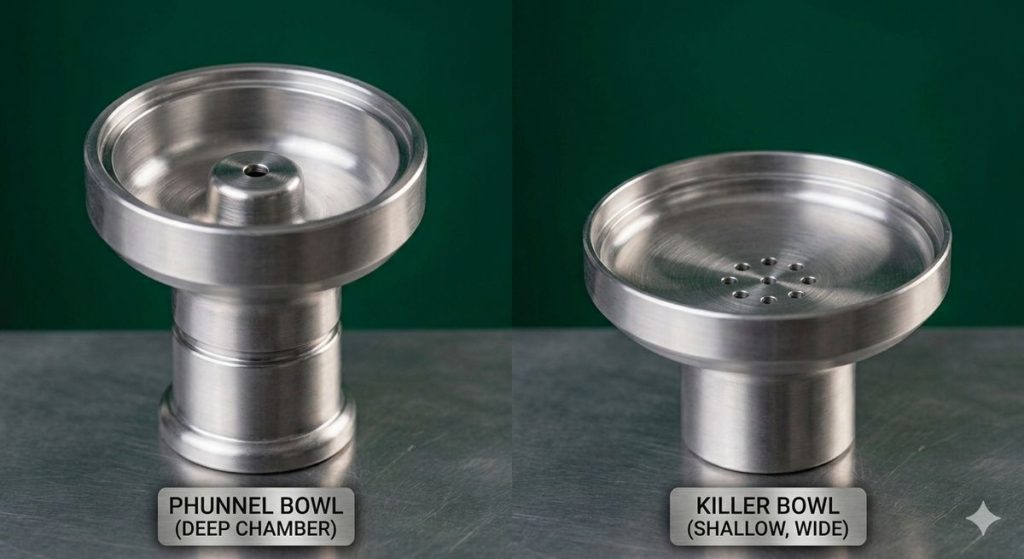
The Phunnel Bowl
The Phunnel bowl is designed with a central spire. The tobacco is placed around the spire and smoke travels down the tobacco, into the spire, and out of the bowl and into the hookah. The design is unique in that the hole is situated at the hookah bases of the spire and not at the base of the bowl. This means:
- – The extremely viscous tobacco (such as moassel) will not travel down the hookah and will remain in the bowl.
- – The heat will disperse through the tobacco, since the air will be forced through the tobacco.
- – The uniform design of the spire will ensure that the tobacco will be heated uniformly.
Phunnel designs have become popular and the standard for bowl designs. Oblako, Stone, and Alpaca have popularized high-quality phunnel designs, and Linkup Hookah carries the Oblako Phunnel Bowl Head which is a favorite due to its consistent performance and the durability of its materials.
 Traditional Egyptian Killer Bowl
 Traditional Egyptian Killer Bowl
The traditional Egyptian killer bowl design differs from other bowl designs by having a spire-less design and multiple holes at the bottom. The tobacco is placed directly above these holes. Leading features:
- – Spillage occurs. The molasses can leak along the stem and will mess the setup but will keep the tobacco from becoming oversaturated.
- – More unrestricted airflow. The multiple open holes create less draw resistance.
- – Impact of coal to the tobacco is more direct. Without a spire in the middle, the coal is placed directly on the tobacco.
Though the killer bowl design is considered an old style of bowl, it is still widely accepted in lounges for certain tobacco.
The One Variable
The one most important thing that needs to be considered is how the bowl’s surface area and how it will affect heat transfer.
To explain simply: coal = heat. When heat moves it will spread along the bowl and the tobacco it is touching. The shallower and wider the bowl, the less coal is needed. The deeper and narrower the bowl, the greater amount of coal is required to reach the tobacco.
Phunnel Bowl Surface Area
 Phunnel Bowl Surface Area
A phunnel bowl has a large rim diameter of 60 to 80 mm, while the bowl itself has the tobacco packed surrounding a central spire. The working heating area is the top layer of the ring of tobacco. The tobacco packed inside can stretch 15 mm to 25 mm deep, meaning that a lot of tobacco is between the heat source and the layer of tobacco that is being heated.
Killer Bowl Surface Area
A killer bowl is generally shallower. The tobacco sits in a flatter bed above the holes. The heating area is the top of the surface, and the depth is less from the surface to the holes at 10 to 18 mm.
Coal Guidance by Bowl Type
Phunnel Bowl: The Standard Procedure
For a standard-sized phunnel bowl with a capacity of 15 to 20 g of tobacco, use the following:
- – With two coals, place one at 12 o’clock and the other at 6 o’clock (or at 3 o’clock and 9 o’clock) to provide even heating to the ring.
- – With three coals, place them in a triangle formation, offset. Do not place a coal directly above the spire, as this is a waste of a coal.
Killer Bowl: The Standard Procedure
For a standard-sized killer bowl with a capacity of 12 to 18 g tobacco:
With two coals, place the coals on opposite edges of the bowl. Since the holes are spread across the entire bottom of the bowl, the aim is to have as much surface area as heated as possible.
Three-coal setup: Arrange coals in a triangle with outer edges towards the sides. The center of a killer bowl gets the hottest because it is closest to the holes.
Those Other Things
Still, even with these guides, no two sessions will ever truly be the same. Here are the things that will make you want to change your coal count, some of which will skew your coal count by one or more:
Coal Size
The guides tend to assume a 25 mm cube in your coal count. If you are using 22 mm cubes, add 1 coal. Using 26 mm, take away 1 coal. Flat coconut coins have less total heat energy. In this case, the cube count should be used, and 1 coal should be added.
The Surrounding Temperature
Added heat (AC) in the summer or cold in the winter: add 1 coal. Or, for a cold, put in 1 extra coal to pre-warm the bowl, and then take it out after 5 minutes. Decreased heat: take away 1 coal or start with the minimum.
Moisture Content
Wet or juicy tobacco requires more heat to vaporize the extra liquid, so start with the higher half of the range. Essentially the opposite is true for dry tobacco.
Packing Density
fluff pack technique (light and airy): Less tobacco means more air. So coals burn hotter coals. Use fewer coals. Semi-dense: use the standard recommendation. dense pack technique: use more coals, as the tobacco mass will absorb heat.
Smoking Style
With relaxed slower puffs, less air gets drawn through the coals, causing the bowl to cool, and an extra coal might be needed. Quick puffs cause an aggressive airflow, pulling more heat through the tobacco and making the bowl run hotter, meaning a coal probably needs to be removed 10 minutes into the session.
Heat Management Troubleshooting
Problem: Too Harsh / Burnt Taste
Problem: Too Weak / Thin Smoke
Problem: Session Dies Too Quickly
Advanced Tips for Lounge Staff
Pre-Heating the Bowl
Pre-heating Phunnel bowls helps a lot. To pre-heat, set a coal to the bowl 2-3 minutes before your customer starts the session, and take it off. This helps the bowl reach the coal’s optimal temperature, making the first few puffs better. The Ps of the pre-heat coal is to take it off so you do not overshoot. For Killer bowls, pre-heating is not needed, but a quick 60-second pre-heat can be done.
Bowl Rotation in Lounges
 Bowl Rotation in Lounges
For a high-volume lounge with multiple bowls in rotation, set your coal to every staff member. The tray should be set with the following counts:
Phunnel + blonde leaf: 2 coals, opposite placement
Phunnel + dark leaf: 3 coals (triangular placement), then go to 2 coals after 10 minutes
Killer + blonde leaf: 2 coals, edge placement
Killer + dark leaf: 2 coals, edge placement, and monitor closely.
Adjusting for Customer Preferences
Keep an eye on your customer’s smoking behavior for the first five minutes. If he/she takes longer and slower draws, count coals as normal. If he/she takes fast puffs, proactively remove one coal after 10 minutes. They won’t notice the removed coal because the session would have ended harshly.
Wind Covers
Using a wind cover tends to make the coals burn 20–30% hotter due to trapped heat. How do they fit into standard operating procedures?
- – The phunnel: the first five minutes of a phunnel is a fun time to use a wind cover to help the bowl get fully heated. You can go ahead and take the cover off once the bowl reaches the desired temperature.
- – A cold, drafty area: in this area, a wind cover can help stabilize the coals.
- – When the density of the smoke is low and you have a full coal count: before you add coals, try a wind cover.
Final Thoughts
So how many coals do you really need? The unsatisfying truth is it depends. It depends on the bowl you’re using, the type of tobacco, and the environment you’re in. These specifics will also depend on your customer. The information in this article will get you started in the majority of the common scenarios.
The most important concept to remember is phunnel bowls accumulate heat. They are slow and require patience. In contrast, Killer bowls are fast and heat conductive. They too require and are rewarded with patience.
Become familiar with both and have the ability to work any hookah setup in your lounge. You will be able to determine upon viewing the bowl whether the session needs an additional coal or if one needs to be removed. This knowledge and ability is what makes the best hookah lounge staff from the rest.
The best staff will also have the knowledge and tools to manage the heat appropriately. Staff that have high quality bowls, HMD’s, charcoal burners, and foil will have the knowledge and ability to make every session enjoyable.