

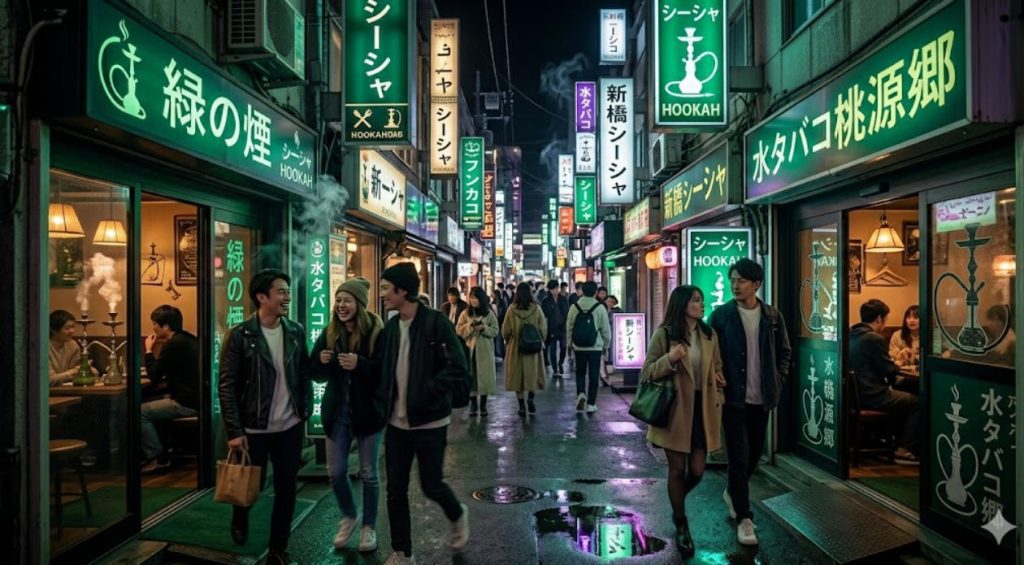
In the late-night districts of Shibuya and the Dotonbori in Osaka, the streets are dotted with warm lights from loungewear offering up a glass storefront and exposed hookah sets lounge sets. Frequently seen packed are groups of students and young dedicated professionals lined with glass and beautiful warm lights from hookahs. A culturally quiet movement that has taken place in Japan perceives hookah smoking from a basic curiosity, and transforms it into a social mainstream choice, all in the span of a decade.
Japan has never been associated with a hookah lifestyle. Japan is home to some of the world’s most dedicated tea ceremony traditions, dedicated izakaya public culture, severe restrictions on tobacco and shisha nicotine content. However, hookah lounges have accomplished some of the most rapid growth across other cities in Japan. It is said that there is a minimum of 400 registered hookah lounges in Tokyo alone. Beyond this, Japan is said to have 2,000 lounges nationwide.
The emerging market reflects the early phases of growth in the shisha industry. Japanese lounge owners have a sophisticated taste when it comes to selecting quality lounge equipment and are highly reliant on imported products. Linkup Hookah, alongside several other Chinese manufacturing and wholesale companies, fit the market’s demand perfectly.
This paper looks into the shisha lounges in Japan to analyze the possible openings for Chinese B2B suppliers in the Japanese market. It covers the phenomenon that has come to be the hottest thing in Japan’s social smoking.
Chapter 1: Why Japan? The Forces Behind the Boom
It’s a fact that there are shisha lounges in Japan and this is due to many structural and cultural factors that came together in the mid 2010s and led to diverse smoking experiences.
Regulatory Tailwinds
Japanese laws regarding smoking are quite strict. The Health Promotion Act, which was made stricter before the Tokyo 2020 summer olympics, expanded the already existing bans on all indoor smoking for most restaurants, bars, and public spaces. Traditional cigarette smokers now face the unappealing options of being funneled into the packed and cramped smoking booths lining the streets.
Shisha lounges are in a different legal category. Mostly due to the fact that shisha tobacco is not classified the same way as regular cigarettes are, and other lounges install pollution and air control systems, shisha lounges have the opportunity to operate legally as other restricted establishments that are otherwise forbidden for a regular bar or restaurant to operate. The law essentially gives shisha lounges a unique position regarding the indoor social smoking activities of the public.
“Cultural Shift Towards More Relaxed Social Spaces”
Japan is known to have a demanding work environment. Long hours and strict hierarchies combined with the social obligation of participating in nomikai (after work drinking gatherings) has many working professionals looking for less demanding work breaks. The shisha lounge provides a solution, as it has an environment that is relaxed and pressure-free and invites conversation, as it centers on the experience of the conversation rather than on how much one has to drink.
Japan’s omotenashi hospitality culture fits perfectly with the shisha lounge as the process and ritual of hookah preparation, hookah coals management, and hookah hoses passing are all in alignment with the Japanese sense of craftsmanship, precision, and the importance of shared experience. The majority of lounge owners have made it known that they promote their businesses as quieter and relaxed alternatives to izakaya and karaoke; places to visit and relax in the absence of a hangover.
“Attention to Detail”
Shisha lounges in Tokyo are not the dingy, stuffy rooms to sit in if they even exist in name as a lounge. Sick of the aforementioned lounges, Japan’s liberal spending has led to the shisha lounge being a highly prized establishment that has the means for an extensive build-out literally. Think Lars Von Trier pointing to the millions of Yens spent on optimally minimalist, customized lounges, lighting, sound, and art. This level of esteem also applies to the lounges hookahs.
Steamulation, Moze, Aeon, and Union, and a Japanese line of hookahs called Japona Satori, all fall under the category of premium and design-oriented. For Japan, design standards include the ugly duckling next to these guys; an ode to value engineering. Yes, they are expensive with prices ranging from $800-$200, but the quality and a hookah as part of the visual experience of one’s lounge, are guaranteed.
B2B Insight: Japanese buyers prefer 304 stainless steel over aluminum and brass construction. They prefer modular designs that are easy to clean and maintain. Their aesthetic preference runs to matte surfaces, gunmetal, and minimalist designs. This will guide your product selection when sourcing for the Japanese market.
Chapter 2: Market Profile – Size, Growth and Structure
It is difficult to quantify the Japanese market for shisha precisely because the industry is still largely unregulated. Many lounges operate as “members-only” clubs or café-shisha hybrids that do not appear in standard hospitality databases. Still, the available data show rapid expansion.
Growth Trajectory
Since 2016, the number of shisha lounges in Japan has increased significantly (20-25% CAGR). The COVID-19 pandemic caused a temporary decline for 2020-2021, but the market had a strong rebound and continued to grow during 2022-2024. Several innovations that were implemented during the pandemic — outdoor terrace seating, take-home hookah sets, and digital ordering — became permanent business model innovations.
Major Markets
Tokyo is still the major market, with Shinjuku, Shibuya, Roppongi and Ueno districts each with dozens of lounges. Osaka’s Namba and Umeda districts, Kyoto’s Kawaramachi, and Nagoya’s Sakae district are also major markets. The trend beyond larger markets has seen new lounge openings in Fukuoka, Sapporo, Kobe and Yokohama.
Pricing and Positioning
The cost of a session in a Japanese shisha lounge ranges from ¥1,500 to ¥3,500 (approx. $10–$25 USD) for a single-flavor bowl. Various price options are available for premium, house-blend as well as single flavor bowl varietals starting at ¥4,000 and ending at ¥6,000 (about $28–$42 USD). Most lounges use a price structure called time-based pricing, where a user can consume unlimited shisha for a specific duration of 60 to 90 minutes, as is the common consumer preference in Japan for a fixed-price bundle.
Introducing a cover fee or table charge from ¥500 to ¥1,000 (approx. $3.50–$7 USD) per person, is a common practice in the Japanese hospitality business that ensures a guaranteed minimum revenue. Adding a shisha to a table fee comes at a price from ¥500 to ¥800, and usually contains either a soft drink, tea or a mocktail.
To enhance the lounge’s revenue, most of the lounges practice a hybrid style of business, operating like a café during the day and offering drinks like coffee, matcha and light food. When day time revenue practices are exhausted and operating like a lounge during the night, the financial risk of the business decreases.
Chapter 3: The Japanese Consumer — What They Want and How They Choose
The Japanese consumer is arguably the most intimidating and hardest to penetrate market, but understanding how the Japanese consumer chooses to spend their money is critical, for any business, to be able to maximize their opportunities in the B2B variant of the competitive market that is Japanese lounge ownership. Buying on behalf of others means the owner and future lessee must understand all aspects of the Japanese market.
Quality Over Price
Many Japanese business owners consider quality to be the most important part of their purchasing decisions. For example, Japanese lounge owners will buy a more expensive product if the materials and finishes are of higher quality. Although this example may seem as if they are favoring the brand, it is actually a more logical way to conduct business; low-quality tools will break often and produce complaints. This will cost more in replacements and lost business.
For B2B suppliers, considering the Japanese market costs more to compete on quality and reliability, and after-sales service. Pricing of products/services should be at a fair level, but not a rock-bottom level.
Aesthetic Harmony
Japanese customers typically notice visual inconsistencies. This means if a lounge is using a premium Steamulation hookah with a cheap mismatching silicone hose, mouthpieces, and burner, it will still be viewed negatively, even if the experience of smoking is good.
Products that come in a cohesive set have a distinct advantage in the market. For example, Linkup Hookah provides resin mouthpieces, stainless steel tongs, and electric charcoal burners. Each of these products contributes to a lounge that is visually appealing in its entirety and provides a complete set of products that are coordinated.
Novelty and Rotation
Japanese customers, and especially the younger demographic that uses shisha lounges, appreciate novelty. It is common to rapidly change flavors, and even the products themselves. Temporary, limited-edition collaborations draw a lot of attention. Seasonal menus that change with the cherry blossoms, summer festivals, and winter holidays are expected at this point.
For B2B buyers, this means that a tobacco catalog that includes variety and frequent updates is of high market value. Suppliers who provide a full range of high-quality tobacco brands, including MustHave, Element, Darkside, Blackburn, Adalya, and assist lounge owners in planning their flavor rotations, create a better value proposition than suppliers who offer tobacco products.
Chapter 4: Sourcing Dynamics – The Procurement Practices of Japanese Lounges
Compared to owners of lounges in Europe, the Middle East, and the Americas, the procurement behavior of Japanese lounge owners is unique. It is essential to appreciate this uniqueness for the purpose of advancing B2B commerce in this space.
Buying with and without Intermediaries
For the Japanese lounge owners, the limited ability of many of their counterparts to speak and/or understand the English language creates a sizable demand for bilingual trading firms, as well as agents, to conduct negotiations for them and assure quality and arrange the logistics to their lounges. For many of the Chinese suppliers, the preferred way in which to conduct business is to engage an intermediary within Japan who is fluent in their native language to conduct business on their behalf.
An increasing number of younger lounge owners, however, especially those who have ventured abroad or have engaged in the hospitality sector and consequently have acquired basic English skills, are more than willing to purchase from international suppliers.
MOQ SMF Sensitivity
Japanese businesses often prefer to start with smaller, initial orders. Smaller initial orders are common for accessory sets or initial orders of 5–10 hookahs. They do not typically place orders that number into the container. Unlike Middle Eastern or European buyers, Japanese buyers work with suppliers on a more methodical basis. They take the time to validate their suppliers via initial orders. It is important to note that this is not an indication of their level of interest. Japanese buyers tend to place larger orders over time as they have developed a sufficient level of confidence in a supplier.
Logistics and Compliance
Japan has strict compliance regulations associated with imports and products that contact food and/or tobacco. Hookahs, hoses, mouthpieces and bowls are considered food products and are subject to the Japanese Food Sanitation Act. The Ministry of Health, Labour and Welfare has a higher level of control over tobacco. Food grade stainless steel, BPA-free silicone, lead-free glass and appropriate labeling are key compliance elements. Japanese buyers tend to have an edge over other markets as they have access to a multitude of suppliers.
Chapter 4: Sourcing Dynamics – The Procurement Practices of Japanese Lounges
Compared to owners of lounges in Europe, the Middle East, and the Americas, the procurement behavior of Japanese lounge owners is unique. It is essential to appreciate this uniqueness for the purpose of advancing B2B commerce in this space.
Buying with and without Intermediaries
For the Japanese lounge owners, the limited ability of many of their counterparts to speak and/or understand the English language creates a sizable demand for bilingual trading firms, as well as agents, to conduct negotiations for them and assure quality and arrange the logistics to their lounges. For many of the Chinese suppliers, the preferred way in which to conduct business is to engage an intermediary within Japan who is fluent in their native language to conduct business on their behalf.
An increasing number of younger lounge owners, however, especially those who have ventured abroad or have engaged in the hospitality sector and consequently have acquired basic English skills, are more than willing to purchase from international suppliers.
MOQ SMF Sensitivity
Japanese businesses often prefer to start with smaller, initial orders. Smaller initial orders are common for accessory sets or initial orders of 5–10 hookahs. They do not typically place orders that number into the container. Unlike Middle Eastern or European buyers, Japanese buyers work with suppliers on a more methodical basis. They take the time to validate their suppliers via initial orders. It is important to note that this is not an indication of their level of interest. Japanese buyers tend to place larger orders over time as they have developed a sufficient level of confidence in a supplier.
Logistics and Compliance
Japan has strict compliance regulations associated with imports and products that contact food and/or tobacco. Hookahs, hoses, mouthpieces and bowls are considered food products and are subject to the Japanese Food Sanitation Act. The Ministry of Health, Labour and Welfare has a higher level of control over tobacco. Food grade stainless steel, BPA-free silicone, lead-free glass and appropriate labeling are key compliance elements. Japanese buyers tend to have an edge over other markets as they have access to a multitude of suppliers.