

Lukas thought he’d have his work cut out for him getting his first shisha lounge in Munich situated under accurate tangible attributes making up a commercial sale and convincing a property owner /refusing to become an unwilling business partner by doing a shoddy job negotiating a contract he would bother to sign. He thought there must be something else that tests a budding entrepreneur. Then, the Trade Regulations Office flagged his request for an inspection due to the absence of a compliance report for the ventilation system. He was losing 3 months of rent on his deposit because of his haste to open, and would have to schedule an expensive opening-day budget to fully train his staff.
Things work easier 800 km to the west in Amsterdam, and things have a tendency to get better. Her lounge passed every inspection reliably and she had the business acumen to see things through to the lucrative first 6 months of operation. During that time, however, the Dutch NVWA, the Food and Consumer Product Safety Authority, reviewed a standing order on arranged tobacco laws and decided that every shisha tobacco product would now fall under a display ban. Overnight, she had no choice but to remove every red cup.
Lukas and Sofia know a painful truth about all shisha lounges in Europe — that working within multiple markets comes hand in hand with operating multiple regulatory frameworks. At a minimum, you will be working with the European Union’s Tobacco Products Directive (TPD). However, individual member states go beyond the TPD’s minimum requirements, and the interpretation and enforcement of the TPD will differ, leaving you with unique challenges. Certain countries will have specific lounge licensing requirements that may not apply to other countries, and some will ban certain flavors, impose restrictions on nicotine levels, and/or institute age limitations that do affect menu marketing.
If you are looking to start or grow your shisha lounge business in the European Union, knowing these regulations is essential. There will be a stark difference between a successful lounge and one that suffers from the regulatory burden of being forced to close before it even open
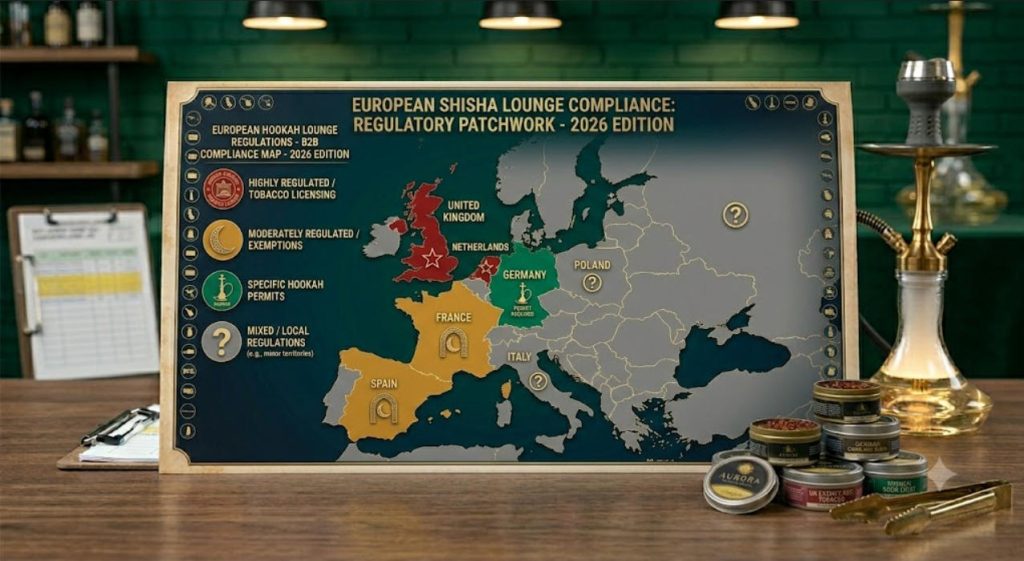
This guide will cover the major shisha markets in Europe, including Germany, France, the Netherlands, Belgium, Poland, and the UK, and will provide a general overview of the regulations that govern each. You will also know the minimum requirements for the TPD, the licensing of a lounge, and what specific regulations are required for each country.
The TPD Framework: What Every Lounge Owner Needs to Know
The Tobacco Products Directive (TPD) — or Directive 2014/40/EU — is the cornerstone of tobacco regulation in the European Union. The TPD was passed in 2014 and implemented in all EU Member States in 2016. It was created to standardize tobacco rules for the European market. Concerning shisha lounges, three parts of the directive are critical.
Product Classification
Under the TPD, shisha tobacco is categorized as a ‘tobacco product for smoking.’ This classification brings about several obligations. Firstly, shisha tobacco should be sold in the EU, and if so, the EU demands complete compliance with the ingredient reporting. This demands complete ingredient lists for all variants to be reported to the European Commission by the manufacturers and importers. Secondly, all products must be sold with health warnings which are to cover 65% of the front and back of the packaging, as well as graphic depictions. Lastly, the directive bans characterizing flavors in cigarettes, although, in the EU, it makes an exception for shisha tobacco, meaning that shisha tobacco may continue to be sold with fruit and dessert flavors.
Limits on Tar and Nicotine Content
The TPD has tough limitations on tar, nicotine, and carbon monoxide levels. Smoke shisha tobacco can’t have nicotine levels higher than 1 milligram per gram of tobacco, and tar and carbon monoxide levels can’t be more than 10 milligrams per gram. These restrictions determine what products you can offer at your lounge. Some of the best dark leaf packing tobaccos may be above these restrictions, which is why the Darkside Series (https://www.linkuphookah.com/product/premium-darkside-series-bulk-dark-leaf-shisha-tobacco-for-industry-leading-lounges/) has such a rich profile, especially for commercial lounges that care about satisfying customers. (P.S. Darkside Series is fairly priced too).
Labeling and Packaging
Per Article 12 of the TPD, shisha tobacco unit packets must weigh between 40 and 500 grams. This may be difficult for lounge owners buying in bulk. This is because you can’t split bulk tobacco into smaller containers for individual sale unless you comply with the full labeling requirements. Many lounges have worked around this by selling prepared hookah bowlss instead of tobacco, but the rule still constrains your supplier’s packaging for wholesale orders.
Country-by-Country: The Major European Markets Compared
Even though the TPD does set a baseline, complexities exist at the national level. Here are differences in the major shisha markets.

Germany — Benchmark
Germany has one of the most extensive regulatory frameworks for shisha lounges in Europe. The key regulations comprise the following:
- – Non-smoker protection laws (Nichtraucherschutzgesetze): These laws differ per Bundesland (federal state). Bavaria has some of the most stringent laws, with smoking rooms needing to be fully enclosed, and having separate ventilation. As for Berlin, the regulations are more relaxed, with smoking allowed in bars, provided that they do not serve food.
- – Youth protection: Nationwide, the legal age for the purchase and consumption of shisha tobacco is set at 18. Stricter enforcement of the laws has led to harsher punishments of selling to minors, with the penalties starting at €1,000 and increasing to losing the license to operate.
- – Ventilation requirements: All lounges are required to follow DIN 1946-4 (German standard for ventilation of enclosed smoking areas), which typically means that a mechanical ventilation system is needed to replace the air in the smoking room 10 to 12 times an hour.
- – Trade license (Gewerbeanmeldung): This is a prerequisite for the opening of the business. There is a need to visit the local trade office, and then there is a need to get the Public Order Office (Ordnungsamt) to conduct an inspection of the premises before they will then authorize the license.
Germany serves as the benchmark, as the implementation of the legal framework is comprehensive, documented, and done seamlessly. If you are able to open a compliant lounge in either Munich or Berlin, then you can open a compliant lounge anywhere in Europe.
France – The Flavor Ban Debate
Over the years, France has occupied the top ranks as Europe’s largest shisha market, but the compelling changes in regulation lately may prove difficult.
In February 2022, the French government announced plans to completely abolish flavorings in all tobacco heating products. Shisha tobacco products remain unaffected. However, French regulators increasingly have their eyes on flavored shisha, as it has been indicated that such products may target the youth.
French lounges are currently obligated to adhere to the Évin Law (Loi Évin), which is a law that banned advertisements related to tobacco products, along with very stringent regulations on the legality of smoking in a certain location, including:
- – License de débit de tabac: a highly limited state-controlled license that allows the sale of tobacco. Only licensed bars may sell tobacco (including shisha), and selling shisha in bars and lounges that do not have such a license is prohibited.
- – Smoking room permits: Smoking rooms are only allowable if the room is 20 square meters or smaller, has an automatic closure, and a separate ventilation system.
- – Proof of age: Bars and lounges may only allow patrons who are 18 years or older.
The Netherlands – Display Bans and Stringent Enforcement
As of 2020, the NVWA has imposed one of Europe’s most stringent shisha market regulations, which include a display ban on all tobacco products, inclusive of shisha tobacco. This translates to:
- – When serving a customer, products are only to be taken out of a closed cabinet to avoid open display.
- – The absence of advertising specific Tobacco brands or flavors is to be ensured while formulating the menu.
The smoking ban as applied to hospitality venues, which should, in theory, exempt shisha lounges, has been accepted more widely. To qualify for this exemption, lounges must demonstrate that they are not a restaurant or a bar serving food and are, in fact, “primarily” a smoking venue.
Licensing: There is no “shisha lounge license” in the Netherlands. However, a hospitality license (Drank- en Horecavergunning) is required, which can only be obtained if one provides a hygiene certificate, proof of social hygiene, an absence of convictions for the owner of the business, and proof of cleanliness.
Belgium — The Phased Approach
Belgium has taken a phased shisha approach to regulation. In 2020, the sale of tobacco in supermarkets and at gas stations was banned. In 2023, the ban on disposable e-cigarettes was enacted. The trajectory is clear for shisha regulations in the coming years.
Applicable Belgian regulations for shisha lounges:
- – Municipal license (Exploitatievergunning): Often mandatory in most municipalities. The route involves a police check, an inspection of the premises, and the imposition of fire safety measures.
- – Rookruimte permits: Smoking rooms must be separated from non-smoking areas, and kept in structural separation, must have a negative air pressure differential with respect to the surrounding space, and have self-closing doors.
- – NO tobacco advertising: Belgium is quite strict in the enforcement of the ban, imposed on a Union-wide basis, of tobacco advertising. It’s illegal to advertise shisha tobacco on your online space, be it a website, your social media, or in your offline space with shisha tobacco signage.
Poland — The Fast-Growing but Ambiguous Market
For the past five years, shisha has rapidly become part of the culture in Poland, and the regulations have yet to develop. This creates new opportunities, but also creates a risk.
No shisha lounge licensing: Poland does not have a set licensing category for shisha lounges. Most run as a “gastronomic establishment” serving food and beverages, where shisha is an ancillary service.
TPD compliance: Poland has incorporated the TPD into its own laws, therefore product-level rules exist. However, the enforcement of the requirements to report and label the ingredients is erratic.
Minimum legal age: 18 years. This is enforced through random inspections conducted by the Sanitary Inspectorate (Sanepid).
Smoking areas in Poland are required to have mechanical ventilation systems. However, the laws do not provide as much detail about the ventilation system, compared to the systems in Germany and France.
It is advisable to use a conservative compliance approach, and voluntarily adhere to the German or French standards. This will provide a buffer when Poland’s laws become more stringent.

United Kingdom – the divergence after Brexit
After its exit from the EU in 2020, the focus and control of its own Tobacco and Related Products Regulations (TRPR) 2016 (amended) governs the rules of shisha tobacco for the UK. The important aspects are as follows:
No flavor ban: The UK is one of the most liberal jurisdictions in relation to restricting characterizing flavors in shisha tobacco.
Licensing: There is no specific license in the UK for shisha lounges. However, shisha lounges that sell tobacco need to have a standard tobacco retail license, which is issued by the local council. It usually costs between £100 to £350 each year.
- – Smoking Ban: The Health Act 2006 prevents smoking in all public and enclosed areas. Shisha lounges can allow smoking within these provisions if they meet the criteria of a ‘smoking room’ which is completely sealed, has no air ventilation that can transfer air to non-smoking areas, and is exclusively used for smoking.
- – Age of Sale: The age of sale is set at 18 years and must be followed strictly. It is suggested that a Challenge 25 policy be put in place.


Licensing Requirements: A Practical Comparison
To assist you with your analysis of the various markets, the following section collates what is required from you in each country.
| Requirement | Germany | France | Netherlands | Belgium | Poland | UK |
| National tobacco license | Yes (Gewerbeanmeldung) | Yes (Licence de débit) | No | No | No | Yes (council license) |
| Specific lounge permit | Varies by state | Yes (smoking room) | Municipal license | Yes (Exploitatieverg.) | No | Smoking room exemption |
| Ventilation standard | DIN 1946-4 | ≥10x/hour | Building code | Building code | Building code | Building regs |
| Display ban | No | No | Yes | No | No | No |
| Flavor restrictions | None planned | Under review | None | None | None | None |
| Max nicotine | 1 mg/g (TPD) | 1 mg/g (TPD) | 1 mg/g (TPD) | 1 mg/g (TPD) | 1 mg/g (TPD) | TRPR limits |
Practical Compliance Checklist for Lounge Owners
In one market or across many markets, this checklist indicates how to comply with the regulations.
Before you Sign a Lease
Check zoning. Some cities dwindle the establishment of smoking businesses that are within a given proximity to schools, hospitals, or residential communities. Check with the local planning office prior to signing a lease.
Check for current tobacco shop licenses as many cities place limits on the number of tobacco retail licenses. If the quota is full, you will not be able to obtain a license for that location.
Check if requirements for the local ventilation system can be met. It is advisable to obtain the services of a ventilation engineer as retrofitting a system is very costly, usually between €10,000 and €30,000, depending on the space.
Install a compliant ventilation system. Engage a local HVAC contractor, as the specific standards in your country may vary, like the German DIN 1946-4, which mandates a dedicated duct system with no cross contamination to non-smoking sections.
If your country has a display ban, like the Netherlands, you need to ensure your tobacco product display is adequately sealed or covered out of customer view.
Have your team verify the age of customers who appear to be under 25 by checking their ID. Ensure compliance by updating staff to enforce new age and ID protocols as depicted in compliance guidelines to avoid potential fines or suspension of the operating license.
Document the required ingredients for every product and maintain a record of ingredient submissions. In the event of an inspection, compliance documentation should be produced within 24 hours.
Stay subscribed to updates from your national tobacco authority, like the Adalya Series. Be well informed and remain compliant with the rapidly evolving regulations.
Be proactive about license renewals. Most hospitality and tobacco licenses need to be renewed annually. Set calendar alerts 60 days before to prevent gaps that could lead to fines.
Considerations for Choosing your First EU Market Entry
Your risk tolerance and capacity for operations are key in designing your first market entry into Europe.
Capital intensive, lower risk operators: For thookah hoses operators in the market that want to have more certainty, Germany provides that market. Germany does have some capital costs to set up things like ventilation, but once those are operational the laws are stable and they are enforced.
Independents with a flavor focus: The UK is not in the TPD framework and is probably the most flexible market in Europe for a variety of flavors. If your brand has a variety of flavors, the UK is your best option.
Fast-moving growth operators: The Polish market is developing fast and unregulated, but the market does have a lot of uncertainty for operators. Plan your budget and add a contingency to comply with requirements.
For advanced operators: the Netherlands is a market that is well developed, sophisticated and has a high per capita income, but the regulations do require some strict compliance, operators need to have experience with that.
Conclusion
The ongoing operational requirements of running a shisha lounge in Europe go beyond your teams operational decisions and customer interactions. They touch everything from your ceiling to the choice of products to your staff interactions with customers.
TPD has some good points. All EU countries have a common ground with the EU TPD. For the rest, just stick to the ingredient reports, TPD compliant packaging, nicotine levels, and health warnings. After that, countries are on their own. For example, the license to sell in Munich does not exist in Amsterdam. The same display banning in Utrecht is not the same in Paris. The ban on shisha flavors in France may change the entire menu in all shisha lounges in France.
You first have to comply with the TPD. After that, keep your other compliance requirements on the specific market you intend to service. Also, prepare yourself regulatory frameworks of each EU country are getting stricter as seen with the countries we researched.
For a limited time, Linkup Hookah is marketing compliant tobacco with TPD compliant shisha and a registered compliant shisha systems across the EU. The Steamulation Mini, which can be found here (link) is an example of what your german hookah Lounge should have for compliant and EU quality standards. Starting with TPD compliant products saves you and your team the trouble of replacing non compliant products.
Don’t think of the EU TPD as a roadblock to a stable business. If you keep your focus on EUTPD rules, you can successfully build your business with shisha lounges across Europe.