


A European buyer entering a lounge in Cairo for the first time quickly notices the heavy clouds of smoke before the lounge’s furniture. The air is infused with the smell of double apple, cardamom coffee, and the faint metallic smell of brass. There are no menus. No one asks for your order. A young man in a white apron places a charbons pour narguilé on a tray, acknowledges the customer, and leaves. It’s time to smoke.
Three thousand kilometers to the North, a lounge in Berlin looks very different. Everything is dark grey concrete and matte black steel. Here, the hookahs are at tall tables. One of the staff presents guests with a leather-bound binder of sixty flavor combination options, organized by tasting notes. She asks how you feel about your hookah arriving with a gylcerin base, and with a timer on the hookah, and a table, it’s all set to arrive in seven minutes. our full hookah collection
You already know these businesses do not serve the same customers. This is especially relevant if you supply hookah hardware to both markets. If neither one is your core market, the differences you see between a Middle Eastern lounge and a European lounge will dictate almost everything in your line of products. This includes the raw materials you stock, as well as the dimensions you are willing to manufacture.
This article compares Middle Eastern and European Shisha Lounges through five lenses: service, design, flavor, hardware, and buying behavior. You’ll know where to send your cargo container when you learn what Europeans and Middle Easterners like.
Interior Design: Cushions or Concrete
Middle Eastern Lounges: The Floor is the Table
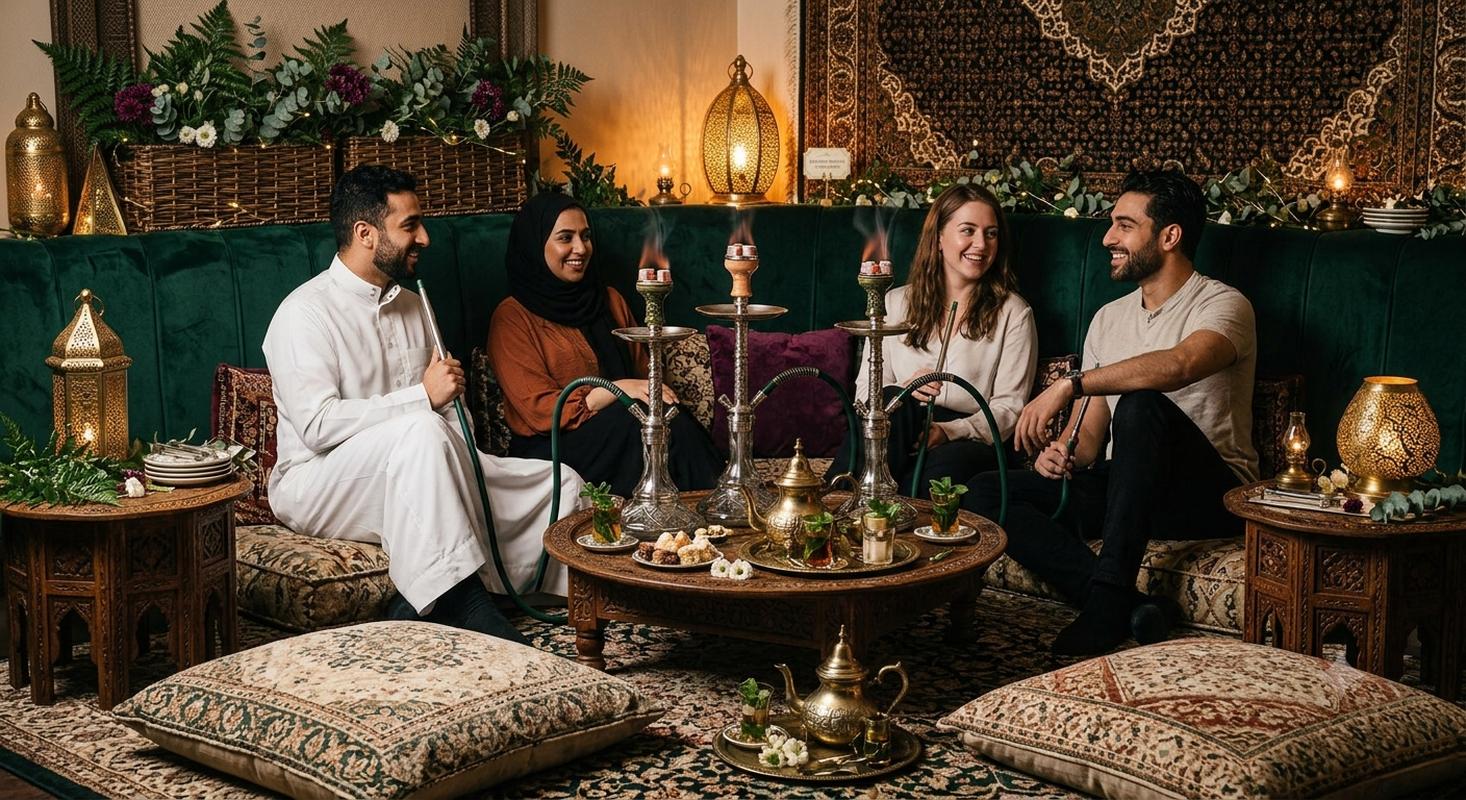
Middle Easterns trace their lounges to the floor-level seating in the Istanbul, Cairo, and Damascus coffee houses to which they attach historical significance. The central area is brought low, as are hookahs. The lounges require the user to relax as quickly as the cushions do.
The Middle Eastern design dictates that lounges have a lot of thick textiles, cushions, and fabrics which are layered, warm, and feel like they are telling the user to stay, as do the patterns.
The low seating dictates relaxation, and contributes to the relaxed atmosphere of which design plays a large part. The central area is low, the hookahs are low, as are the tables, and the cushions are floor level, telling the user to stay, just like the decor. The arrangements force you to interact with people.
European Lounges: The Bar Reimagined
The popular European hookah trends of the last 15 years have all been influenced by German and Eastern European lounge owners, who integrated elements of the café and nightclub cultures of their regions into their lounges. This is in stark contrast to the Eastern Maximalism.
Walls are either exposed brick, polished concrete, or matte black slats. The furniture looks industrial: metal stools and high communal tables, combined with leather benches. The hookah sits at chest level, on a stainless-steel stand. The overall design is reminiscent of a craft cocktail bar.
Aspects of the overall design prioritize speed and cleanliness. The tables are high to eliminate bending. The lighting is very targeted to create a small space for conversation. The efficiency of every detail is very apparent. There are no tassels, carpets, or clutter to create a polished and minimal look, allowing for rapid implementation in a variety of locations.
What This Means for Hardware Buyers
The overall design dictates the hardware used Middle Eastern lounges use taller hookahs of about 70-90cm with a wide, stable base. These hookahs sit on the floor or a small table. Customers will be looking at the pieces from above, so the base and tray need to make a statement. Decorated brass and copper, along with aged pieces, all sell well compared to modern pieces.
European lounges prefer modular hookahs that are 35 to 55 cm tall. These hookahs are designed to sit at eye level on high-top tables. They have small bases, which are often narrow, and can be made of borosilicate glass or thick acrylic. These materials help the hookah base to withstand being knocked off the table. The stem, made of V2A stainless steel, can be found in brushed or sandblasted finishes. Changeable downstems, quick-connect purge valves, and quick-twist disassembly can be expected. To these lounges, hookah design is a precision instrument, not a decorative object.
If you are a B2B buyer stocking both markets, you carry two distinct product lines as the shisha hardware preferences of each market are not negotiable. For example, a Berlin lounge will not use a brass elephant-stem hookah on a concrete high-top table, and a Dubai lounge will not use a matte black modular piece on a Persian carpet.
Service Model: Reflex vs Ritual
Middle Eastern: The Hookah Arrives Before the Order
The service model in traditional Middle Eastern lounges tends to be anticipatory. The server knows that when a regular customer arrives, they pick a flavor like double apple, perhaps with mint, and thus the coal arrives within two minutes. The hookah is lit before the customer has finished settling.
This speed is not efficiency in the western sense. It is hospitality. A hookah is woven into the very fabric of the greeting. The absence of a hookah is the absence of welcome. The protocol is standard: one coal per person immediately, a new grommet, a new clean tuyaux de narguilé tip, no consultation of the menu, and no taste sampling. The value of the experience is in the familiarity and quickness.
Employees in these lounges have undergone training to provide service with speed and precision. The coal handling, foil stretching and drawing tests have all been completed in the same order for decades. There will be no talk of how to manage heat, what kind of cuvettes de narguilés to use or how to cut tobacco. It’s assumed that the end product will be consistent and the customer should expect the same.
European: The Sommelier Approach
European lounges have focused on providing a consistent experience to the customer. The goal is to have the customer come not knowing what they want.
The menus here are long. A single lounge in either Berlin or Paris will have thirty to fifty distinct flavors classified by profile ranging from citrus and floral to dessert, spices and mints. These are essentially cocktails. Before a selection is made, the server inquires about the desired nicotine, clouds and session length. Some lounges have begun to offer two-gram sampling flights in mini bowls to allow the customer to choose flavors. our shisha tobacco selection
Once a selection is made, the loaded bowls will draw and coal will be managed by the server. The customer is informed throughout the experience. Sessions are longer and more measured with a draw and coal management being performed every fifteen minutes.
To be able to afford to have this service model, the lounges will be able to charge more for their sessions. A European lounge will charge upwards of €25 to €40 for a session, while a Middle Eastern lounge would charge around €8 to €12. The customer is paying for the curation of the lounge and not the hookah.
What This Means for Product Selection
Middle Eastern lounges like bulk purchases, and they buy the same items year after year, so they prefer consistency over variety. Purchase decisions hinge mainly on how affordable the unit price is and how consistent the items meet their needs each year. Middle Eastern lounges are known for ordering the same model of brass stem, same type of clay bowls, same length of silicone hoses, and same items for years on end.
European lounges prefer to buy smaller amounts of a greater variety of SKUs and do not have as rigid an item ordering process as Middle Eastern lounges. European lounges buy several different styles of bowls each season, prefer to buy different styles and materials of hoses, and are more open to buying the latest offerings like the newest HMD, diffuser, or base.
A B2B supplier needs to ensure that their catalog meets the different needs of Middle Eastern buyers as well as European buyers. For the former, Middle Eastern buyers should see the catalogs that have longer product dimensions and other physical product specs, and bulk pricing should be readily available. For European buyers, catalogs should show how products work with other items, offer design features, and emphasize the ability to place specialty orders for samples.
Flavor Preferences: Tradition vs Experimentation
Middle Eastern: The Classics Never Die
Double apple isn’t a flavor; it is a cultural preference for Middle Eastern lounges. Visiting a lounge in any of the Middle Eastern countries from Marrakech to Manama, you will see that double apple comprises 60% to 70% of sold bowls, with mint often sold in a close second, and grape, lemon, and watermelon are sold in the remaining bowls.
Middle Eastern lounges prefer a more traditional style of tobacco. The cut is coarser and not as moistened, with more of a heat and less glycerin content, and is designed to be very tolerant. It is very important for lounge owners as well as their clientele that the smoke is thick, warm, and has a strong flavor of tobacco, rather than a sweet, creamy aftertaste or dessert note.
European: The Unlimited Palate
In Europe, lounges interpret flavor as an art form. In 2025, best-sellers included creamy desserts (such as vanilla crème brûlée and pistachio gelato), fresh fruits (including peach-berry blends and lychee-mint), and the hybrid combinations between shisha and candy.
A lighter tobacco base is used. Blonde leaf tobacco (lower in nicotine and glycerin for larger clouds) is commonly used. Fluff-pack Guide sur les bols Phunnels, as opposed to dense-pack Egyptian bowls, are used. When it comes to shisha, less is more. With the emphasis on flavor rather than shisha volume, management of the bowls is key.
Europe also leads the market in research and development of flavor concentrates. Water-soluble extracts, terpene blends, and nicotine-free products are becoming increasingly popular. The European market also rewards suppliers who offer larger flavor assortments in smaller, more frequent shipments.
What This Means for Inventory
If you supply to the two different markets, you will need two different lines of tobacco. The Middle East will buy bulk products like double apples and mint in traditional cut. The European market will buy more expensive, smaller variety packs with tasting notes and seasonal special editions.
While the differences in hardware are not as obvious, they are there. European lounges that flavor rotating are required to make cleaning the shisha quick and easy with removable parts. The valves are removable, and multi-port stems allow customers to make quick alterations to the equipment.
Brass Heritage vs. Stainless Precision
Middle Eastern: The Weight of Tradition
Step into a Middle Eastern souq and examine their hardware. Their hookahs are heavy brass and copper. They are engraved. They are designed to last for generations.
What’s in the traditional Middle Eastern hookahs?
- Materials: Brass and copper and nickel plated brass. Sometimes stainless steel, but usually in cheaper imports.
- Construction: Cast or spun metal. They have threaded connections. A permanent downstem and a fixed purge valve.
- Seals: Rubber grommets that are slowly compressed over time.
- Bases: Hand blown glass or etched crystal. Usually bulbous and wide.
- Bowls: Traditional clay or ceramic, are of standard sizing and are meant to hold a dense tobacco pack (usually covered with foil).
The style encompasses an ornamental design. This includes a large, scalloped tray, fluted or ribbed stems, and an ornate hose port. Together the hookah serves a purpose of being a piece of furniture.
Linkup Hookah utilizes the traditional construction of brass hookahs, the detail of cast engravings, and the use of hand blown glass to offer customizable brass hookahs for lounges that desire an authentic heritage look. Each hookah is designed for daily use and offers reinforced threaded connections and replaceable grommets.
View Traditional Brass Hookahs →
 European: Engineered to Perform
 European: Engineered to Perform
One look at the European lounge hardware, and you can tell it is not Middle Eastern. V2A stainless steel takes the spotlight as the primary material, missing the traditional Middle Eastern styles altogether. This stainless steel is used in commercial kitchens and marine equipment, and for good reason. It doesn’t rust, it doesn’t ghost, and it can be polished to a matte or brushed finish which looks clean in low lighting.
European-style hookahs feature:
- Materials: V2A stainless steel stems, Tritan or Borosilicate glass bases, POM or silicone downstems, aluminum or stainless steel trays.
- Construction: Modular designs with O-ring seals. Made to be taken apart with no tools. Allows for the swapping of downstems and hose adapters.
- Seals: Silicone O-rings, with no grommets. Leak-proof seals, tested in the factory.
- Bases: Designed to draw attention, narrow-neck borosilicate glass bases come in many colors or offer UV-reactivity.
- Bowls: Glazed or unglazed Phunnel bowls or ‘killer’ bowls.
The aesthetic is an industrial minimalism. Clean cylinders for stems and simple bulb or cone shapes for bases. The use of a sandwich tray system built into the stem means that many European hookahs have small or no trays. The hookah is a tool.
Linkup Hookah’s full range of V2A stainless steel modular hookahs with O-ring seal systems with interchangeable downstems and sandblasted matte finishes are perfect for European lounge spaces.
View V2A Stainless Steel Modular Hookahs →
Hybrid Buyers
A large number of buyers, especially in the UK and Canada, are looking for hybrid styles. They want a V2A stainless steel stem for hygiene, but prefer a brass tray for design. They want a clay bowl, but are okay with a modern silicone hose. Their clientele is their only loyalty.
Being a B2B supplier of modular elements that can adapt to differing design languages also provides opportunities for differentiation. A brass stem can be paired with a stainless downstem. A glass base can be used with a clay bowl adapter. These components tend to have small SKUs with higher profit margins.
Purchasing Habits: Understanding Each Market
Middle Eastern Buyers
- Order size: Large. Pallet quantities. Single SKU predominates.
- Acceptable lead time: Medium
- Price sensitivity: High. Profit margins for lounge tend to be small.
- Value: Long-term relationships and the consistent availability of replacement parts.
- Relationship: Personalized.
European Buyers
- Order size: Small to Medium. Multi-SKU.
- Acceptable lead time: Low. Expect rapid shipping and low MOQs.
- Price sensitivity: Medium. Will purchase for design and novelty.
- Value: Differentiation.
- Relationship: Initially transactional, but over time, loyal customers. Expect new suppliers to be used frequently, but will remain loyal to those who continue to innovate.
Things You Can Do
 Things You Can Do
The comparison of Middle Eastern and European shisha lounges is not of greater vs lesser quality, but rather different markets with their own operating logics. If you are selling to both:
- Differentiate your catalogs. Do not present brass hookahs to your European customers alongside stainless steel in the same pricing grid. Market differently for each market.
- Revise MOQ strategy. Provide European buyers with sample kits that meet low MOQs. Sample pallet pricing with scheduled reorders for Middle Eastern buyers.
- Equip yourself with the right supply for lounges. For Middle Eastern lounges, stock brass stems, wide base glass, clay bowls and grommets. For European lounges, stock V2A stems, Phunnel bowls, HMDs, silicone hoses, and O-rings.
- Spend on modularity. The most dynamic focus of both markets is the supply of configurable Hookah’s. A lounge in the center of Cairo may want the looks of brass with the internals of stainless. A lounge in the center of Amsterdam may want a frame of stainless with a port of brass. Modular components let you serve both without doubling inventory.
Résumé
Middle Eastern and European lounges, blend of the same name, have the most culture differences. To smoke relaxing, a tight group of friends is ideal and they value each item as it transforms the experience.
| Dimension | Middle Eastern Lounge | European Lounge |
| Seating | Low — floor cushions, short tables | High — bar stools, high-top tables |
| Décor | Maximalist — carpets, brass, tile | Minimalist — concrete, steel, glass |
| Service | Immediate, standardized | Consultative, curated |
| Saveurs | Double apple, mint — 70% of sales | Dessert, fruit blends — fast rotation |
| Hardware | Brass/copper, traditional, heavy | V2A stainless, modular, light |
| Bowl type | Egyptian clay, foil cover | Phunnel/killer, HMD |
| Price per session | €8–€12 | €25–€40 |
| Buying pattern | Large bulk, single SKU repeats | Small multi-SKU, seasonal rotation |
Buying pattern Large bulk, single SKU repeats Small multi-SKU, seasonal rotation
Supplying hookah hardware and tobacco to both markets means you need two catalogs, two pricing models, and two inventory strategies. The supplier who knows this difference and stocks brass for Cairo and V2A for Berlin wins both.
Linkup Hookah is a China-based B2B one-stop supplier that services both markets. Our product range covers traditional brass hookahs with hand-blown glass bases and modern V2A stainless steel modular hookahs with O-ring seal systems. We ship to over thirty countries and work with importers, lounge groups, and distributor partners. Contact our B2B sales team for catalog segmentation and bulk pricing tailored to your target market.