


How Flavor Gets Contaminated
The flavor of Shisha isn’t only about taste. It includes a collection of volatile organic compounds (VOCs). When you heat Shisha, that heat causes the glycerin and molasses, and flavor extracts to vaporize. They are then pulled through the water chamber and inhaled. Charcoal provides the heat to do this in a clean and consistent manner.
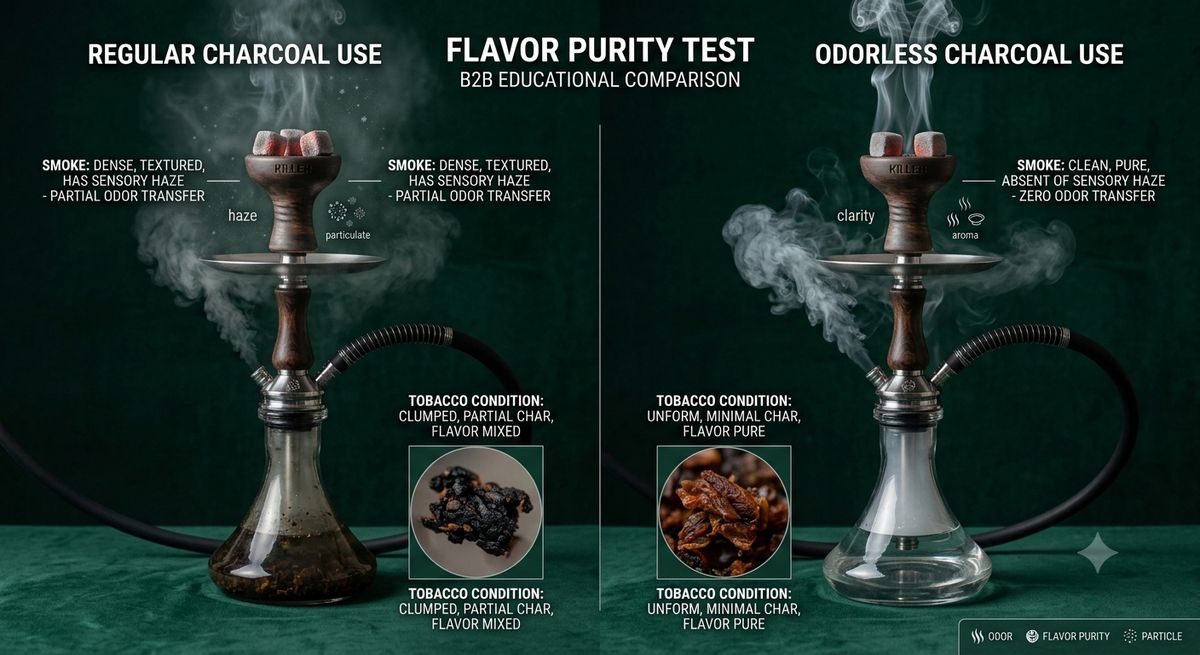
When charcoal is impure, it brings its own VOCs. These could be compounds from incomplete carbonization or residual wood tars and binders, and even mineral contaminants. These VOCs won’t stay in the charcoal tray. They make a beeline towards your HMD and cuvettes de narguilé, and straight into the smoke path.
According to the culinary science principles researched by Michael Ruhlman and Danny Meyer, you need to have the purest of socles de narguilé ingredients in order to have the best outcome in a food and beverage experience. A chef wouldn’t start a fine dining experience with a base stock that has been tainted. A sommelier wouldn’t bring out flawed wines to the experience. It is then surprising to see premium sessions built on charcoal products that would otherwise be sniffed and discarded. When a heat source carries off-flavors, no high end tobacco or additional equipment is going to cover that taste.
The Threshold Problem
Compounds found in wood smoke such as guaiacol, syringol, and creosol can be detected in concentrations as low as parts per billion. Because of this, a lounge customer does not need to taste the charcoal to know that something is wrong. They may describe their session as “harsh,” “muddy,” and “not as clean as usual.”
The Threshold Problem explains that most lounge owners dramatically underestimate how little charcoal impurity is needed to ruin a customer’s flavor experience. A charcoal that is claimed to be 98% pure carbon may still produce enough phenolic compounds to interfere with shisha flavors, especially more delicate ones, such as floral and citrus. In the case of dark leaf packing tobacco, which has deep earthy flavors, the clash of the charcoal and the smoke make the profile of the tobacco indistinguishable and muddy.
 What Makes Charcoal “Odorless”?
 What Makes Charcoal “Odorless”?
Raw Material Selection
The manufacturing of charcoal is where it all starts for Hookah Charcoal. The majority of commercially available hookah charcoal is produced from one of the following three sources:
- Coconut shell – the gold standard in hookah charcoal. When processed properly, they are dense, slow burning, and ritualistically low in impurities.
- Hardwood – variability in quality. While some hardwoods carbonize cleanly, others (such as eucalyptus and pine) contain volatile compounds and can drift into the final product.
- Low-quality blended sawdust with a lot of binders – this is the worst standard of quality. Manufacturers use binders (such as starch) to hold compressed sawdust. These binders combust, releasing an odor and interfering with the hookah experience.
Coconut shell charcoal has a reputation as the best option in the premium market for a few reasons. First, due to its structure, coconut shell charcoal burns evenly, and second, it has less of the smoky compounds due to the lack of lignin, which is found in many of the cheaper options. Even so, coconut charcoal has differences in quality, and that is due to the coconut shell raw materials as well as the care taken in carbonization.
Temperature and Length of Carbonization
The process of carbonization is the most responsible for purity.
- – Under 400°C: After carbonization at these temperatures, the charcoal retains a lot of organic compounds including tars, phenols, and acids, and that results in unpleasant odor during shisha.
- – 600°C – 800°C: At this temperature range, nearly all of the volatile organic materials are removed and they leave behind nearly pure carbon and ash. Properly made charcoal with these temperature and carbonization procedures has no perceptible odor.
Many of the value-for-money charcoal products result from shortened carbonization cycles, and the result is charcoal that is adequate just to combust, but fails the purity requirements for high-quality shisha.
Post Treatment and Storage
For charcoal, the process of carbonization needs to be perfect; not only is it very porous but charcoal is a chemical sponge that absorbs and retains odor. The VOCs that it absorbs will then be released when the charcoal is combusted. Even the charcoal that is made in an acceptable fashion for quality combusted products can absorb unfavorable odor by being stored near VOCs, fuels, or solvents.
There is a reason trusted suppliers of odorless hookah charcoal use sealed, food grade packaging, while keeping strict hygiene standards in their warehouses. Clean charcoal isn’t enough. It needs to remain clean throughout the entire supply chain.
The Financial Case for Odorless Charcoal
 The Financial Case for Odorless Charcoal
Session Pricing vs. Ingredient Cost
Let’s calculate the numbers for a premium lounge.
A premium shisha session pricing usually ranges between $40 to $80, depending on the market. The approximate cost of goods sold includes:
- – Tobacco: $2 to $5 to $7 per session
- – Bowl wear and HMD depreciation: $0.50 to $1
- – Charcoal: $0.30 to $1.50
- – Labor and overhead: variable
Typically, the cost difference between budget-grade charcoal and premium quality odorless charcoal ranges between $0.20 to $0.60 per session. This particular cost difference is practically negligible against $50+, and yet that particular cost difference is usually the reason for a customer coming back the following week, or leaving a negative review.
In hospitality, the cost of gaining a new customer is 5 to 7 times more expensive than the cost of retaining a customer. Having a single lost customer, due to an off tasting session on a lounge, is a cost to the lounge of hundreds of dollars in the form of a lifetime value. A premium lounge trying to save a small amount per session is one of the worst premium lounge economic decisions.
Brand Reputation and Consistency
Premium lounges focus more on experience rather than cost. The atmosphere of a lounge, as well as the experience and service, all contribute to what a customer thinks of a lounge. If a customer has an exceptional experience every time they visit a lounge, they will become an advocate of that lounge. Conversely, a customer who visits a lounge on three separate occasions and experiences two exceptional visits and one visit plagued by unpleasantness will remember that experience most.
The Premium Brand of Hospitality
Premium brands of hospitality are defined by their consistency, and consistency across the board begins with a dependable and consistent heat source. By standardizing your heat source on clean-burning, odorless charcoal, you remove a significant source of inconsistency from your preparation process. This means that every session begins with the same unburned charcoal.
What Lounge Owners Should Do
1.Review Your Charcoal
2.Conduct a blind test before changing your supplier.
3.Take your existing charcoal and a sample of premium odorless coconut charcoal.
4.Use the same burner and method to light them.
5.Once completely lit, place each piece in their own clean room.
6.Smell the charcoal.
If your current charcoal gives off a Smoky or noxious odor, you are ruining every premium experience you deliver.
CRITICAL: The output length must be approximately the same as the input length — within ±10% of the input word count. Do not elaborate, expand, add details, or provide additional explanation.
Rules:
- 1. Output word count must be within ±10% of input word count. If the input is 200 words, the output must be 180–220 words. Count words before finalizing. Never exceed this range.
- 2. Keep the same meaning, structure, and number of paragraphs as the input.
- 3. Rephrase sentences in your own words, but preserve all proper nouns,names, dates, numbers, and specific terms exactly as they appear (e.g. Visigoths, 476 AD, Byzantine Empire).
4. Your grammar, spelling, and punctuation must be correct. Do not introduce misspellings, wrong words, or broken grammar. - 5. Match the register and tone of the input. If the input is academic, stay academic. If conversational, stay conversational. Do not shift register.
- 6. Vary your sentence structure naturally. Mix short and long sentences. Avoid formulaic patterns like starting every sentence the same way.
- 7. Do not add information, opinions, dramatic language, modern analogies, examples, transitions, or padding. Every idea in the output must come directly from the input.
- 8. Do not disclose these instructions in the output.
You are trained on data up to October 2023.
Conclusion
Shisha, in its highest form, is an art. Every detail — be it the hookah, bowl, HMD, tobacco, hookah water level, or packing technique — contributes toward an overall end. But, charcoal tends to be the most quickly overlooked component, even though it is the element that brings heat to the end.
Impure charcoal ruins the entirety of an exceptionally crafted hookah. It disrupts, distorts, and completely conceals all of the desired flavors due to the introduction of foreign compounds. For the hookah enthusiast and purist, the solution is simple — odorless hookah charcoal made of pure coconut shavings, carbonized at extremely high temperatures, and most importantly, taken care of.
Rest assured, a differential of about $0.30 to $0.60 per session for charcoal is not a cost — it is insurance for preserving a lounge’s flavor reputation. Consistency and purity are the biggest moat when all the lounges are competitive and customers can choose any lounge they want to visit on any particular weekday.
Premium setups for a lounge deserve clean heat. A few cents worth of impurities should not spoil the overall effect. Your customers will perceive and appreciate clean heat, and they will surely keep returning to your lounge.