


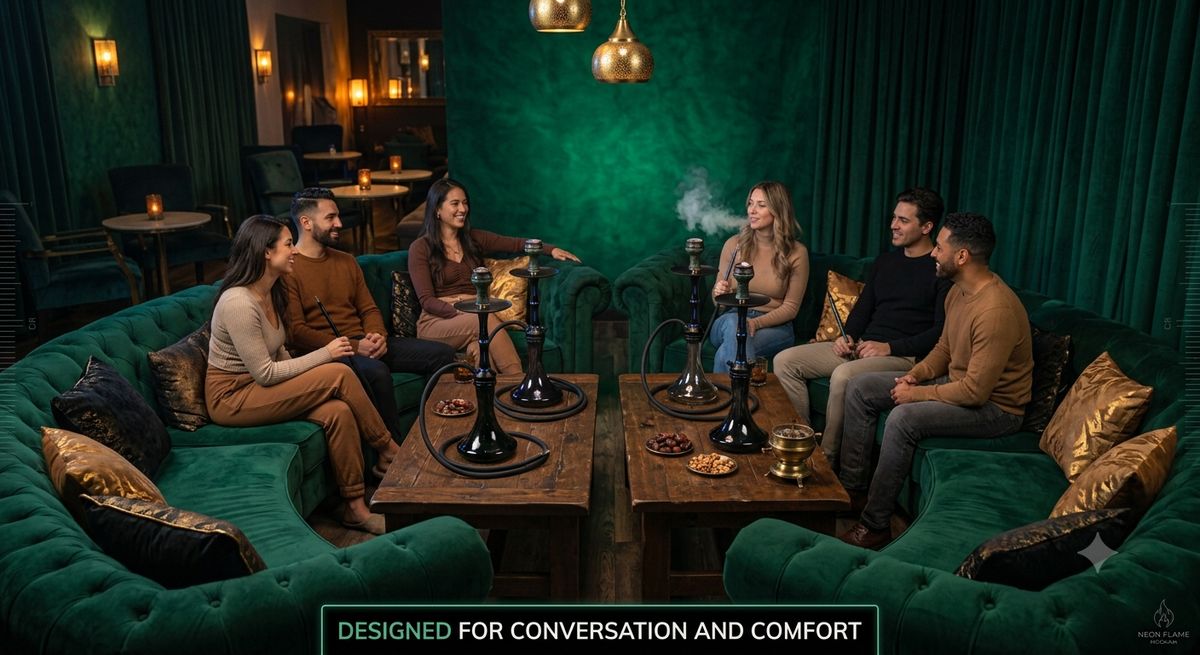
The specialized and skilled design of a shisha lounge stands out when you walk into a successful lounge. The low and warm glow of the lights and the careful balance of the ambient audio all serve to bring customers together to share moments and conversation. The shadows in the corners hold banquettes of leather. Conversations and the sounds of distinct smoke drift, accented by the sculptural centerpieces, the ensembles de narguilés.
Interior design is purposeful in these spaces. It brings together elements to serve a purpose and help sell your brand.
Taking the plunge on the right lighting and spatial design will bring you the return you want most on your build or renovations. The interplay of darkness and warm light, when combined with hookah smoke, offers the customers an experience they will pay a premium to return to. This design will build a space that customers want to flock to week after week, enticing them to stay longer on each visit.
The Psychology of Low Lighting in Hospitality
There’s a psychological reason behind why almost every lounge dims their lights. Research within hospitality design shows that lowering the light level relaxes patrons, reduces their social inhibitions, and increases the duration they occupy a table. For a shisha lounge that serves bursts of sessions that last between sixty and ninety minutes, longer table occupation means more patrons purchasing additional food and drinks, increasing overall revenue.
Dim lights signal exclusivity. A room that is bright and filled with harsh, fluorescent lighting is often associated with economy and fast service. A room that has layered light, with pools of illumination that are separated by shadows, is perceived as curated and premium. The customer knows that this is a place to spend time.
In terms of hookah bar design, there is an additional psychological element we have to mention, and that is design of smoke. In a space that is brightly lit, hookah smoke can feel as if it is an oppressive and uninviting fog. However, in conjunction with dim lighting and accent uplighting, the smoke can catch the light and be perceived as a premium and dynamic element. This is the synergy between smoke and light that creates the signature feel of a premium lounge.
 The Minimalist Theory of Lounge Lighting
 The Minimalist Theory of Lounge Lighting
A lighting plan can be broken down into 4 layers, and each successful lounge utilizes all of the 4 layers.
1.Ambient Lighting — The Basis
Ambient lighting serves as a foundation for comfortable movement and navigation. In a shisha lounge, you want ambient lighting to be low—approximately 10 to 30 lux at floor level. It’s the lighting that you don’t actively perceive until it has been turned off. Dimmable recessed LED strips work well when placed behind wall panels or ceiling coves, and along the socles de narguiléboards. The color temperature of the strips should be in the 2200K to 2700K range. In the ambient layer, 3000K and 4000K lighting should also be avoided, as they make a space feel less intimate.
2.Accent Lighting — The Interior Design
Accent lighting is where your shisha lounge’s personality comes to life. It is used to bring focus to the lounge’s architectural and decorative elements. Premium shisha lounge lighting design leads to and relies on a “jewel box” effect in which the contrast between the dark, empty space and the illuminated lighting features is the most dramatic.
For shisha displays, use shelving with individual uplights, and add a steamulation Pro X or an El Bomber Apocalypse on display with a dedicated accent light to stop customers mid-conversation. Both hookahs are premium and should be appreciated, and lighting helps achieve that respect.
3.Task Lighting – The Practical
Each seat must have its own control light. The standard is a low-profile table lamp or a dimmable pendant light dropped to just above eye level. They can also come in the form of LED tealights that are clustered together on a tray, a mini Edisonal lamp on the table, or a gobo that is used to project a pattern onto a tabletop. They can all be used as an effective means of task lighting as long as they are warm and dimmable.
Task lighting has two functions. It helps customers see their phone, their drink, and their hookah and also creates a small ‘territory’ of personal light around each group. When a table is illuminated from above, the people sitting at the table become the brightest in the room, and human faces are captivating, drawing the attention of the room to that table. This makes for a fulfilling experience of people watching.
4.Decorative Lighting – The Signature
Decorative lighting is the level of lighting that can draw a customer to your lounge and make it memorable. This can be in the form of chandeliers, statement pendants, neon lights, LED art lights, and even illuminated hookah accessories. An example is a Brilliant Diamond hookah with LED lights in the center of the table as a statement decor piece. A custom made neon sign with your lounge logo in warm amber or soft pink can create a photo opportunity for customers and free lounge advertisement on social media.
Less is more with decorative lighting. One or two bold lighting elements per room are effective, but six or seven items create a distracting amount of visual noise.
Color Temperature and Mood Mapping
This is a very useful design tool often overlooked in the design of lounges. Here’s a guide with color temperature, effects, and the best use of each temperature.
Color Temp Effect Best Use
2200K – 2400K Candle-like, amber Ambient base layer, table lamps
2700K Warm white, cozy Accent walls, decorative fixtures
3000K Soft white, neutral Bar task lighting, hallway transition
3500K+ Cool white Avoid in lounge areas entirely
When using the same room, the color temperature of lighting should not be mixed. Stick to one temperature (2200K – 2700K) in any and all visible lighting fixtures. If you use LED accents colored (RGB) to contrast against the warm light, then artwork should be the only exception.
The Role of Shadow
 The Role of Shadow
When designing a lounge for the first time, the fear of dark corners is a design pitfall. It’s true that when every inch of space is visible, it is safer and appears to be cleaner, but shadows are your best tools.
Shadows create mystery and can hide imperfections. Even with open layouts, shadows can create a sense of privacy. A booth with partial shadows will appear as a more private space than a booth with lighting directly above and shining down. The more people that are in the group, the more they will stay if they feel that they are in their own individual spaces.
It is not about darkness for its own sake — it is dark, but *controlled*. In each part of the lounge, you should be able to walk around safely, and be able to read the menu at the table. But the edges of the room, ceiling, and unoccupied areas should fade into darkness. The eye should be guided, not forced.
The most interesting thing about a shisha lounge is the smoke. Unlike a restaurant or a bar, a shisha lounge fills the air space with a vapor, which slowly fills the bar space and interacts with light in interesting ways. Good designers tend to take advantage of that.
Backlighting — Create a warm light source behind a group of seated customers, and shine it away from them and toward the open room. The smoke that rises from their shisha will catch the back lighting and create a halo, a vignette that is a portion of the whole table. This works especially well with a shisha glass base light — the Socle de narguilé en verre sur mesure sends the light and patterns across the table.
Low cross-lighting — A fixture placed near the floor and angling at 15 to 30 degrees will light the lower third of the smoke column. This makes the faces of the customers and the smoke separate, and the room has depth.
Do not install any overhead downlights directly above tables. Downlights flatten people’s faces, cast dark shadows under their eyes, and create an opaque haze of smoke under the fixture. If you have to use overhead pendants, choose wide frosted globes so the lighting isn’t harsh or concentrated.
Good Material Selection in Lighting
Lighting design never holds up without great surface selection. Matte materials absorb light, and glossy ones reflect it unpredictably. If you want the high-end dark-and-smoky look in your shisha lounge, you will have adequate control over your design.
Walls: Dark mattes like charcharbons pour narguilé, navy, forest green, or deep burgundy; textured wallpapers. Loose textiles like velvet wall panels absorb excess light and dampen sound simultaneously.
Furniture: Dark leather or velvet upholstery. Steer clear of shiny synthetic leather, which out-gasses and reflects light in concentration.
Floors: Dark-stained wood, black tiles, or dark carpets. Light-colored floors degrade the design by bouncing ambient light and raising it upward.
Ceilings: Use paint to bring the ceiling into a black or dark grey value. A white ceiling in a dimly lit place brings a dead zone where the focus should be on a black-painted design, which encourages the eyes to expand an immersive, dark, and elevated space.
Brass, copper, and blackened steel accents. Treat your design in the equivalent of a dark atmosphere.
Sound and Lighting: A Unified Experience
 Sound and Lighting: A Unified Experience
Lighting and sound complement each other. What the lighting design communicates and what the audio environment communicates needs to be in harmony too. A softly lit room would benefit from spacious warm sound — think deep house, downtempo, and even lo-fi and instrumental hip-hop at about 65 to 75 dB. A lighting scheme that suggests “intimacy” combined with upbeat “nightclub” music creates dissonance that drives customers away.
Try combining your lighting and audio control; consider using a single system. It can be Lutron, Control4, or even a DMX rig with a tablet interface, well-programmed. With such a system, you can save “scene” presets to switch the lighting and audio controls from individual dimmers without effort.
What You Can Do Now
If you’re about to renovate your lounge or planning a new build, here’s a prioritized action list.
- First, get rid of the overhead lights. Dim or disable all ceiling mounted broad lights. They spoil the mood.
- Put dimmers on every circuit and break up the zones. It’s vital that you can control the ambient, accent, and task lighting independently.
- Buy warm lighting fixtures. If you buy nothing else, buy good table lamps with warm LED bulbs (2200K-2400K) for all the seating areas.
- Put backlighting on the bar and display shelving. LED tape in warm white, placed behind a lip or a channel, is a low cost, transformative display lighting solution.
- Smoke Test. Before you finish the lighting layout, throw a hookah in the spot and walk around. Where does the smoke look nice? Where does it look bad? Make adjustments.
- Choose centerpiece hookahs. Choose two to three high-end hookahs to spotlight under individual accent lighting. The Steamulation Pro X (https://www.linkuphookah.com/product/steamulation-pro-x-premium-hookah/) is a good pick. The high-polished narguilé en acier inoxydable picks up almost any light.
- Spend money on smoke control. While smokes good, if airflow dampers control smoke volume, then it will become air quality is a good smoke design. Ensure your ventilation moves air without drafts.
The ROI
A good smoke design shows relevant numbers. Lounges with lighting designs report:
- – 15-25% increase in time customers spent on-site.
- – 10-20% increase in sales.
- – Increase social media engagement.
- – Decreased table turnover than previously occurred.
The high end of the lighting design range for a mid-sized lounge (1,500-2,500 sq ft) is $25,000. If the lighting design causes a 15% increase of an annual income of $500k, then the lighting design pays for itself in three to six months.
Conclusion
At this time, the market for shisha lounges is more saturated and competitive than ever before. Customers have high expectations and standards. They have visited lounges with mismatched, worn furniture and unflattering fluorescent lighting. They don’t want lounges like that anymore. They want lounges that are thoughtful and immersive in design and offer a high quality experience.
Interior design of your hookah bar is not just decoration – it is an integral part of your business offering. It determines the clientele you attract and the price you’re able to market your product at. It also determines the reputation your clientele will create for your business after their visit. Carefully consider the placement of your lighting, the design of your bar, and the elements that create the ambiance of the space. You will see the reward in your profits.
*Linkup Hookah is a premier B2B supplier of premium hookahs, accessories, and tobacco to lounges and hospitality businesses worldwide. Browse our full wholesale catalog at linkuphookah.com.