

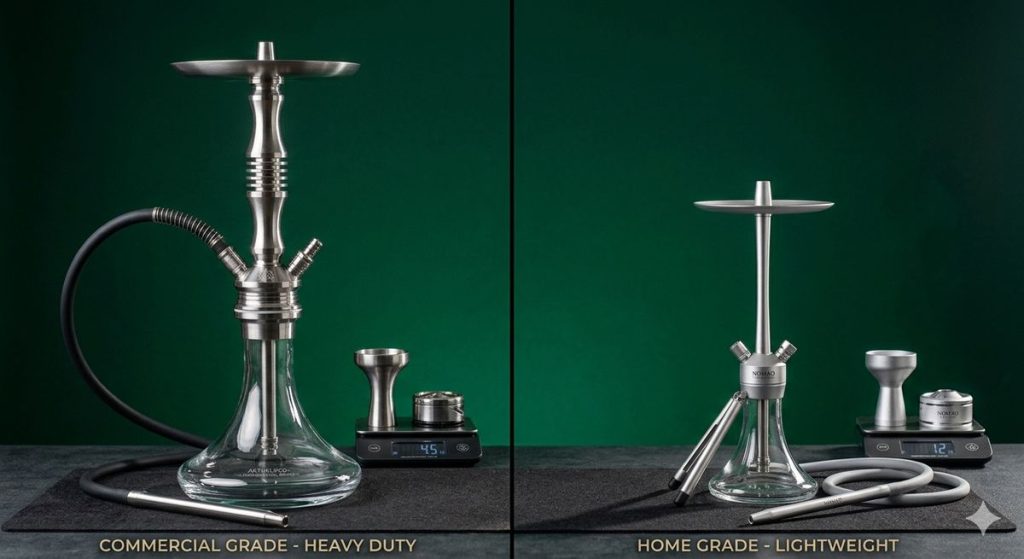
You may see something when entering a ensembles de narguilé lounge that has been open for a year or more. The hookah that costs less usually survives the nightly workload more so than expensive hookah kits. The less expensive kits in this case are more durable.
When you see “commercial grade hookah” in B2B catalogs, this term signifies more than marketing. This term identifies a metal frame consistent in thickness, with joints that fit with less slop, seals that are more secure and consistent in their reliability, and durability when in use for extended periods. A hookah designed for commercial grade use will last for 500 to 1,000 uses a year, given a good routine cleaning and minimal replacement of parts. The following is a checklist of eight characteristics that will help identify a hookah that is more likely to be used for a lounge than the competitors that have a commercial grade marketing.
We will explain how the eight characteristics of this procurement checklist will help identify a lounge hookah best suited to your needs. Based on the criteria outlined, you will be able to inspect a unit, identify construction quality, and understand the cost of ownership over a 24 month equipment refresh cycle that is considered standard in the industry.
 1. Material Grade — 304 Stainless Steel as the Baseline
 1. Material Grade — 304 Stainless Steel as the Baseline
The most important criterion. All commercially used hookahs employ 304 stainless steel (18/8 chromium-nickel austenitic) for all elements that make contact with water and smoke. This includes the downhookah stems, stem body, hose ports, and purge valve housing. Other grades (201 stainless, zinc alloy, plated brass) will most likely pit, corrode and fail within a couple of weeks of commercial use. Request a material test certificate (MTC) from the mill. If they cannot provide one, the material is not 304.
2. Wall Thickness — The 1.2 mm Minimum
What happens in a hookah lounge when a hookah is tipped, bumped, and cleaned aggressively is different than hookah use at home. That is why tubing with a wall thickness of 0.5–0.8 mm does not work for a lounge. It is important to use commercial-grade tubing with a minimum of 1.2 mm wall thickness and 1.5 mm for all threaded fittings. Commercial-grade tubing is the minimum wall thickness that will provide robust threading and resistance to denting. In this case, you should ask for 1.2 mm and 1.5 mm wall thickness rather than “heavy-grade” or “reinforced.”
3. Base Joint Seal — O-Ring, Not Bare Glass
The base joint seal is the weakest link in a hookah if it is being commercially used. Ground glass joints can develop air leaks after a use or two. Thus, it is important to have a positive, field-replaceable seal that will not degrade with use, such as a machining O-ring gland with a silicone O-ring. If a hookah has a bare ground glass joint with no secondary seal, you should consider that as a deal breaker.
4. Thread Quality — CNC-Cut Precision
In a commercial environment, threads will be entered and exited many times during the day to the point where they will strip, gall or cross-thread due to rolling or stamping. For a hookah to be truly commercial-grade, it has to have threads that were cut through a CNC machine and have a surface finish of 1.6 Ra or better, which is smooth enough that an O-ring will not snag as it is slid over. Coarse threads (12 TPI or M20×1.5) are preferable for quick engagement during shift setup.
5. Purge Valve — Field-Serviceable
The purge valve requires the most attention. In a typical lounge, either the valve ball cleaning or diaphragm can fail after several months due to residue buildup. A completely serviceable purge valve should not require tools to complete the service. The housing should hand-loosely screw to hold it in place, the ball should be a replacement that can be sourced from multiple vendors and the o-ring should be easily replaceable. Avoid proprietary assemblies that require factory servicing or complete unit replacements.
6. Hose Port — Ball-Bearing or Magnetic Lock
The customer hoses receive a considerable amount of tension with pulls and twists in every direction. The rubber replacing grommets hose ports begin to fail after several weeks and start to drop hoses mid-session. The commercial standard now uses a ball-bearing lock (spring-loaded bearings that grip the adapter securely) or a magnetic connection. Both significantly outperform grommet designs in cycle testing.
7. Base Stability — Safety and Operational Cost
A tipped hookah in a lounge means broken glass, spilled water, and a disrupted session. The base diameter must be at least 60 percent of the total hookah height, or the base must be weighted with at least 2 kg. Borosilicate glass or Tritan copolymer should be used as a base material — not soda-lime glass, which fractures under thermal shock from hot water cleaning.
8. Serviceability – Total Disassembly No Tool Required
This is the most significant consideration. Every component in a commercial-grade unit (stem, downstem, tray, hose ports, purge valve, base) must break apart without the use of tools. Every component that comes in contact with the smoke must be easily removable for cleaning. For your first disassembly, time yourself. If it takes longer than a minute, the design is commercially unviable.
Consumer vs. Commercial: Side by Side Spec Comparative
 Consumer vs. Commercial: Side by Side Spec Comparative
The table below lists differences in each specification. Use it for a swift reference when comparing goods from any supplier.
| Specification | Consumer Grade | Commercial Grade |
| Matériau | 201 SS, zinc alloy, plated brass | 304 SS (verified MTC) |
| Wall thickness | 0.5–0.8 mm | >= 1.2 mm stem, >= 1.5 mm fittings |
| Base seal | Bare ground glass | O-ring gland + silicone seal |
| Threads | Rolled or stamped | CNC-cut, 1.6 Ra finish |
| Purge valve | Plastic housing, proprietary | SS housing, serviceable, standard ball |
| Hose port | Rubber grommet | Ball-bearing lock or magnetic |
| Base material | Soda-lime glass | Borosilicate or Tritan copolymer |
| Disassembly | Partial, tool may be needed | Full, no tools, < 60 seconds |
| Lounge lifespan | 2–6 months | 24–48+ months |
Consumer-Grade Equipment Warning Signs
 Consumer-Grade Equipment Warning Signs
Catalog copy can easily mislead even the most seasoned buyers. Beware of the following:
- Missing material certificate. A company claims “304 stainless steel” with no MTC produced. If the MTC were available, they would show it.
- Substandard weight. Stem assembly weighing under 300 grams for a 50 cm hookah. The metal is too thin.
- Aluminum construction described a premium feature, heavy-duty aluminum. Not a commercial grade metal for hookah stems.
- – Non-standard ports. With hose ports of proprietary dimensions, you must rely on a single supplier for replacement parts.
- – Non-serviceable purge valve. The purge valve is encapsulated within the body of the stem. This valve requires stem body machining in order to be replaced.
Here is what you will find in a total-of-ownership value analysis on why commercial grade wins:
A consumer-grade hookah ranges from $15–$40 wholesale. A commercial-grade hookah ranges from $60–$180. It seems advantageous to order 50 units to save $40 per unit. However, taking a total cost of ownership view across 24 months reveals a very different story.
Let’s do a total cost of ownership walk for one hookah station. You buy a consumer unit for $30. You replace the rubber grommet four times for a cost of $3 each, for a total of $12. You replace the hose due to residue build-up and a loss in airflow that occurs residual build-up a total of three times, for a total of $24. You replace the purge valve and then you replace the parts of the purge valve two times for a total cost of $8. Having to clean the unit increases over time as the residue build-up and the labor cost for cleaning is $15 for 10 minutes each day per shift for a total cost of $182 over 24 months. That gives a total cost of $286 in consumables and labor on top of the purchase price of $30. The total cost of ownership of the first station is $286 and a total cost of ownership of a second station for the replacement hoses in the second 12 month cycle brings the total to $390.
The bullet points identify the expected service cost of the commercial-grade unit.
The commercial grade unit costs $120 to purchase. They cost $1.50 for each O-ring. $3.00 for two O-rings. $10 for a hose replacement. $2 for a purge valve seal kit. There is a standard cleaning and no additional labor is charged. The total cost of the commercial unit is approximately $135 for 24 months. The price of the commercial unit is $120. The price of a consumer grade unit is $30. The commercial unit saves $150 to $255.
The commercial unit costs more. They pay less for every unit over their lifespan. Taking into account fewer complaints and less downtime, the TCO is highly favorable for commercial grade equipment.
Five-Minute Inspection Protocol for Bulk Orders
You do not need to be a metallurgist to verify a commercial-grade hookah. Run this protocol on a sample unit before committing to a bulk order.
1 . Weigh the stem. If it is 30% below prediction, the steel is thinner than stated.
- Engage and disengage every threaded connection ten times. If the threads are rough, they are not CNC-cut.
- Assemble the hookah and fill the base. Plug the hose port, and draw on the purge valve. If there is air leaking at the base joint, it will fail in a commercial environment.
- Fully disassemble and time yourself. Over 60 seconds indicates they are not serviceable.
- Apply hookah molasses to the downstem interior, let it sit for 24 hours, and then wipe. If there is discoloration, or pitting, then the material is not 304.
Linkup Hookah’s product specifications and MTCs can be obtained by B2B buyers interested in assessing product samples.
Consider the following commercial-grade models from the Linkup Hookah catalog, which meets the criteria of this article and can be used as benchmarks when evaluating other suppliers.
Steamulation Pro X Premium Hookah: View Product – Made from 304 stainless steel, the base seal is made from o-rings and features ball bearing hose ports with CNC thread.
Moze Breeze Pro 304 Stainless Steel Hookah: View Product – Drawn 304 SS stem with a purge valve that can be serviced in the field and can be completely disassembled without the use of tools.
Large Electric Hookah for High-Volume Lounges: View Product – Contains a lithium-ion battery and a borosilicate base; suitable for commercial sessions lasting all night.
A commercial-grade hookah is a necessity to help control costs. A hookah that lasts two months in a lounge as opposed to one that lasts two years is an example of good engineering: a 1.2mm stainless steel wall as opposed to a 0.6mm; o-ring seals instead of unsealed, bare glass; CNC threads instead of stamped metal; and a field-serviced purge valve instead of a sealed one.
The eight criteria listed in this article should be met by every commercial-grade hookah in your fleet. Implement them as a procurement standard. Ask for MTCs. Measure wall thickness. Validate disassembly time. Apply the TCO tests. Do business with a vendor whose answers to specification queries are objective, quantifiable data, rather than marketing slogans.
Many commercial-grade products made by Linkup Hookah are manufactured to these specifications. You can request samples, check the specifications, and compare them with the equivalents from other manufacturers. The difference will be visible.
Important points to keep in mind
- – Anything lower than 304 stainless steel with MTC Document is not going to last in a lounge setting.
- – 1.2 mm stems and 1.5 mm fittings
- – In commercial cycling tests, O-ring base seals are 10 times better than ground glass joints.
- – You have to have CNC-cut threads, ball-bearing hose ports, and purge valves that can be serviced in the field.
- – If you can take the product apart with no tools in under 60 seconds, that’s a commercial-grade design.
- – For a commercial-grade product, the Total Cost of Ownership (TCO) is roughly $240 compared to $390 over 24 months per station.
- – Before bulk ordering, physically inspect sample units using the 5-minute inspection protocol.