


Hookahs are the most reliable equipment you purchase for your hookah lounge. Everyday, customers come back for your hookahs to show them an amazing time. Like other equipment, hookahs break, lose performance and start to rust. Customers lose interest in your hookah lounge and stop coming back.
Upgrading your lounge’s hookahs is necessary for the survival of your business. If hookahs remain too long at a lounge, customers lose interest in the brand and performance of the hookahs. The best business owners are tWasserpfeifenschläuche who are able to upgrade their hookahs the most and who remain at the top of the competition.
Equipment that is deemed to be at the end of its useful life has replacement cycles. Understanding replacement cycles for hookah equipment will ensure optimal performance.
Your old hookahs seem like they’re the less expensive option.
Old equipment is cheaply purchased but expensively operated. The total cost is a more appropriate lens for evaluating hookah equipment that should be scrapped. Total costs include the equipment purchase costs, everything spent on maintenance, and poor performance losses. The losses of poor performance will affect your brand. Old equipment ends up costing more than completely new hookah equipment.
Aging Hookahs Cost More Than You Think
1.Increased Cost of Upkeep
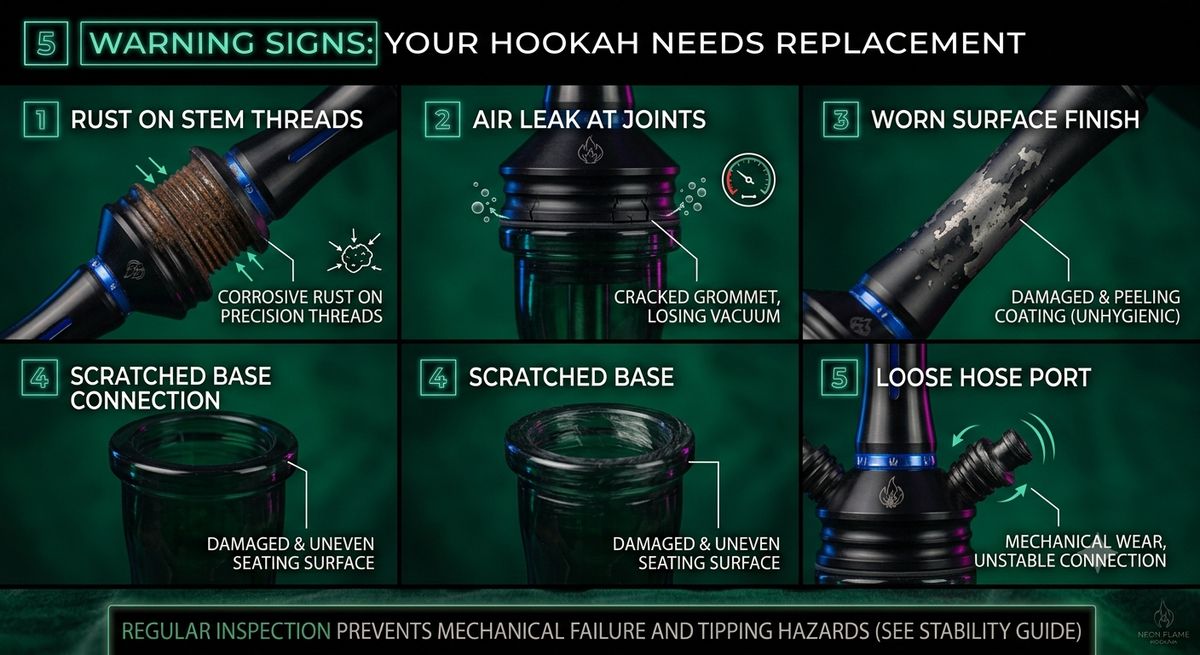
With age, hookahs require more upkeep. Grommets dry up, require more time and money to replace. Downstem threads become worn, and do not seal properly. Hose ports become loose. Each of these minor issues costs your staff time and money. Maintaining aging hookahs requires so much staffing time that it is not uncommon to see a hookah lounge use 20 of their weekly staff hours to deal with their aging hookahs due to repairs. This does not take into consideration the aging hookah lounge staff time it takes to prepare, load, and clean the old and new equipment.
2.Loss of Customers
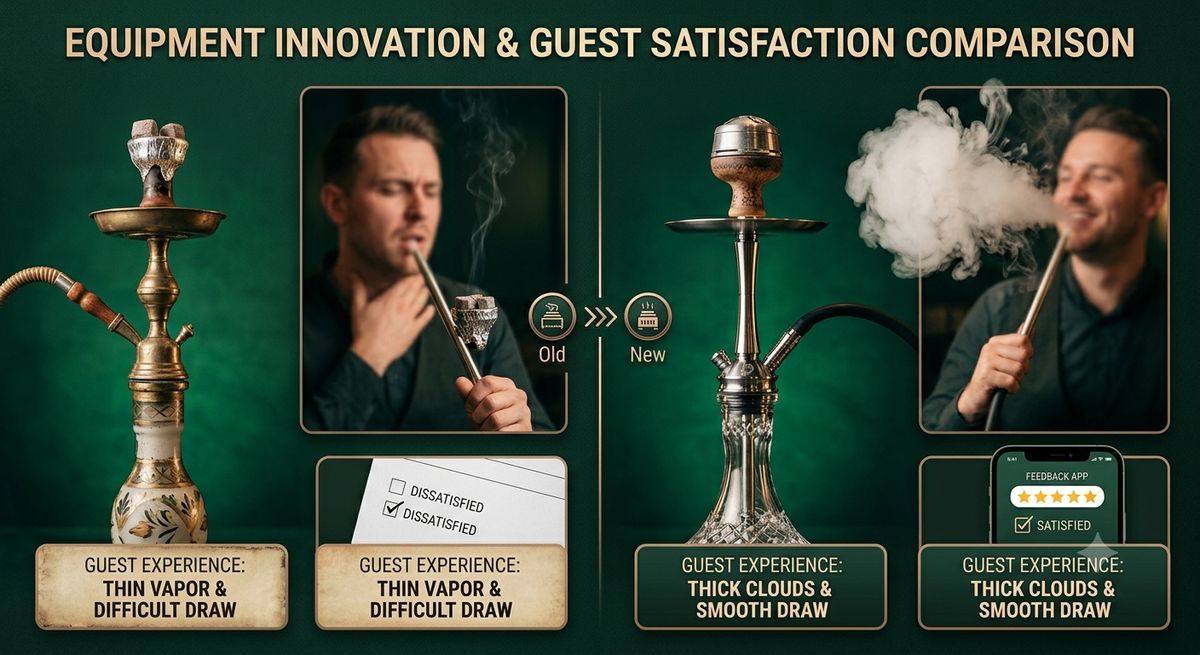
Your customers do not need to know how a hookah works to appreciate a quality hookah. While some of your aging hookah equipment is probably still working, at the end of the day, there’s a point where equipment just doesn’t work well enough. Hookahs can begin to deliver less dense, harsher hit. This equipment aging can lead to customers shortening their sessions to multiple hookah lounges within a session. This lost revenue fades and is almost guaranteed to be larger than the expense to replace the equipment.
3.Loss of Brand Identity and Perception
Every business relies on perception to a degree, but the lounge business is built on it. A successful hookah lounge, for instance, is distinguished by the cleanliness and modernity of their equipment. Customers form perceptions about your lounge based on what they see on your tables. A discolored, damaged hookah with an uneven purge valve and a base with burnt buildup sends a message of carelessness. Upgrading the hookah fleet sends the message of an establishment that is concerned about the customer experience: “this lounge is premium.”
The 7 Surefire Signs It’s Time to Retire Your Lounge Hookahs
There’s no doubt that a few dents and scratches don’t mean the hookahs have outlived their purpose. There are, however, a set of standards about the status of a hookah that are objective about whether or not the hookahs have lived their purpose. Use this list for every hookah in the lounge.
Sign 1: Rust or Corrosion
The most common reason to retire commercial hookahs is because of rust. Even the highest quality of a hookah stem made of stainless steel can rust if used in a commercial context on a daily basis. Pay special attention to the following:
- Inside of the Downstem: One of the most frequent and common locations for hidden rust. If the inside of the downstem has orange or brown rust, the quality of the metal will be compromised, and so will the quality of the draw of the hookah, along with the safety.
- Stem Threads: When the hookah base or the downstem are rusted and connect the hookah base and the downstem, they will never seal again.
- Corroded Hose Ports: Corrosion causes the hookah to leak air and create loose hose connections, which will lead to further frustration on the customer’s end.
When upgrading your wholesale hookah offerings, opt for hookahs made from 304 stainless steel like the [**Steamulation Pro X Premium Hookah**](https://www.linkuphookah.com/product/steamulation-pro-x-premium-hookah/), that do not suffer rust problems like the stainless steel used in value hookahs in high humidity environments.
Sign 2: Grommets that are worn out or are leaking
Actually, grommets are overworked yet underappreciated components of hookahs. Base grommets, hookah bowls grommets, hose port grommets are all critical grommets, that are used for creating adequate seal. If staff members are frequently doing grommet repairs like the grommet is wrapped in wet paper towels, or grommet is replaced every week, then the hookah is probably the problem. As the hookah ages, the grommet seating area wears and even brand new grommets do not make a good seal.
Sign 3: Worn out threads or cross threaded
On any hookah, threads are the things that wear out the fastest. Each time the stem is screwed into the base, or the downstem is attached, the threads wear. If threads are worn, the connection is loose, and the hookah is not reliable for commercial use. An example of a hookah that is designed to have better threads is the [**Moze Breeze Pro 304 Stainless Steel Hookah**](https://www.linkuphookah.com/product/moze-breeze-pro-304-stainless-steel-hookah/).
Sign 4: Cloudy or Etched Glass Bases
Bases made of glass start crisp and lustrous, but many wash cycles and gradual thermal expansion can lead to cloudiness and etching of surfaces that cannot be corrected no matter how many times you attempt to wash it. A base that has become cloudy and dull detracts from the quality of the overall appearance of the hookah. For lounges that operate a fleet, sourcing replacements for a base can take considerable time and effort; it’s best to upgrade entire hookahs for a new, matching set.
Sign 5: Inconsistent Draw or Restricted Airflow
If a hookah used to be easy and fun to pull, but now it takes considerable effort, it’s a sign that airflow has been compromised and not from a lack of cleaning. It could be a defective or broken downstem, misalignment of the internal Shisha-Teile, or an obstruction from a build up of minerals on the inside of the shaft. In a lounge, restricted airflow is a session killer; customers come to hookah lounges to relax and unwind, not to struggle.
Sign 6: Wobbling and Unstable Assembly
Being able to assemble a hookah that stands straight is an unspoken requirement to being a manufacturer of quality hookah products. A hookah that looks like it can tip displays poor craftsmanship. Wobbling often is the result of the wear at the connection of the stem and base from use. Tightening the joints will not improve wobbling of a hookah.
Sign 7: Outdated Aesthetics
One of the biggest signs that it’s time to retire your hookahs is that they appear outdated aesthetically. Like every other piece of design, hookah design is always changing. What might have looked like cutting edge design three years ago will likely look outdated now. If your hookah fleet features a variety of styles, finishes, and designs that clash and look dated compared to your lounge’s current atmosphere, it would be best to upgrade to a more contemporary and cohesive look.
The Ideal Replacement Cycle for Commercial Hookahs
How long should a commercial hookah be in service before it is no longer used? The simplistic answer is: it depends. The more detailed answer is: it depends on how much use it receives, the quality of the materials, and preservation practices. However, considering real world examples of many types of lounges, here are some typical benchmarks.
Hookah Tier Typical Lifespan Recommended For
| Hookah Tier | Typical Lifespan | Best For |
| Economy / Entry-level | 6–12 months | High-volume rotations, disposable pricing models |
| Mid-range Commercial | 12–24 months | Daily lounge operations, moderate traffic |
| Premium Stainless Steel | 24–36 months | Flagship tables, VIP sections, heavy daily use |
| Ultra-premium (e.g., MIG, Steamulation) | 36–48+ months | High-end lounges, long-term investment fleets |
These ranges are based on averages and are not regarded as firm caps. For example, a premium stainless steel hookah that is maintained well, and is used in a low-traffic setting, is likely to last well beyond three years. An economy hookah in a high-traffic lounge, on the other hand, will likely need to be replaced after just six months.
The 20% Rule
A rule of thumb: when 20% or more of your fleet demonstrate any combination of the seven signs above, plan a bulk upgrade. Replacing hookahs one by one is inefficient as you end up with a fleet mismatch, resulting in different customer experiences. A planned upgrade strategy for wholesale hookahs helps you achieve better pricing, maintain visual uniformity across your fleet, and asymmetrical equipment distribution throughout your tables.
What to Consider When Upgrading Hookahs
If you are getting these signs, it is time to refresh your fleet, plan your next step which is choosing the right replacement. Here are the top considerations to cover before purchasing bulk hookahs for your commercial space.
1.Material Quality: Always Demand 304 Stainless Steel
When your hookah is made from 304-grade stainless steel, you get higher corrosion resistance, durability and appearance compared to hookahs made from 201-grade or chrome-plated brass. If your hookah is going to be in a lounge where they are exposed to 100% humidity and getting washed daily, 304 stainless steel is your minimum standard. The [**MIG 66 Hookah 304 Stainless Steel**](https://www.linkuphookah.com/product/mig-66-hookah-304-stainless-steel/) is a great example of a hookah that is a commercial product made from a great material that you can expect to hold up for a long time.
2.Ease of Cleaning
In a commercial lounge, every minute spent cleaning a hookah is a minute not spent serving customers. Look for hookahs with smooth internal surfaces, removable downstems, and wide-mouth openings that allow easy access for brushes. Avoid designs with tight internal corners or decorative elements that trap residue.
3.Taking Multiple Units Out of the Same Production Run
The appeal of purchasing hookahs in bulk is consistency. When you upgrade to bulk hookahs, every unit should have the same draw resistance, the same seal quality, and the same dimensions. Every unit should perform the same. Stick to reputable brands that manufacture with tight tolerances.
4.Replacement Parts
No hookah is good forever. Make certain that your seller has hookah bowls, hose, grommets, and downstems for sale before you make your order. The more parts need to be replaced, the less your hookah will be in service.
5.The Manufacturer’s Warranty
Big companies rely on a significant amount of quality control and assurance. A nice hookah setup from a well-respected company will have a good warranty, meaning you should plan on replacing it in the long run.
 Making the Business Case for a Fleet Refresh
 Making the Business Case for a Fleet Refresh
Making it make sense for you is one thing, but making it make sense for an investor is quite another. The hookahs’ wholesale intentions should have a clear cost/benefit impact.
The Cost of NOT Upgrading
20 hookah lounges, 5-year old fleet, 6 tables pitched to 2x sessions daily.
The lost revenue due to shorter sessions is approximately $150 per day. This results in $4,500 per month.
The costs of maintenance, labor, and parts are approximately $800 per month.
The impact of bad reviews and reduced customer inflow is hard to calculate, but can be considered significant.
The total cost of maintaining an old fleet is $5,300/month.
The Cost of Upgrading:
The cost of the new fleet is 20 units (at $150-$300 each) is between $3,000 to $6,000.
The benefit of longer sessions with greater customer retention is at least $3,000 per month for lost revenue which can be recouped.
The maintenance costs of the fleet is reduced by $500 per month.
The impact on brand perception is difficult to quantify, but is much greater than cost of the new fleet.
The break-even period for the upgrade is estimated to be 2 to 4 months.
The owners who reran the numbers estimated that the fleet upgrade would provide a full return on investment in under 3 months.
Fazit
Hookah lounges rely on hookah fleets to provide a good experience to customers. The older the fleets are, the more detrimental the hookah lounges become to their customers. Continual investment towards high quality replacements of wll hookahs will ensure hookah lounges remain in business providing good experiences to customers.
Looking to do an upgrade? Linkup Hookah provides a selection of high end, premium hookahs suitable for a complete lounge fleet refresh. Visit our wholesale catalog at [LinkupHookah.com] or reach out to our B2B department for bulk pricing on the best brands in the industry.